
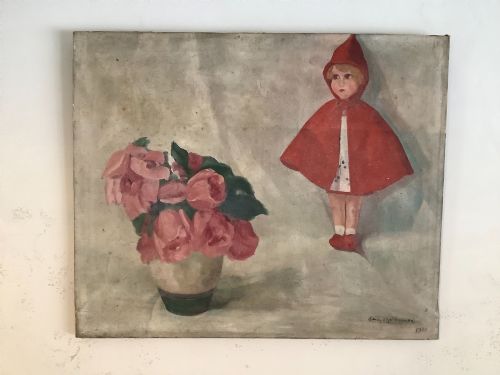


Surrealist Oil Painting
These surrealist oil painting works bring dreamlike visions and uncanny narratives to your walls, built from decades of imaginative twentieth-century image-making.
Surrealist Oil Painting
A surrealist oil painting presents dreamlike scenes, hidden figures, and uncanny juxtapositions across the canvas or board. These works emerge from the early decades of the twentieth century, with mid-century examples appearing frequently in this selection.
The subjects range from naive Flemish compositions and circus acts to architectural dreamscapes and psychological interiors. Artists combine everyday elements with bizarre or metaphysical arrangements to provoke thought and unsettle logic.
You will encounter works spanning from the nineteen-tens through to the nineteen-sixties, reflecting varied European traditions from France, Flanders, and Britain. The forms encompass both intimate oil on board pieces and larger canvases.
Materials and technique
Artists apply oil paint to traditional woven canvas, wooden panels, or compressed hardboard supports. Some surfaces receive an underlying layer of gesso to prepare the ground for smooth application.
The handling of pigment shifts between flat naive blocking and meticulous, hyperrealist detail. Brushwork serves the narrative, building eerie light effects and shadowy depths without relying on flashy technique.
Materials recorded across the archive include oil paint, canvas, wood, board, hardboard, and gesso.
Judging quality
Quality rests upon the strength of the composition and the psychological tension held within the imagery. A compelling piece engages the viewer through purposeful placement of strange motifs rather than random bizarre objects.
The mastery of the medium shows in the control of tone and the preservation of the paint surface over time. Stronger works demonstrate confident handling of the oil medium, whether applied thickly to board or thinned across canvas.
Phillip Krevoruck·Yo Mayer·Andre Delfau·Harold Hitchcock·Horas Kennedy·Harold C Kimball·Hugo Gnam·Arthur Okamura·Fernand Carette
The Surrealist Oil Painting Glossary
- Oil paint
- A slow-drying medium made by mixing pigments with oils such as linseed. This allowed artists to blend tones seamlessly and work on details over several days.
- Hardboard
- An engineered wood product pressed into dense sheets, utilised by artists as a rigid painting support during the mid-twentieth century.
- Metaphysical art
- An early twentieth-century Italian style depicting uncanny, deserted public squares and dreamlike interior spaces. It laid vital groundwork for later surrealist explorations.
- Naive art
- Artwork created by a person without formal training, characterising works by flat perspectives and unpretentious charm. Several pieces in this field adopt a naive approach to heighten their dream logic.
- Gesso
- A white paint mixture consisting of a binder mixed with chalk, gypsum, or pigment, applied to wooden boards or canvas to create a stable painting surface.
Surrealist Oil Painting: Frequently Asked Questions
How do I hang a surrealist oil painting?
Position the painting at eye level on a neutral wall away from direct sunlight to protect the oil pigments and wooden supports.
Keep the surrounding decor simple so the dreamlike narrative of the artwork remains the primary focus of the room.
Are these paintings original twentieth-century works?
Yes, the selection consists of original period pieces created across the decades of the twentieth century, primarily from the nineteen-twenties through to the nineteen-sixties.
Each piece reflects the materials and artistic styles of its specific decade of production.
What is the difference between canvas and board supports?
Canvas offers a flexible woven surface that reacts to atmospheric changes, while board provides a completely rigid foundation for the oil paint.
Both supports were utilised extensively by surrealist artists depending on the desired scale and texture of the finished work.