




Sultanabad Style Rug
These large floor coverings are substantial Persian carpets created in the nineteenth and early twentieth centuries, prized for their expansive floral patterns and muted tones.
Sultanabad Style Rug
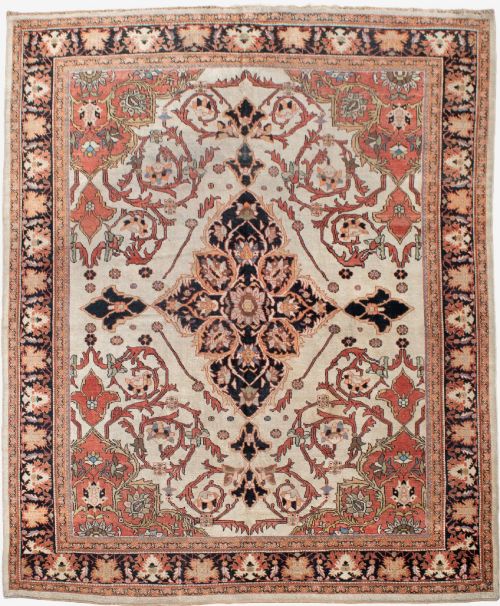
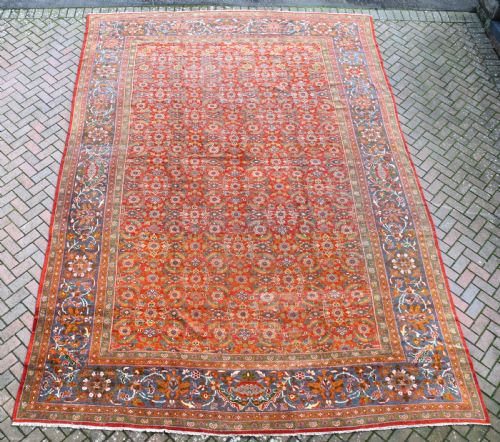
When you search for a sultanabad style rug, you are looking at substantial Persian floor coverings originating from late nineteenth and early twentieth-century production centres. These pieces include large carpets and area rugs that often share design roots with Mahal and Ziegler productions.
The versions you are most likely to meet on this page date from the decades between 1880 and 1900. They arrive in generous room-size formats, frequently featuring all-over Mina Khani motifs and traditional Persian compositions suited to grand spaces.
How they were made
These carpets are constructed using durable wool pile knotted onto cotton foundations, a combination that provides both structural stability and a soft underfoot feel. The natural resilience of wool allows these nineteenth-century floor coverings to withstand generations of domestic use.
Weavers employed traditional Persian techniques to build expansive fields and detailed borders, often utilising vegetable dyes that mellow gracefully over time. The careful spinning of wool and handling of cotton warps and wefts define the physical build of every piece.
Listings span the late nineteenth and early twentieth centuries, specifically covering the years 1880, 1890, and 1900.
What varies in quality
The distinction between a standard example and a superior piece rests primarily in the fineness of the knotting and the crispness of the drawing. Tightly packed knots allow intricate floral details to remain sharp and legible across large expanses.
Quality also shows in the depth and complexity of the colour palette, where subtle shifts in tone give the field a luminous character. Superior handling of traditional motifs ensures the overall composition maintains balance and harmony.
The Sultanabad Style Rug Glossary
- Mahal
- A category of Persian carpets from the Arak region, known for large-scale patterns and muted colour palettes. They share many aesthetic qualities with Sultanabad productions.
- Ziegler
- A nineteenth-century firm that commissioned carpets in Persia for Western tastes, often featuring softer colours and expansive designs. These pieces are closely linked to the Sultanabad tradition.
- Mina Khani
- A traditional all-over repeating pattern composed of daisy-like flowers connected by delicate curved vines. This motif frequently appears across the field of large Persian carpets.
- Pile
- The upright yarn loop surface of a carpet that forms the soft layer walked upon. It is traditionally made from hand-spun wool knotted onto a foundation.
Sultanabad Style Rug: Frequently Asked Questions
How do I care for my rug?
Regular gentle vacuuming without a beater bar keeps dust from settling deep into the wool pile.
Professional cleaning by specialists familiar with antique Persian textiles ensures the natural dyes remain protected.
Where were these carpets made?
These floor coverings originated in Persia, specifically around the Arak region and associated weaving centres.
Production flourished during the late nineteenth and early twentieth centuries to satisfy both domestic and international markets.
What materials are used?
The structural foundation relies on sturdy cotton warps and wefts that provide essential grid strength.
Wool forms the thick, durable pile on top, carrying the intricate patterns and rich colours.
How do I identify the period?
Dating relies on examining the specific wool texture, dye characteristics, and structural wear patterns.
Design conventions and workshop attributions from the decades around 1900 also help place pieces in their proper era.