
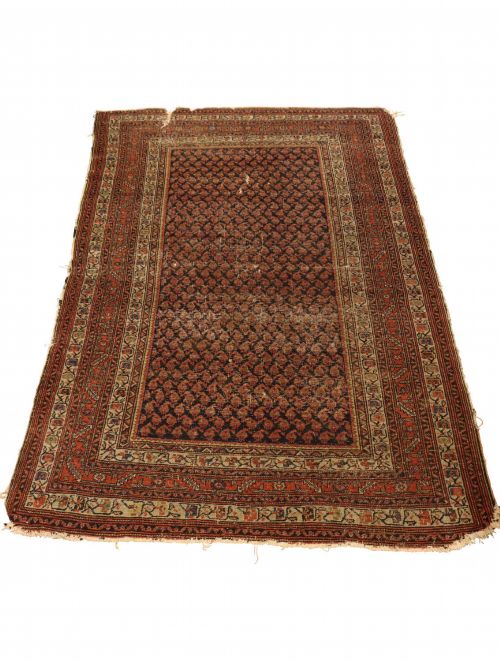


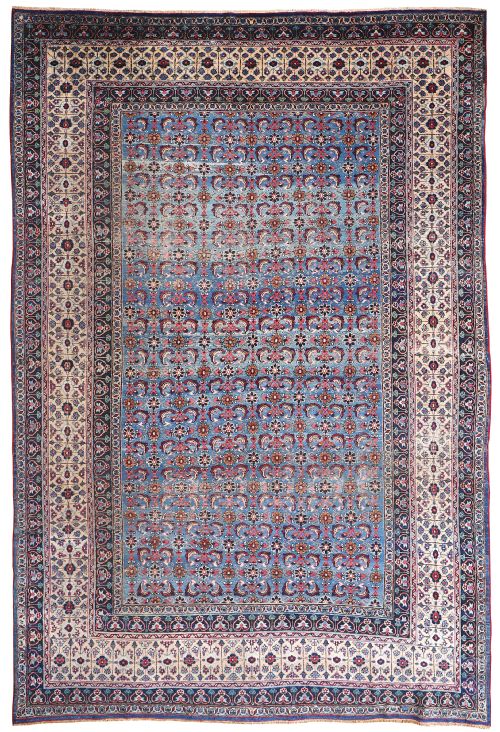

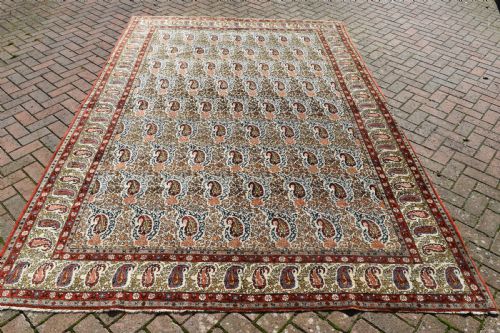


All Over Pattern Carpet
An all over pattern carpet delivers a repeating field of design that anchors a room without relying on a central medallion.
All Over Pattern Carpet
An all over pattern carpet presents a continuous, repeating motif across the field rather than drawing the eye to a single central medallion. When you search for an all over pattern carpet, you encounter room-size carpets, runners, and smaller area rugs originating from Persian, Indian, and other traditional weaving regions.
The pieces listed on this page span from the late nineteenth century into the early twentieth century, including styles such as Mahal, Tabriz, Heriz, Sultanabad, and Khorassan. Buyers most frequently meet large room carpets and runner formats featuring dense floral lattices, boteh, or Herati designs woven during this productive era.
These floor coverings served both grand reception rooms and country houses, offering durability alongside intricate artistic expression. Their repetitive compositions allow furniture to sit comfortably over the field without obscuring a focal point.
How they were made
Traditional weavers constructed these carpets using wool, cotton, and occasionally silk, knotted by hand onto sturdy cotton or wool foundations. The choice of pile material determined the weight and longevity of the floor covering, while foundation threads provided structural tension.
Natural and early aniline dyestuffs imparted rich tones to the wool, creating complex palettes that mellow gracefully over decades of light and wear. Weavers knotted individual tufts by hand, following established regional patterns or master cartoons to achieve dense, repeating field designs.
Wandering weavers sometimes slipped tiny deliberate flaws into their repeating patterns to appease ancient spirits of perfection.
What varies in quality
Knot density and the precision of the repeating design separate standard production from finer examples of an all over pattern carpet. A tighter knotting structure allows for crisper outlines in complex floral lattices and geometric borders.
The depth and harmony of the palette also define the calibre of a piece, as does the balance of the repeating motifs across the field. Superior wool quality ensures the pile retains its resilience and soft handle after extensive use.
Mahal·Tabriz·Heriz·Sultanabad·Khorassan·Afshar·Qum·Agra·Malayer·Sharkoy
The All Over Pattern Carpet Glossary
- Boteh
- A stylised almond or pear-shaped motif representing a floral shoot or cypress tree. It appears frequently in repeating rows across traditional rugs.
- Herati
- A popular repeating pattern composed of a central rosette framed by four leaves and flanked by fish-like motifs. It creates an interconnected, rhythmic field across the carpet.
- Kilim
- A flat-woven carpet or rug produced without a pile by tightly interweaving warp and weft strands. These pieces offer a lighter weight and a smooth surface texture.
- Mina Khani
- A repeating grid design of daisies or rosettes linked by delicate curved vines. This balanced layout provides an orderly, continuous field across antique room carpets.
- Warp
- The vertical foundation threads stretched tightly on the loom before knotting begins. The visible ends of these threads often form the fringe of the carpet.
All Over Pattern Carpet: Frequently Asked Questions
How do I choose the right size?
Measure your floor space to allow a uniform margin of exposed boards around the perimeter of the room. Large formats suit principal reception rooms, while long runners fit corridors and hallways effectively.
Consider how furniture placement interacts with the repeating field design. A well-proportioned rug lets chairs and tables rest comfortably on the woven surface without crowding the room.
Where should I place a runner?
Runners suit hallways, landings, and narrow corridors where linear foot traffic benefits from a durable floor covering. They also work well alongside kitchen islands or beside a bed.
Ensure you use an appropriate underlay to keep the runner secure on smooth timber or stone floors. This prevents slipping and cushions the weave against hard subfloors.
How do I care for antique wool?
Vacuum your carpet gently with a suction-only attachment to remove surface dust without pulling at the hand-knotted pile. Avoid rotary brush heads that can fray older foundation threads and fibres.
Rotate the carpet periodically to ensure even exposure to foot traffic and sunlight. Professional cleaning by a specialist in antique textiles preserves the lanolin in the wool.
What is an all over field?
An all over field distributes motifs evenly across the entire surface rather than concentrating decorative weight in a central medallion. This layout creates visual consistency throughout the room.
Repeating designs make it easier to arrange furniture without worrying about obscuring a focal point. The eye travels smoothly across the continuous pattern.
How do I identify regional styles?
Regional styles reveal themselves through specific colour palettes, knotting densities, and characteristic motifs like the geometric Heriz medallion or the curved floral lattice of Sultanabad. Examine the secondary borders and the handle of the wool to gather further clues.
Comparing the weave structure on the reverse side often highlights differences between tribal workshops and established city manufactories.