

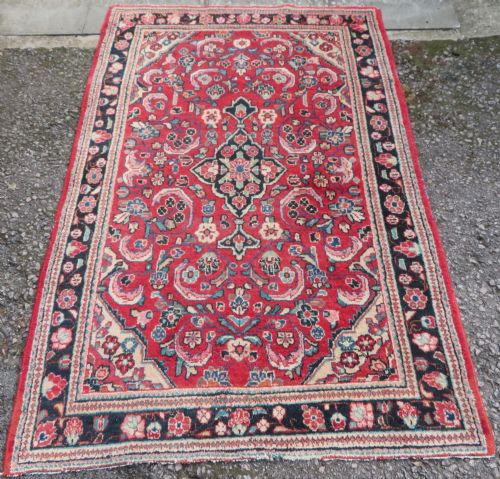
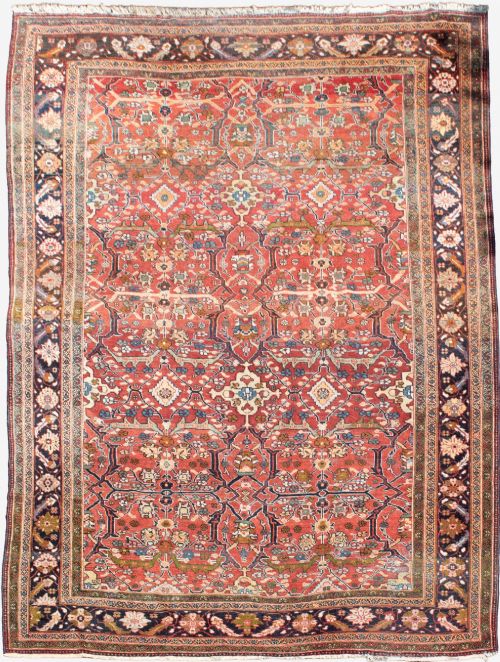


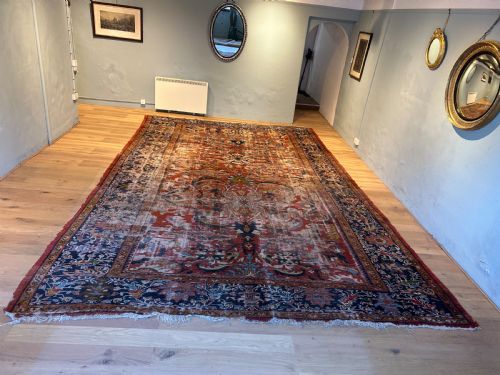
Red Mahal Carpet
A red mahal carpet brings generous room-scale Persian warmth to a floor, rooted in traditional Western regional weaving.
Red Mahal Carpet
A red mahal carpet represents a significant category of large-format floor coverings originating from Western Persia, often produced in village workshops and regional centres. Buyers searching for a red mahal carpet encounter floor coverings designed for substantial spaces, frequently described as room size, oversize, or country house proportions.
The inventory demonstrates production spanning from the nineteenth century through the early decades of the twentieth century, including periods such as Victorian, 1880, 1890, 1900, 1910, 1920, and 1930. Alongside standard mahal definitions, titles frequently reference related Persian styles including Ziegler, Sultanabad, Bakhtiari, and Saroukh, indicating stylistic crossovers within the region.
Formats vary from expansive room-size carpets down to smaller village rugs and runners, accommodating diverse architectural scales. The overarching characteristic remains the prominent red ground paired with traditional Persian motifs, executed across varying dimensions.
How they were made
These floor coverings are constructed utilising wool pile hand-knotted onto a sturdy cotton foundation. This traditional pairing of materials provides the structural stability required for large room-size formats and runners.
Weavers employed hand-spun wool dyed with traditional colourants to create the characteristic red field. The pile is knotted to withstand daily use while accommodating intricate all-over shrub or geometric designs.
Country house proportions ensure your floor accommodates centuries of stepped-on shrub designs.
What varies in quality
Quality differences stem from the fineness of the knotting and the handling of the wool. Finer examples display crisper definition in motifs such as the Mina Khani or shrub patterns across the red field.
The scale of the piece and the integrity of the cotton foundation influence durability. Larger formats, including oversize and country house scales, demand superior structural execution to maintain flat placement on the floor.
The Red Mahal Carpet Glossary
- Mahal
- A type of Persian carpet originating from the western region, known for room-scale formats and traditional village designs. They frequently feature expansive red fields.
- Ziegler
- A style associated with nineteenth-century commercial production in Persia, often linked to European design tastes. These pieces share stylistic traits with traditional mahal weaving.
- Sultanabad
- A nineteenth-century Persian carpet designation from the same district as mahal production. They share similar large-scale floral and Herati patterns.
- Bakhtiari
- A regional Persian weaving style originating from the Chahar Mahal valley. These pieces utilise sturdy wool construction and distinctive village motifs.
- Mina Khani
- A traditional repeating geometric floral pattern found across Persian carpets. It arranges flowers in a continuous lattice grid over the red ground.
Red Mahal Carpet: Frequently Asked Questions
Where were these carpets made?
These carpets were produced in Western Persia, specifically in the Chahar Mahal region and surrounding village workshops.
Production centres like Sultanabad and the broader Mahal district supplied both local markets and nineteenth-century European trade.
How do I choose the right size?
Measure your room to allow a uniform border of exposed floorboards around the perimeter of the carpet. Consider room-size or oversize formats for principal living spaces and narrow runners for hallways.
Large formats require adequate clearance from doorways and heavy furniture placement to display the central field design properly.
What is a Ziegler Mahal?
A Ziegler Mahal combines traditional Persian village weaving with designs tailored for nineteenth-century European interiors. These pieces often exhibit softer palettes and large-scale motifs.
They represent commercial workshop production managed by European firms operating within the Persian weaving districts.
How do I care for wool pile?
Vacuum the pile regularly using standard suction without a rotating brush roll to prevent fibre distortion. Rotate the rug periodically to ensure even wear across high-traffic areas.
Professional cleaning suited for antique hand-knotted wool is recommended for maintenance.