


Strike Repeat Carriage Clock
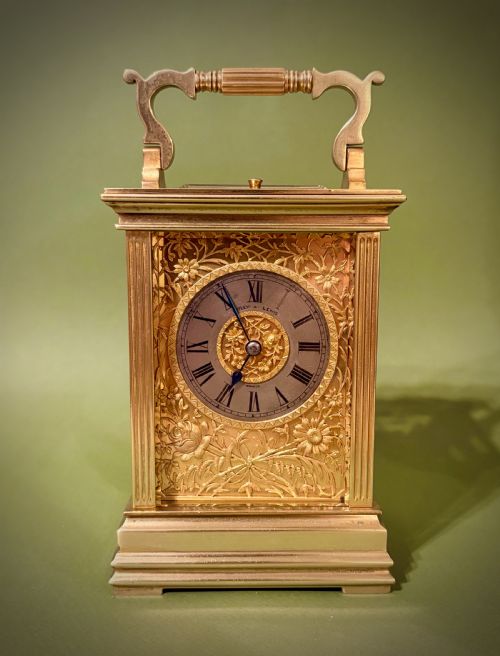
A strike repeat carriage clock brings together portable mechanical precision and audible timekeeping from the nineteenth century.
Strike Repeat Carriage Clock
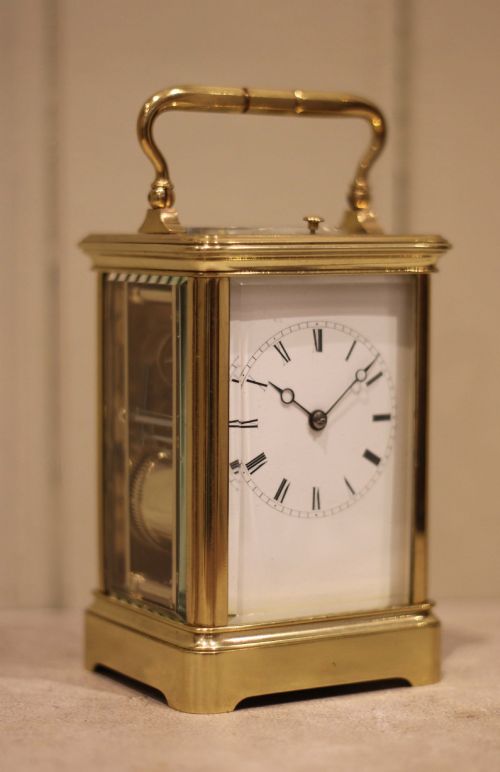
A strike repeat carriage clock is a portable timepiece designed for travel during the nineteenth century, equipped with a mechanism that sounds the hours and quarters upon demand. When you search for a strike repeat carriage clock, you are looking at sophisticated horology enclosed in glazed brass cases intended for easy movement. These portable mechanisms bridge domestic longcase clocks and personal pocket timepieces.
The pieces listed here span the Victorian era and the broader nineteenth century, originating largely from French workshops alongside English retailers. Most examples employ brass and gilt brass frames inset with bevelled glass panels to display the escaping wheelwork within. Enamel dials bearing Roman numerals feature prominently across the available stock.
Common case variants include the stepped gorge case, the curved oval form, and the classical columned Corinthian style. Certain pieces incorporate additional complications such as alarm functions and grand sonnerie striking sequences. Every mechanism relies on spring-driven power rather than hanging weights.
Materials and construction
Makers constructed these housings predominantly from heavy brass and gilt metal, casting and finishing the components by hand. Polished steel levers and arbors interact within the movement plates to govern the striking and repeating trains. Bevelled glass panes are fitted tightly into the metal frames to protect the internal escapement from dust.
Dials are typically formed from white enamel fired onto a metal backing, carrying painted Roman numerals and minute markers. Original leather travel cases frequently accompanied these portable devices to shield the exterior gilding during transit. Artisans often engraved the brass plates with serial numbers or maker signatures before final assembly.
Factors of quality
The standard of a strike repeat carriage clock rests upon the complexity of its internal movement and the crispness of its audible strike. Pieces featuring grand sonnerie or petit sonnerie striking arrangements demand superior mechanical execution compared to basic hour-striking models. Finer examples retain their original fire gilding and heavy bevelled glass without chips.
The reputation of the maker heavily influences distinction, with signed works from established horologists commanding greater regard. The integration of auxiliary functions like alarm mechanisms and subsidiary dials indicates higher grade workshop output. Original matching travel boxes further elevate the completeness of surviving pieces.
Alfred Drocourt·Henri Jacot·J W Benson·Hunt and Roskell·Le Roy and Fils·Richard and Co
The Strike Repeat Carriage Clock Glossary
- Carriage clock
- A portable spring-driven timepiece developed for travel in the nineteenth century. These clocks typically feature brass frames with glass panels on all sides.
- Repeat function
- A mechanical mechanism operated by pressing a button on the case, causing the clock to sound the last elapsed hour and quarter. This allowed owners to check the time in darkness.
- Grand Sonnerie
- A complex striking train that automatically chimes both the hours and the quarters as each quarter-hour passes. It represents an advanced level of horological complication.
- Enamel dial
- A fused glass-powder surface applied to a metal plate and fired in a kiln. It provides a durable, glossy white face for painted numerals.
Strike Repeat Carriage Clock: Frequently Asked Questions
How do I wind a carriage clock?
Wind the mainsprings using a properly fitted key inserted into the winding squares on the back plate. Turn the key gently until resistance indicates the spring is fully tensioned.
Avoid overwinding the mechanism, as this can strain the internal steel springs. Ensure the strike and time trains are both addressed if the movement has separate arbors.
How should I clean the brass case?
Dust the exterior brass framework and glass panels regularly with a soft, dry microfibre cloth. Avoid harsh commercial metal polishes, which can strip the original gilding or lacquer.
Keep moisture away from the dial and movement apertures. Professional conservation is recommended if tarnishing obscures engraved details.
Can these clocks travel safely today?
While originally built for travel, nineteenth-century mechanisms require careful handling by modern standards. Secure the platform escapement lever if the clock includes a transit lock.
Transport the piece upright in a padded container rather than loose in a vehicle. Sudden shocks can disrupt the delicate balance spring.