


French Repeating Table Clock
A French repeating table clock is a precision timepiece made to travel or sit on a desk, prized for its ability to chime the hours on demand.
French Repeating Table Clock
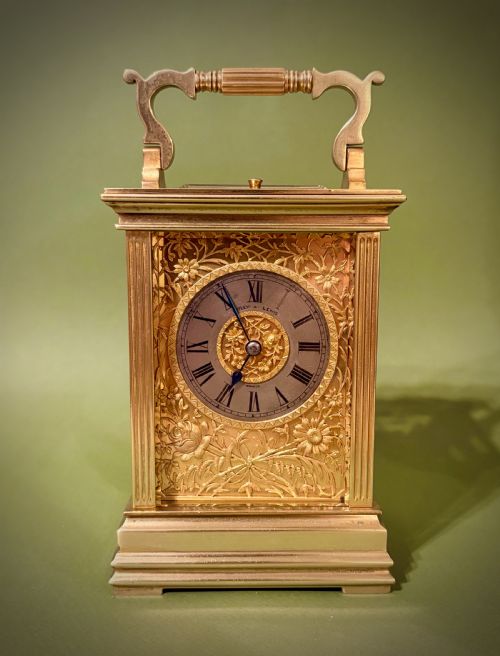
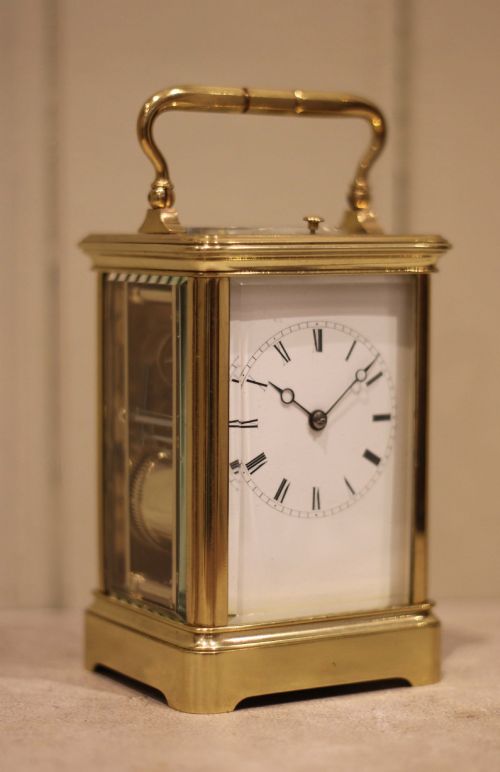
A French repeating table clock is fundamentally a portable mechanical timekeeper housed in a metal and glass case. Most examples found here belong to the nineteenth century, spanning Victorian decades up to nineteen ten.
The carriage clock format dominates the selection, featuring bevelled glass panels that reveal the moving escapement inside. These pieces originate from French workshops and often bear retailers' names from London as well.
Materials and construction
Brass and gilt bronze form the structural frames and cases, often housing intricate steel gear trains within. Enamel dials provide the face for painted Roman numerals, protected beneath heavy glass panels.
Gilding coats the metal surfaces of many examples, while specialised leather travel cases occasionally accompany the clocks. The repeat mechanism relies on complex spring arrangements to strike the last hour or quarter when pressed.
Some carriage clocks survived bumpy nineteenth-century coach journeys well enough to keep telling tales on modern desks.
Judging quality
Quality rests in the complexity of the internal movement and the crispness of the exterior case casting. Grand sonnerie systems and quarter-repeating functions elevate a piece far above a standard single-hammer strike.
Engraved gilt brass masks around the dial and specialised case shapes, such as the gorge or oval forms, indicate finer production standards. The presence of signed maker movements adds substantial weight to the piece.
DROCOURT·Henry Jacot·Henri Jacot·L Epee·Richard and Co
The French Repeating Table Clock Glossary
- Repeating mechanism
- A complication operated by pressing a button on the case, causing the clock to chime the last hour or quarter. This clever feature allowed owners to tell the time in total darkness.
- Gorge case
- A heavy brass carriage clock case with stepped mouldings at the top and base. It represents a classic French housing style from the nineteenth century.
- Grand sonnerie
- A striking system that chimes the hours and the passing quarters automatically. It is a highly intricate movement found in advanced table clocks.
- Escapement
- The internal mechanism that controls the release of gear train energy to maintain regular impulses. Platform escapements are standard in these portable clocks.
- Enamel dial
- A metal face coated with fused glass powder and fired to create a smooth white surface. Roman numerals are typically painted onto this bright ground.
French Repeating Table Clock: Frequently Asked Questions
Why does the clock chime when I press the button?
The push repeat button activates a rack and snail mechanism that reads the current position of the gear train. This clever mechanical memory triggers the hammers to strike the gongs for the last elapsed hour.
It was designed for travellers who needed to know the time during dark carriage journeys without striking a match. The mechanism requires precise adjustment by a horologist to maintain correct synchronization.
Where should I place a carriage clock at home?
Position the clock on a stable, level surface away from direct sunlight, draughts, and damp environments. A mantelpiece or desk makes an ideal spot where the bevelled glass can catch the light.
Keep the piece away from heavy vibrations, such as near slamming doors, which can disrupt the delicate platform escapement. Ensuring a level foundation helps the clock keep accurate time.
How do I date a nineteenth-century carriage clock?
Examine the style of the case, the shape of the escapement platform, and any signatures or serial numbers stamped on the backplate. Maker marks often correlate with specific operational decades.
Enamel dial fonts and the complexity of the striking train also offer clues to the manufacturing period. Consulting movement records helps narrow down the exact year of production.