





Mechanical Alarm Carriage Clock
These mechanical alarm carriage clocks are portable timepieces built for travel, offering dependable timekeeping and striking alarms in robust brass and glass cases.
Mechanical Alarm Carriage Clock
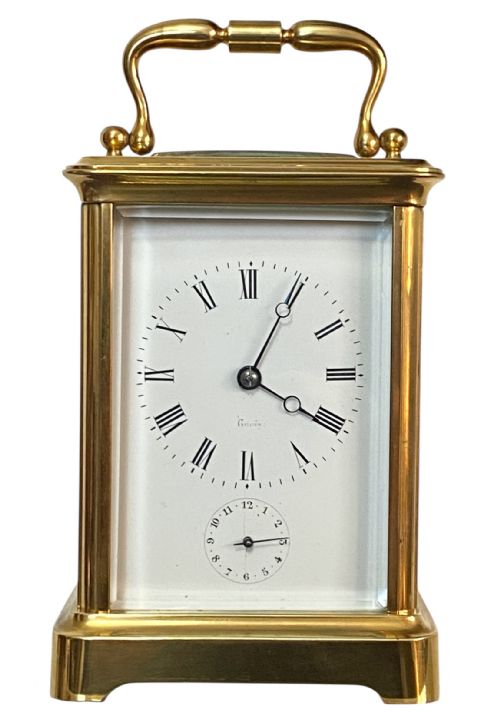
A mechanical alarm carriage clock is a portable timepiece designed for travel, housed in a protective metal frame with bevelled glass panels. These objects combine timekeeping with an alarm mechanism, often featuring striking capabilities or repeat functions.
The pieces on this page span the nineteenth century and the early twentieth century, showing strong French and Swiss origins. Most examples date from the Victorian and Edwardian eras, alongside pieces from the eighteen-fifties up to nineteen-hundred.
How they were made
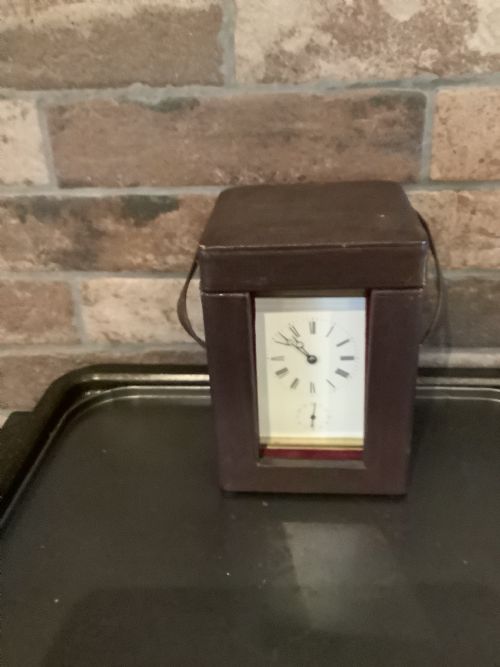
Makers constructed the cases primarily from brass, gilt brass, and gilt bronze, often mounting bevelled glass panels to expose the movement within. Leather travel cases frequently accompanied these pieces to protect the metalwork during journeys.
Internal components utilise steel for gears and springs, while enamel dials display the numerals. Metalwork finishes range from polished brass to rich gilding.
Listings feature pieces spanning the Victorian and Edwardian periods, utilising gilt brass, enamel, and leather cases.
What varies in quality
Complexity of the movement separates standard striking pieces from elaborate grand sonnerie and petite sonnerie mechanisms. Superior examples often bear the signatures of notable makers or retailers, indicating higher grade workshop output.
The weight and thickness of the gilt brass or bronze case, alongside the precision of the enamel dial and original leather housing, define the finer pieces.
Bourdin Paris·Hunt And Roskell·Drocourt·E White
The Mechanical Alarm Carriage Clock Glossary
- Carriage clock
- A portable spring-driven timepiece designed for travel during the nineteenth century. These clocks typically feature a rectangular brass frame with glass panels and a handle on top.
- Gilt brass
- Brass treated with a thin layer of gold or a gold-coloured finish to enhance appearance and prevent tarnish. This material forms the primary structure of many nineteenth-century French and Swiss cases.
- Grande-sonnerie
- A complex striking mechanism that automatically chimes the hours and quarters on every quarter-hour. This sophisticated complication represents the pinnacle of clockmaker skill.
- Enamel dial
- A metal dial fused with powdered glass through firing to create a smooth, durable white surface for painted numerals. These dials provide a clean, legible face for the movement.
- Bevelled glass
- Glass with edges cut and polished at an angle, fitted into the sides and top of the case. This technique adds depth and catches light from multiple angles.
Mechanical Alarm Carriage Clock: Frequently Asked Questions
What is a carriage clock?
A carriage clock is a portable spring-driven timepiece developed for travel in the nineteenth century, featuring a protective brass and glass case with a carrying handle.
These clocks were built to withstand movement while maintaining accurate time and often include alarm functions.
How do alarm mechanisms work?
The alarm mechanism uses a separate spring-driven train within the movement that releases at a set time. This action triggers a hammer to strike a bell or the inside of the case.
Setting the alarm typically involves a small hand on the dial and a dedicated winding arbor on the back plate.
How do I date these clocks?
Dating relies on stylistic details, case forms, dial signatures, and the complexity of the movement. Victorian and Edwardian examples show distinct architectural case designs and escapement types.
Maker signatures and registration marks stamped on the movement plates offer precise chronological clues.
Where were they made?
The majority of these timepieces originated in French workshops, particularly in Paris, as well as Swiss manufacturing centres. Makers exported these portable clocks across Europe for travellers.
French makers dominated production through the nineteenth century, producing both simple travel clocks and complex striking variants.