


Staffordshire Hearth Dogs
Staffordshire hearth dogs are ceramic mantelpiece figures that bring traditional nineteenth-century character to a fireplace.

Staffordshire Hearth Dogs
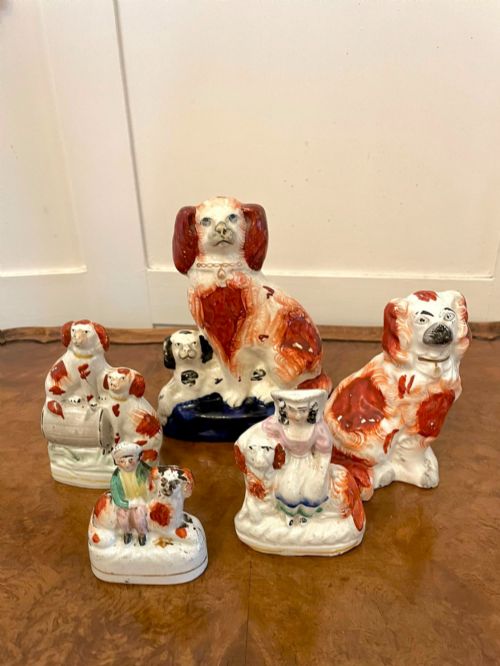
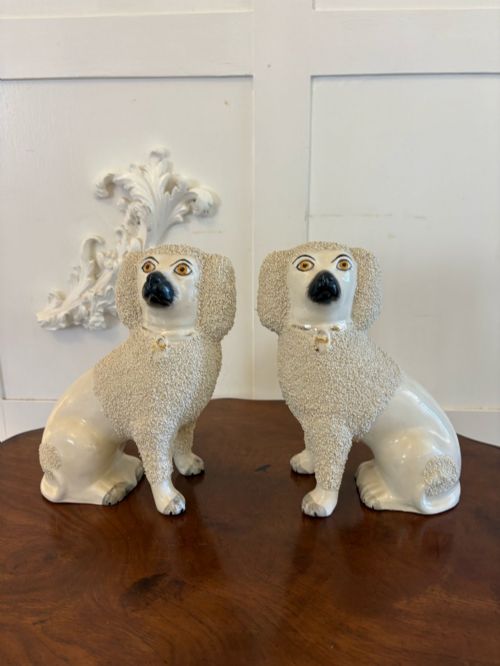
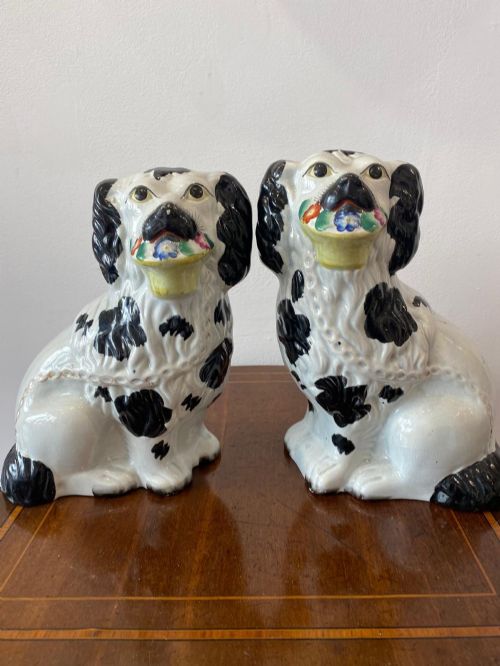
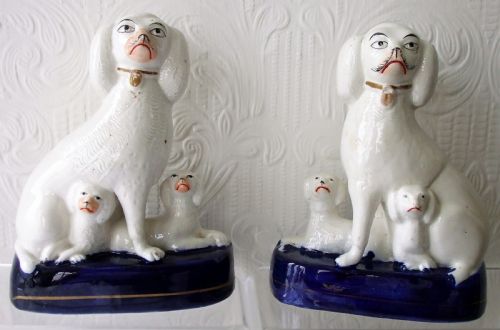
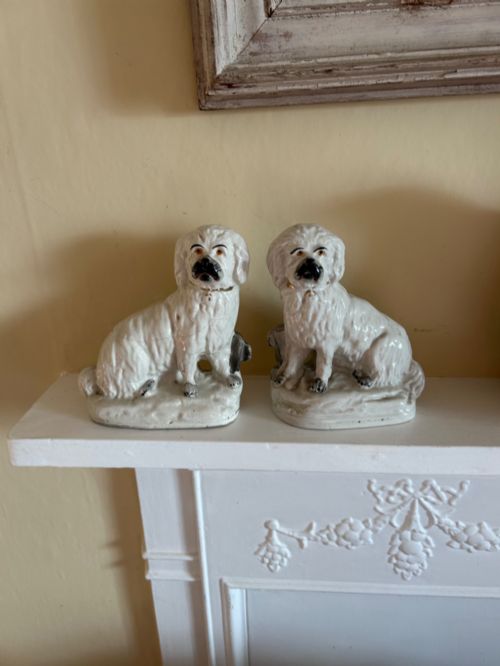
Staffordshire hearth dogs are decorative figures modelled as spaniels, poodles, Maltese terriers and poodles with pups, typically displayed in symmetrical pairs upon a mantelpiece. When you search for Staffordshire hearth dogs, you encounter ceramic figures originating predominantly from the Victorian period, alongside examples attributed to the Regency era and around nineteen hundred. These decorative objects take the form of seated spaniels, poodles with pups, and terriers, often shown wearing chains and lockets or resting on blue cushions with encrusting.
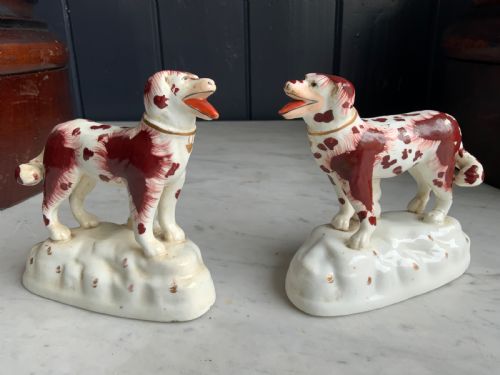
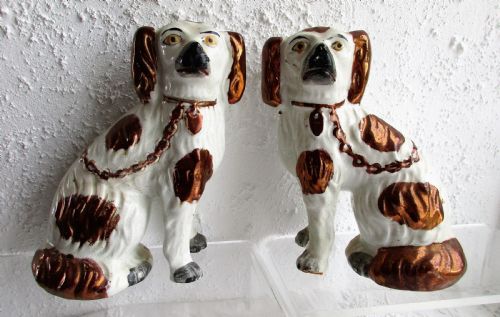
The pieces listed here showcase a strong emphasis on nineteenth-century craftsmanship, with specific dates spanning from eighteen forty-five through to the late Victorian decades. Most examples on this page are paired mantel ornaments designed to sit at either end of a fireplace hearth. Collectors meet both plain white versions and richly coloured variants, including red and white spaniels and copper lustre dogs.
Materials and methods
Certain pieces incorporate copper lustre techniques to impart a metallic sheen across the ceramic body, while others feature textured clay encrusting to represent fur and cushions. Hand painting ensures individual expression on the faces and coats of the spaniels and poodles.
Listings feature earthenware and ceramic Staffordshire dogs spanning the Victorian period, Regency era, and the late nineteenth century.
Evaluating quality and character
The presence of secondary elements, such as modelled pups alongside adult poodles or detailed blue cushions with encrusting, distinguishes more ambitious modelling from standard pairs. Uniformity in a matched pair and the clarity of the underlying ceramic body further separate ordinary ornaments from the finest examples.
Beswick
The Staffordshire Hearth Dogs Glossary
- Earthenware
- A porous pottery body fired at lower temperatures, commonly used for nineteenth-century Staffordshire figures. It forms the structural base beneath the glaze and enamel paint.
- Lead Glaze
- A glossy liquid coating applied to pottery before firing to give a smooth, waterproof surface. It provides the characteristic sheen seen on Victorian ceramic dogs.
- Copper Lustre
- A metallic surface finish applied to ceramics to create a coppery, reflective appearance. This technique produces the distinctive shimmering body seen on specific spaniel pairs.
- Comforter Spaniels
- A traditional term for Staffordshire spaniel figures traditionally placed on hearths to guard the home. These seated dogs often wear moulded chains and padlocks.
Staffordshire Hearth Dogs: Frequently Asked Questions
How were Staffordshire hearth dogs used?
These ceramic figures were traditionally displayed in symmetrical pairs on mantelpieces above fireplaces. Victorians placed them facing inward towards each other to guard the hearth.
Beyond the fireplace, collectors also arranged them on sideboards and tables within nineteenth-century parlours as decorative ornaments.
Are Staffordshire hearth dogs always found in pairs?
Most examples survive as pairs because they were originally modelled and retailed to sit at either end of a mantelpiece. Symmetrical placement remained standard practice for Victorian interior display.
Collections occasionally comprise individual figures or larger groupings of four or six pieces, though matching pairs remain the most common configuration.
What dog breeds do these figures represent?
The most frequent breed represented across these listings is the spaniel, particularly seated spaniels with floppy ears and marked patches. Poodles, often depicted with small pups or textured fur, also appear regularly.
Less common variations include Maltese terriers and other decorative pottery figures modelled during the nineteenth century.