



St Ives Landscape Painting
These st ives landscape painting works capture the shifting light and rugged Cornish coastline through the eyes of coastal modernists and traditionalists.
St Ives Landscape Painting
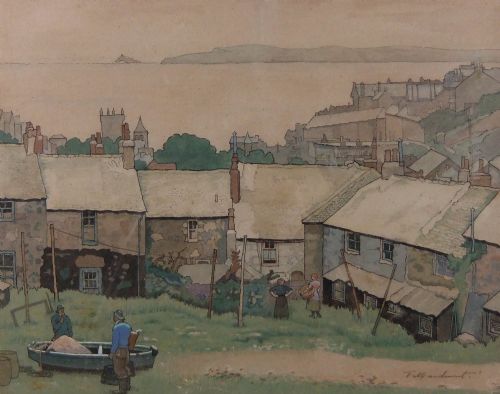
A st ives landscape painting brings the distinctive coastal atmosphere of Cornwall into an interior, recording harbours, fields, and rural life through various artistic movements. You are looking at works that range from late nineteenth-century watercolours to mid-twentieth-century oils created by artists drawn to the distinct peninsular light.
The version you are most likely to meet on this page is a framed watercolour or oil painting depicting St Ives harbour, local streets, or surrounding Cornish landscapes. These pieces frequently reflect the influence of the St Ives School, British Impressionism, and Post-Impressionism.
The selection includes framed works on paper, canvas, and wood panel, spanning periods from the nineteenth century through the 1960s. Each piece documents a specific moment in the artistic history of this renowned coastal hub.
How they were made
Artists relied primarily on oil paint applied to canvas or wood panel, and watercolour applied to paper, capturing both detailed topographical views and looser impressionistic impressions. These media allowed painters to render the variable weather and marine conditions peculiar to the Cornish coast.
Frames form an integral part of these works, with wood and gilt wood frames providing the traditional housing expected of period fine art. Glazing is commonly found protecting works on paper, safeguarding delicate watercolours from environmental moisture.
The selection includes contributions from artists connected to the St Ives School, Newlyn School, and British Impressionism.
What varies in quality
Quality rests upon the sureness of the brushwork and the artist's ability to command the specific quality of light associated with the Cornish coast. Stronger examples demonstrate a confident handling of medium, whether capturing the bustle of a harbour at low tide or the stillness of a rural field.
The integrity of the original framing and the preservation of the pigment surface distinguish finer pieces from those that have suffered from heavy restoration or unsuitable environmental storage. Provenance and attribution to documented regional artists further elevate the standing of individual works.
William Banks Fortescue·Thomas Maidment·George F Pennington·Joan Gillchrest·Edward Matthew Elliott·George Turland Goosey·Ernest F Hill·David Woodlock·Fred Mayor·Frederick William Jackson·Cuthbert Crossley·Thomas Sidney Cooper·J Titcomb
The St Ives Landscape Painting Glossary
- St Ives School
- An association of artists living and working in or around the Cornish town of St Ives, noted for bridging traditional landscape art with modernism. This grouping encompasses various stylistic phases from the early twentieth century onwards.
- Watercolour
- A painting method in which the paints are made of pigments suspended in a water-based solution, typically applied to paper. It allows for translucent washes that suit atmospheric coastal scenes.
- British Impressionism
- A painting style developed in the late nineteenth and early twentieth centuries, characterised by visible brushstrokes and an emphasis on accurate depiction of light. Artists working in this manner often painted outdoors to capture transient atmospheric effects.
- Oil Paint
- A slow-drying paint made of pigments suspended in a drying oil, commonly linseed, utilised on canvas or wood panel. This medium permits rich colour saturation and textured impasto applications.
- Gilt Wood
- Wood that has been treated with a thin layer of gold leaf or gilt finish, commonly used for traditional picture frames. It adds a reflective border that separates the artwork from its surroundings.
St Ives Landscape Painting: Frequently Asked Questions
What subjects do these paintings show?
These works primarily depict Cornish coastal scenes, including harbour views at low tide, local churches, streetscapes, and surrounding rural fields. Artists focused heavily on the specific topography and maritime atmosphere of St Ives and its neighbouring settlements.
Subjects also extend to livestock in landscapes and inland rural views captured by painters associated with the region's artistic circles.
How should I frame and hang them?
Most pieces arrive in period wood or gilt wood frames that suit their age and character, often retaining their original aesthetic. It is best to preserve these housings where structurally sound.
Hang watercolours away from direct sunlight to prevent fading of the pigments on paper. Maintain stable indoor humidity levels to protect both canvases and wooden frames.
How do I identify the period of a piece?
Dating relies on stylistic clues, framing materials, artist signatures, and known biographical dates of the painters. Edwardian and Victorian works often feature tighter brushwork and traditional gilt framing.
Mid-century pieces shift toward looser modernist interpretations of the landscape. Examining the backing boards, paper types, and stretcher bars provides additional physical evidence of age.
What is the difference between Newlyn School and St Ives School?
The Newlyn School originally centred on a fishing village further down the Cornish coast, focusing on naturalistic depictions of rural and fishing communities in the late nineteenth century. Painters there often worked <i>en plein air</i> on large canvases.
The St Ives School later embraced both traditional marine painting and progressive modernist abstraction, reflecting the town's evolution into a major hub for twentieth-century British art.