
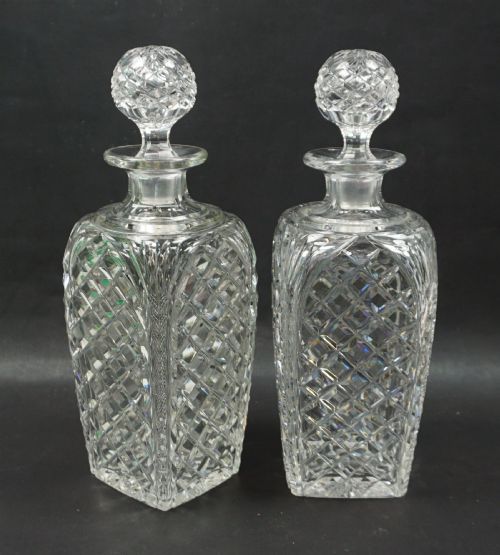


Square Crystal Decanter
A square crystal decanter brings heavy-cut brilliance and crisp geometric form to the sideboard.
Square Crystal Decanter
A square crystal decanter is a heavy vessel designed for holding spirits, featuring flat, geometric sides and often a matching heavy stopper. When searching for a square crystal decanter, buyers encounter examples ranging from nineteenth-century Victorian pieces to mid-century modern designs.
The selections on this page span several decades, encompassing Edwardian pairs and single bottles fitted with silver collars. These vessels were traditionally produced for whisky, brandy, or general spirits service in the home.
Most pieces date from the Victorian, Edwardian, and mid-twentieth-century periods, showing English origin. Buyers meet both single bottles and matched pairs, frequently enhanced by cut glass patterns or precious metal mounts.
Materials and Manufacture
These vessels utilise heavy glass, cut crystal, and lead crystal, shaped into square sections with tapered profiles. Makers applied deep wheel-cutting techniques to create faceted patterns that catch the light across the flat sides.
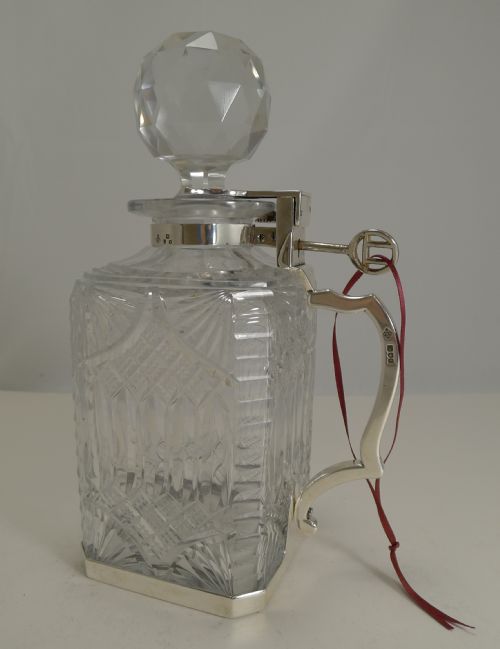
Many examples incorporate sterling silver or silver gilt collars, mounts, and locking mechanisms fitted securely to the glass necks. Hallmarks on the metal elements provide evidence of English assay offices and production dates.
Listings feature English pieces spanning the Victorian era through the mid-twentieth century, utilising cut glass, sterling silver, and silver gilt.
Assessing Quality
Quality rests in the crispness of the glass cutting and the weight of the material, where heavier lead crystal offers greater brilliance. Superior examples display sharp, well-defined facets that show no softening from wear or polishing.
The integration of the metalwork also defines the tier of the piece, with hallmarked sterling silver or silver gilt mounts indicating higher-end manufacturing. Matched pairs and complete sets with original fitted stoppers command greater interest than single or mismatched items.
Freeman & Son Ltd·Mappin & Webb
The Square Crystal Decanter Glossary
- Lead crystal
- Glass containing a high percentage of lead oxide, which increases weight, clarity, and the refractive index for deeper sparkle.
- Silver gilt
- Sterling silver that has been thinly coated with gold, providing a rich, warm metallic finish to collars and mounts.
- Hallmark
- A series of official marks stamped onto precious metal components, indicating the maker, assay office, and year of testing.
- Stopper
- The glass plug that seals the decanter neck, often cut to match the geometric pattern of the body.
- Collar
- The metal band fitted around the neck of the bottle, sometimes incorporating a hinged mechanism for a lock.
Square Crystal Decanter: Frequently Asked Questions
How do I date a square crystal decanter?
Dating relies on the style of the glass cutting, the shape of the body, and any accompanying hallmarks on the silver collar. Victorian and Edwardian pieces often exhibit heavier hand-cut motifs, while mid-century examples show sleeker profiles.
Silver mounts stamped with assay office marks provide exact year letters to confirm the period of manufacture. Comparing the stopper style and base wear also assists in placing the object within its correct decade.
Are these decanters safe for modern spirits?
Most antique glass and crystal vessels safely hold spirits for immediate serving during an evening. However, lead crystal can leach small amounts of lead into liquids stored over long periods.
Collectors generally use these bottles for presentation and serving rather than long-term storage of whiskey or brandy. Hand washing preserves the interior clarity without risking damage to historic glass.
How should I clean a cloudy decanter?
Cloudiness caused by mineral deposits or old sediment can be treated with warm water and specialised cleaning beads or non-abrasive solutions. Harsh scrubbing tools must be avoided to prevent scratching the interior walls.
Allowing the vessel to air dry completely upside down prevents moisture spots from forming inside the narrow neck.
Did these decanters always come in pairs?
While many were produced as matched pairs for serving different spirits side by side on a tray, single bottles were equally common. Sets of three or four in a frame also appear in the historical record.
Pairs generally command higher interest among collectors who wish to display a balanced arrangement on a sideboard or drinks trolley.