


Spoon Back Fireside Chair
Spoon back fireside chair designs offer deep seating and curved timber supports, originating mainly in the Victorian period for comfortable domestic rooms.
Spoon Back Fireside Chair
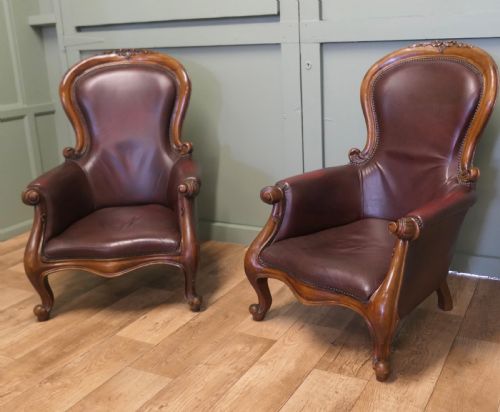
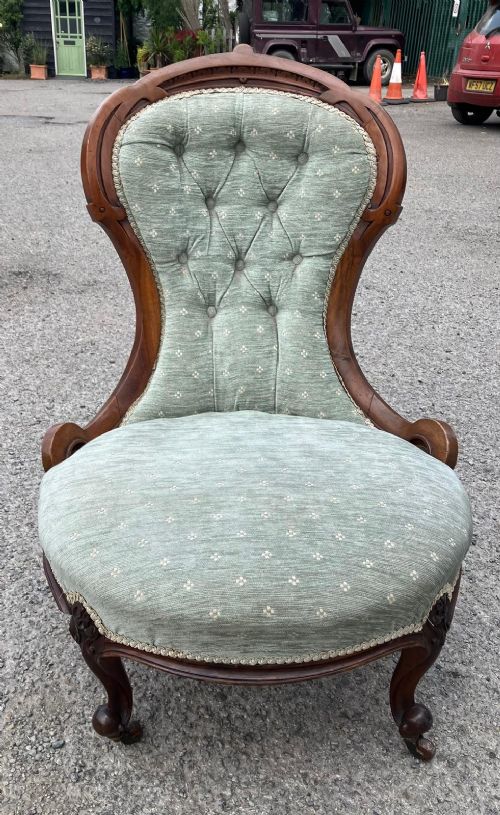
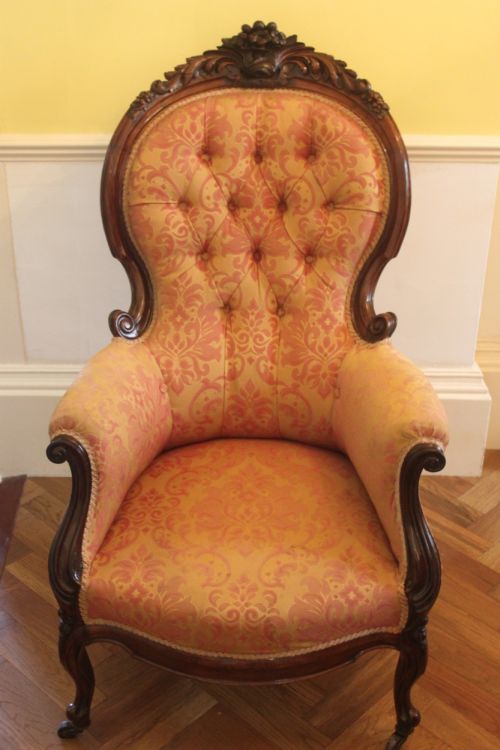
A spoon back fireside chair provides a deep seat and a concave wooden backrest shaped to match the human form. Buyers searching for a spoon back fireside chair encounter nineteenth-century examples predominantly from the Victorian period, alongside pieces reflecting Regency or Victorian Rococo Revival styles.
The selection includes gentleman's armchairs, nursing chairs, and salon chairs constructed from timber frameworks. These seating forms range from low-seated nursing models to wide library and fireside armchairs designed for parlours and drawing rooms.
How they were made
Frames rely on solid timbers such as mahogany and walnut, shaped into curved showwood backs, cabriole legs, scroll arms, or barley twist supports. Joinery often incorporates brass castors on the feet to facilitate movement across carpets.
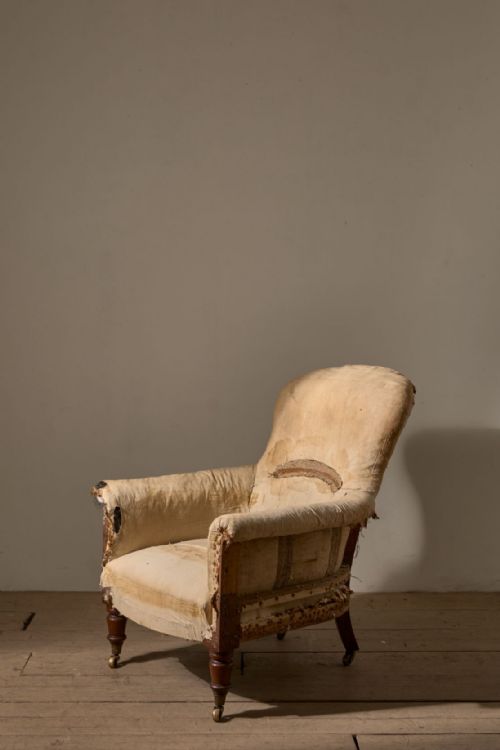
Upholstery techniques utilise traditional stuff-over methods, buttoning, and coil springs beneath textile coverings. Surviving examples feature velvet, damask, leather, fabric, and calico finishes fixed with careful tension.
One chair arrives outfitted in stark black calico, keeping its finished upholstery intentions a complete mystery.
What varies in quality
Quality rests in the precision of the carved timber frame and the fluidity of the spoon-shaped back curve. Heavier showwood mouldings and well-proportioned scroll arms distinguish finer workshop production from simpler builds.
Upholstery execution alters the final standard, from straightforward calico lining to complex buttoning in velvet or leather. The integrity of the internal springing and the grain selection in the walnut or mahogany timber dictate overall refinement.
C. Hindley & Sons
The Spoon Back Fireside Chair Glossary
- Spoon back
- A chair back shaped with a concave oval wooden rim resembling the bowl of a spoon. This contour supports the sitter's spine directly.
- Showwood
- Exposed polished timber frame visible around the upholstered sections of an armchair. Walnut and mahogany serve as the primary woods.
- Cabriole leg
- A furniture leg that curves outward at the knee and tapers inward toward the foot. This leg style appears frequently on Victorian seating.
- Button back
- An upholstery method where tufts are pulled tight and secured with buttons in a geometric pattern. It creates deep folds across the textile.
- Barley twist
- A carved wooden column turned in a spiral resembling a twisted rope. This detail decorates the uprights or legs of nineteenth-century chairs.
Spoon Back Fireside Chair: Frequently Asked Questions
What is a spoon back fireside chair?
A spoon back fireside chair is a nineteenth-century upholstered armchair featuring a concave wooden frame shaped like a spoon. These seats were built for parlours and drawing rooms to provide comfortable fireside lounging.
The design supports the back naturally through its curved timber surround. They appear in mahogany and walnut, often paired with buttoned upholstery and cabriole legs.
How do I date a Victorian fireside chair?
Dating relies on examining the timber frame, upholstery style, and turning details. Mid-nineteenth-century examples frequently display mahogany showwood, scroll arms, and buttoned velvet coverings.
Later Victorian and revival pieces from the late nineteenth century often incorporate ebonised finishes or walnut frames. Castors and joinery methods also help establish the decade of production.
What is the difference between a nursing chair and a gentleman's chair?
Nursing chairs are typically lower to the ground with compact frames intended for domestic chambers. Gentleman's armchairs offer wider proportions, higher backs, and more substantial padded arms.
Both utilise the characteristic spoon back shape but serve different seating positions. Gentleman's chairs suit fireside placement, while nursing chairs occupy bedroom or salon settings.
How should I care for antique upholstery?
Care involves gentle vacuuming with a soft brush attachment to remove dust from velvet, damask, or leather surfaces. Direct sunlight should be avoided to prevent textile fading and timber drying.
Leather benefits from occasional conditioning suited to its age. Checking the stability of the frame and castors maintains the chair during everyday use.