

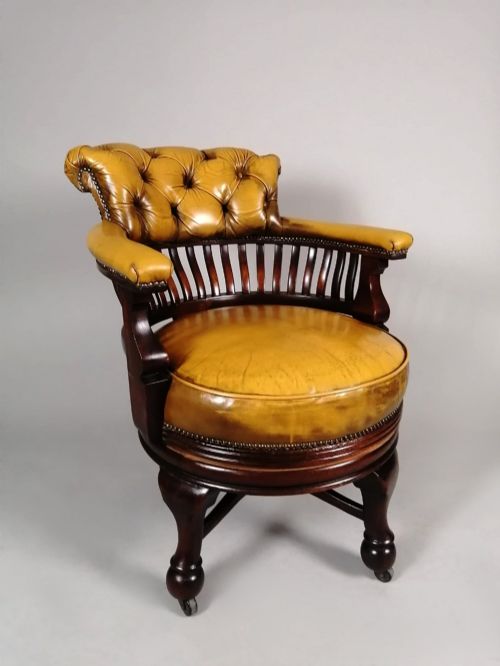
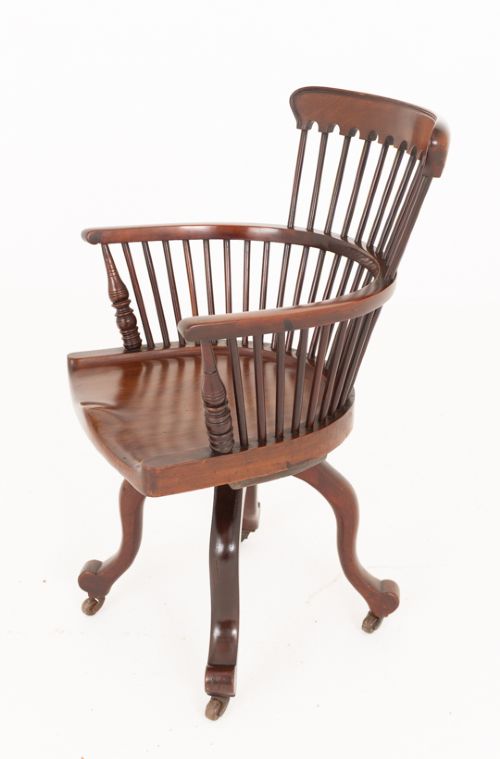


Spindle Back Swivel Chair
A spindle back swivel chair brings historic character and practical movement to a home study or library desk.
Spindle Back Swivel Chair
When you search for a spindle back swivel chair, you are looking at functional seating designed for offices, libraries and studies across the nineteenth and early twentieth centuries. These pieces combine traditional turned uprights with mechanical rotation, allowing movement while seated at a desk.
The most common examples encountered on this page date from the Victorian, Edwardian and Interwar periods, spanning styles from Late Victorian to Arts and Crafts. They typically appear as desk or office chairs intended for daily utility.
Makers from these eras utilised robust timbers like oak, mahogany, beech and ash, frequently mounting the wooden seats upon iron and brass swivel mechanisms. Leather and tan hide upholstery often supplement the wooden frames for added comfort.
Materials and construction
The construction relies heavily on durable hardwoods such as oak, mahogany, beech and ash, shaped into upright spindles and curved armrests. Cabinetmakers joined these components using traditional woodworking joints to withstand the rotational stress of a swivel base.
Mechanically, these chairs incorporate cast iron and brass swivel hardware beneath the timber seat, permitting rotation and sometimes height adjustment. Upholstered variants integrate leather or tan hide pads fixed securely to the wooden frame.
Spindle Back Swivel Chair Retail Price Guide 2026
Typical asking prices for spindle back swivel chair among the pieces listed under this phrase on Sellingantiques today, from the lower quarter to the upper quarter. They describe what is for sale here now, not the wider market.
Distinguishing quality in construction and design
Quality rests in the selection of timber and the sophistication of the turning on the spindles, where denser hardwoods and finer details elevate a piece above standard utilitarian office seating. The integration of the swivel mechanism also dictates the tier, with smoother rotation and robust metal fittings marking superior examples.
The presence of defined design movements, such as the Aesthetic Movement or Arts and Crafts styling, separates simpler commercial office chairs from pieces bearing distinct artistic authorship or thoughtful proportion.
Kendrick and Jefferson·Edward William Godwin
The Spindle Back Swivel Chair Glossary
- Spindle back
- A chair back constructed from vertical turned wooden rods or spindles. These elements provide structural support while maintaining a light, open profile.
- Swivel mechanism
- The under-seat hardware that allows the chair to rotate. In older examples, this typically involves cast iron and brass components.
- Tan hide
- A natural leather upholstery material with a light brown tone. It appears frequently on office and desk chairs from the Edwardian period onwards.
- Arts and Crafts
- A design movement prioritising traditional craftsmanship and simple forms. Pieces from this style often display honest construction and visible material qualities.
Spindle Back Swivel Chair: Frequently Asked Questions
What is a spindle back swivel chair?
A spindle back swivel chair is a nineteenth or early twentieth century desk seat featuring vertical turned spindles and a rotating mechanical base.
These pieces were originally built for offices, libraries and home studies to provide mobility and support during administrative tasks.
How do I date a swivel chair?
Dating relies on identifying the timber species, the style of the turning, and the complexity of the iron or brass swivel mechanism beneath the seat.
Earlier nineteenth century versions often feature heavy mahogany or walnut, whereas Edwardian and later pieces frequently utilise oak, beech or ash.
Are these chairs comfortable for daily use?
Many examples are surprisingly comfortable due to their ergonomic curved backs and supportive wooden or leather-upholstered seats.
They were engineered for long hours at a writing desk, making them practical for modern home office environments.
How do I care for leather on a desk chair?
Leather and tan hide upholstery requires gentle cleaning with a soft cloth and occasional treatment with appropriate leather conditioner to prevent drying.
Keeping the chair away from direct heat sources protects both the leather hide and the seasoned timber frame.