







Spider Leg Occasional Table
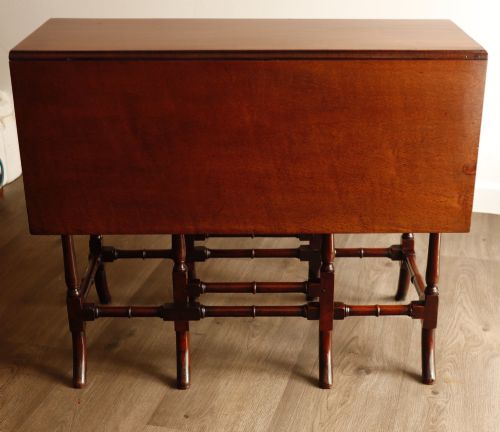
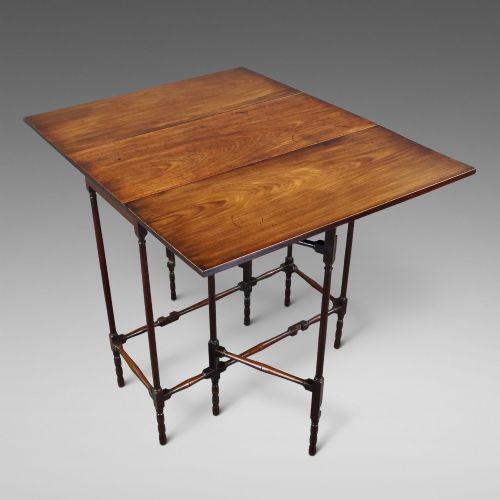
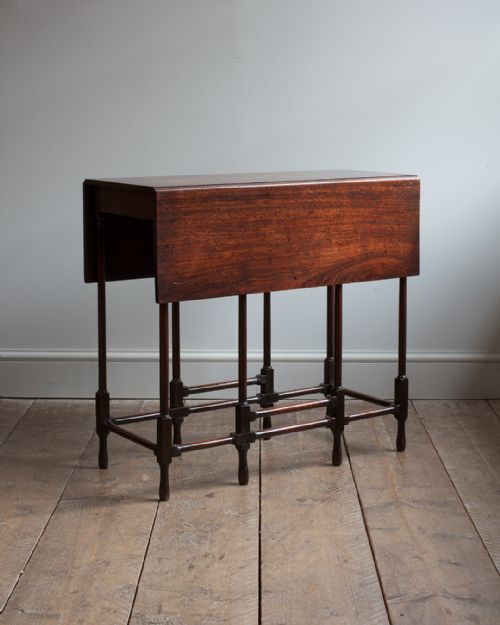
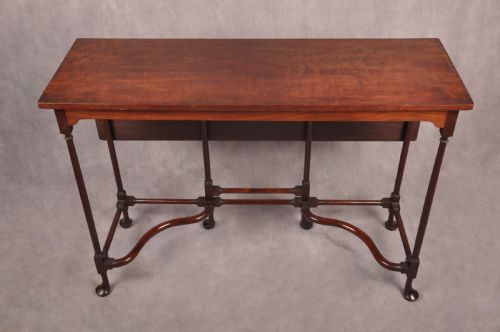
These spider leg occasional table pieces are slender, graceful items prized for their exceptionally delicate turned supports and versatile portability.
Spider Leg Occasional Table
When you search for a spider leg occasional table, you encounter compact side tables designed with slender, stick-like turned wooden legs connected by delicate stretchers. These pieces frequently manifest as drop leaf tables, tea tables, or occasional tables dating predominantly from the eighteenth century through the Edwardian period.
The form relies on minimal framing to achieve a remarkably light appearance while maintaining structural stability through arranged stretchers. Most examples encountered on this page utilise mahogany as the primary timber, reflecting the preferences of Georgian and later makers.
Buyers select these items to serve as functional surfaces in constrained spaces, appreciating the unobtrusive silhouette and period character. The selection spans straightforward drop leaf formats to nests of tables and wine tables.
How they were made
Makers constructed these tables predominantly using solid mahogany, turning the slender legs on a lathe to achieve the signature delicate profile. Brass components appear occasionally on hinges or fittings, while paint finishes surface on selected iterations.
The drop leaf mechanism required precise joinery to ensure the folding flaps operated smoothly without straining the exceptionally thin leg assemblies. Fine examples integrate cross-banded veneers and subtle mouldings that demonstrate advanced cabinet-making skill within a miniature scale.
Formats vary from drop leaf and Pembroke tables to nests of tables and wine tables.
What varies in quality
Quality in a spider leg occasional table rests on the crispness of the wood turnings and the original integrity of the slender frame. Superior specimens display well-proportioned stretchers that fit tightly into the leg turnings without visible movement or excessive reinforcement.
The selection of timber grain and the warmth of the polished surface distinguish finer Georgian and Edwardian examples from later reproductions. Tables retaining their original drop leaf action and undamaged leg joints command greater attention from discerning collectors.
The Spider Leg Occasional Table Glossary
- Spider leg
- A descriptor for furniture featuring exceptionally slender, delicate turned legs braced by fine stretchers. This design maximises visual lightness in small-scale tables.
- Drop leaf
- A table featuring hinged flaps that fold down to reduce the footprint or lift up to extend the surface. These are commonly supported by swing legs.
- Gateleg
- A table with hinged legs that swing outward to support the raised leaves of a drop leaf top. The pivoting action creates a sturdy base from a compact frame.
- Stretchers
- Horizontal wooden rods connecting the legs of a table to provide structural rigidity. In spider leg pieces, these are often arranged in delicate crossed configurations.
- Pembroke
- A small rectangular table featuring two hinged drop leaves on opposite sides and typically a single drawer. They were designed for light writing or tea service.
Spider Leg Occasional Table: Frequently Asked Questions
What is a spider leg table?
A spider leg table is a small occasional table characterised by exceptionally slender, lathe-turned wooden legs and delicate stretchers. The design creates a visually light piece suitable for tea service or as a side table.
Most surviving examples date from the eighteenth century through the Edwardian era and are constructed from mahogany. Their compact scale makes them practical for placement beside seating.
How do you use an occasional table?
These tables function as versatile surfaces for lamps, books, or drinks in sitting rooms and hallways. Drop leaf variants allow the surface area to expand when needed and contract to save space.
Placing them away from direct heat sources helps protect the polished mahogany surfaces and delicate wooden joints from drying out over time.
How do I date a spider leg table?
Dating relies on examining the timber species, construction methods, and secondary woods used within the frame. Georgian pieces often exhibit hand-cut dovetails and rich patina on solid mahogany.
Edwardian interpretations frequently show machine-cut elements and standardised hardware while closely imitating earlier Georgian styles.
Are spider leg tables sturdy?
Despite their fragile appearance, the arrangement of interlocking stretchers provides surprising structural stability for light daily use. The slender legs are designed to bear downward weight rather than lateral force.
Avoiding excessive loads and lifting the table by the main frame rather than the drop leaves ensures longevity.