




Spherical Gilt Frame Mirror
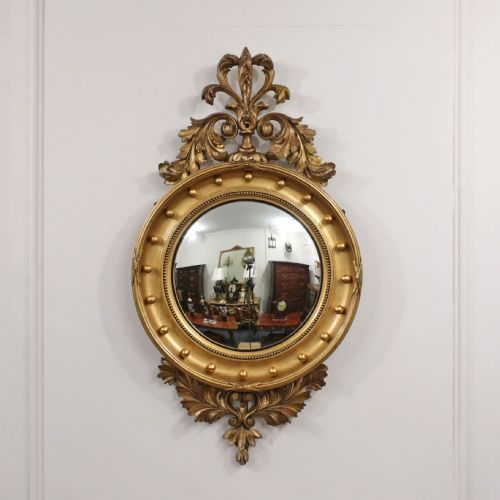
A spherical gilt frame mirror draws the eye across a room with its curved convex glass and bright gilded moulding.
Spherical Gilt Frame Mirror
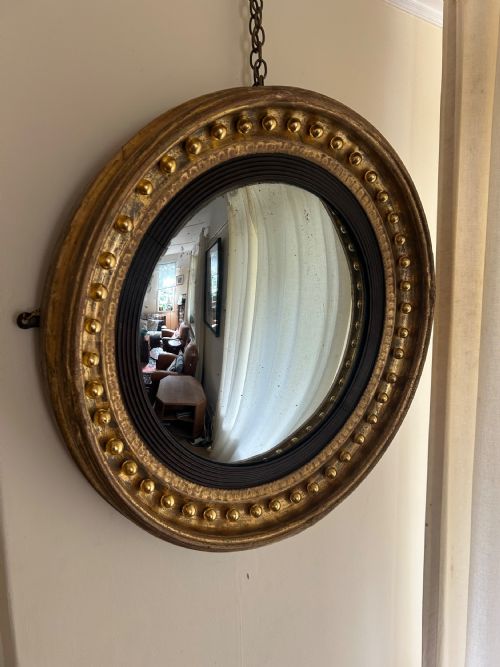
A spherical gilt frame mirror takes the form of a circular wall-hanging glass that bulges outward to reflect a wide angle of the interior. Most examples found here belong to the nineteenth century and the Regency period, capturing light and throwing it back into the space.
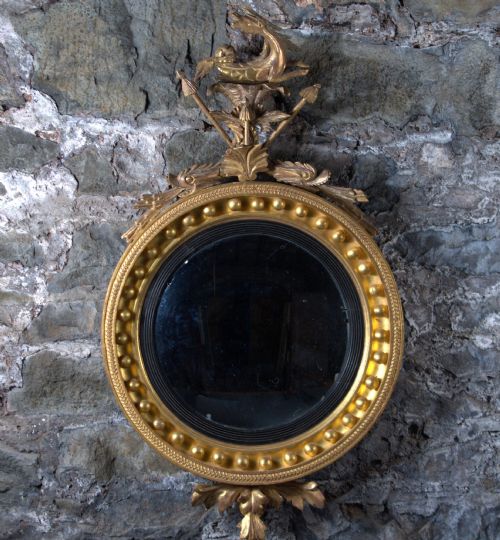
The standard form centres on a circular convex plate set within a round wooden or gesso frame, sometimes featuring decorative carved elements such as dragons. These wall mirrors serve both practical illumination and striking optical decoration in a traditional room scheme.
How they were made
Giltwood and gesso provide the foundation for the characteristic bright finish, shaped into circular mouldings around the curved glass plate. Artisans applied thin layers of gold leaf or gilt over prepared wooden bases to achieve the reflective metallic surface.
Ebonised wood occasionally appears alongside the gilt work, providing a contrasting dark slip or inner rim that frames the distortion of the convex glass.
Some nineteenth-century makers perched a fierce wooden dragon atop the frame, watching over the room's reflection.
What varies in quality
The crispness of the carving on the frame and the depth of the gilding set the finer pieces apart from simpler nineteenth-century production. Superior examples maintain intact gesso ornamentation and rich surface colour without heavy restoration obscuring the original detail.
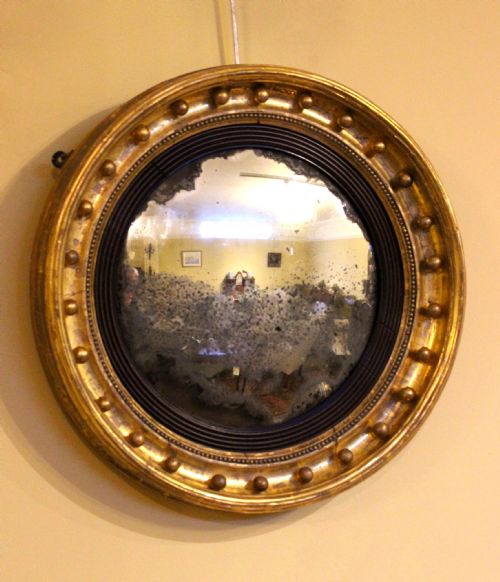
The quality of the convex glass plate itself influences the character of the reflection, with older glass showing distinct age and subtle optical ripples across the curved surface.
The Spherical Gilt Frame Mirror Glossary
- Convex mirror
- A round glass plate curved outward to produce a wide-angle reflection of the interior space. This form was especially popular during the Regency era.
- Giltwood
- Timber that has been coated with thin sheets of gold leaf or a gold-coloured finish. It provides the bright reflective border typical of these wall mirrors.
- Gesso
- A plaster-like mixture applied to wood frames to create a smooth surface for carving and gilding. It allows intricate decorative details to be moulded before applying gold leaf.
- Ebonised wood
- Timber treated to imitate ebony, creating a dense black finish. This dark material is frequently used on the inner rims of convex mirrors to contrast with the outer gilding.
Spherical Gilt Frame Mirror: Frequently Asked Questions
What is the difference between Regency and nineteenth-century mirrors?
Regency pieces date from the early nineteenth century and often display specific neoclassical design traits such as reeded bezels or carved crests. Later nineteenth-century examples tend to simplify these decorative elements.
Both share the fundamental convex glass form but differ in the nuance of their frame carving and secondary woods.
Why does the glass curve outward?
The spherical curve allows the glass to capture a panoramic view of the room within a compact circular frame. This optical property made them popular in period dining rooms and parlours for monitoring activity.
Interior spaces appear deeper and more illuminated because the curved surface gathers light from multiple angles.
How do I clean a gilt frame?
Dust the gilded surface gently with a soft, dry brush to prevent damage to the delicate gold leaf layer. Avoid using liquid cleaners or commercial polishes which can strip the historic finish.
Water and chemical solvents will soften the underlying gesso and permanently ruin the metallic lustre.