
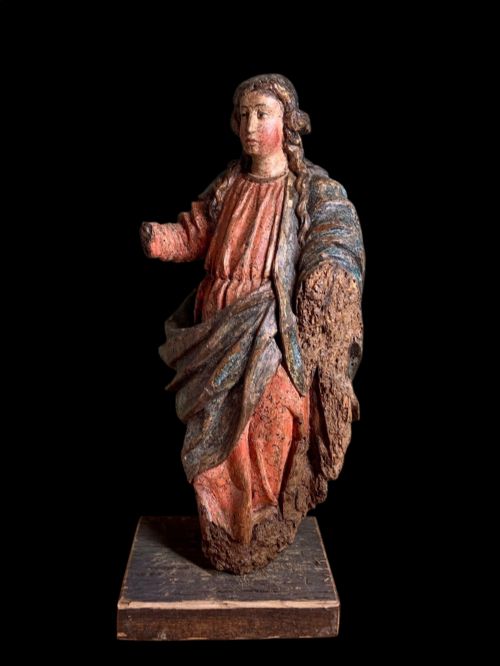
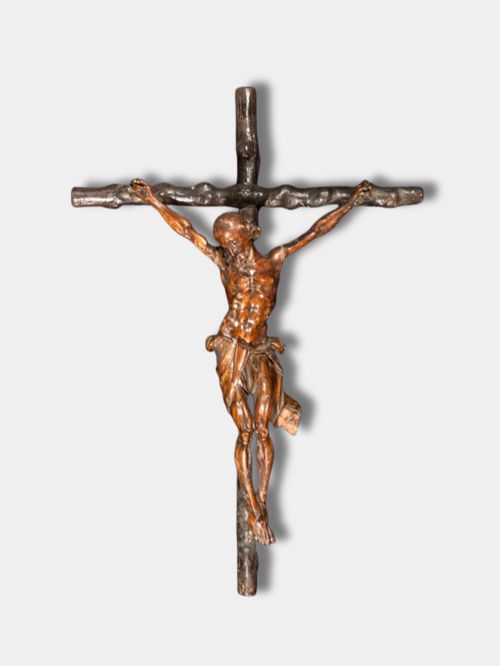


Spanish Colonial Sculpture
Spanish colonial sculpture brings tangible devotional history into your home, offering carved wooden figures rooted in centuries of religious tradition.
Spanish Colonial Sculpture
Spanish colonial sculpture encompasses carved wooden figures, corpus christi crosses, and devotional statues made for religious practice. When you browse this page, you encounter pieces spanning from the seventeenth century through the nineteenth century, reflecting enduring ecclesiastical traditions.
The objects take many forms, ranging from life-size Christ figures and walnut busts to smaller character heads of saints and the Christ Child holding the orb. These works bridge European baroque aesthetics with the distinct artistic output of the colonies.
Makers often drew upon Spanish baroque styles to shape these devotional religious art pieces. You will frequently find representations of saints, the Pieta, and santos figures designed for contemplation and prayer.
How They Were Made
Artisans carved these sculptures from hardwood, shaping the timber into expressive human forms and intricate religious imagery. This foundational woodwork provided the structure for subsequent layers of decoration.
Craftsmen applied gesso to the wooden surfaces to create a smooth base for finishing work. Over this preparation, they added polychrome paint and gold leaf to render lifelike flesh tones, garments, and gilded highlights.
The object types recorded here include full sculptures, corpus christi crosses, pieta groups, santos figures, and individual character heads.
What Varies in Quality
The fidelity of the carving and the subtlety of the polychrome paint application distinguish superior examples from simpler ones. Master carvers captured anatomical nuance and emotional depth in the facial expressions of saints and figures.
The preservation of the original gesso, paint, and gold leaf significantly influences the character of a piece. Finer works retain their layered coloration, allowing the historic hand of the maker to show clearly through the aged surface.
The Spanish Colonial Sculpture Glossary
- Polychrome
- Painted in several colours, this technique brings depth and realism to carved wooden religious figures.
- Gesso
- A plaster mixture applied to wood as a smooth base for painting and gilding.
- Santos
- A carved figure representing a saint or divine personage, traditionally used in Hispanic devotional contexts.
- Corpus Christi
- An image or sculpture of the body of Jesus Christ on the cross.
- Spanish Baroque
- An ornate artistic style emphasising dramatic emotion, movement, and rich ornamentation.
Spanish Colonial Sculpture: Frequently Asked Questions
How were these sculptures used?
These sculptures were created to inspire religious devotion, functioning as altarpieces, processional objects, or aids for contemplation in ecclesiastical and domestic settings.
Believers engaged with them visually and tactilely during prayers, rituals, and seasonal festivals throughout the colonial period.
How do I date a wooden sculpture?
Dating relies on examining the tool marks left by the carver, the style of the carving, and the composition of the underlying gesso and paint layers. Seventeenth and eighteenth-century pieces often display distinct baroque influences and heavier hardwoods.
Later nineteenth-century pieces can show shifts in stylistic execution and variations in material preparation while maintaining traditional religious forms.
Where should I place a sculpture?
Display your sculpture in a stable environment away from direct sunlight, high humidity, and sudden temperature fluctuations to protect the aged wood and painted surfaces.
Positioning the piece on a secure surface or wall mount allows the carved details and polychrome finish to be safely appreciated from multiple angles.