



Solid Silver Condiment Spoon
These solid silver condiment spoon examples are small tableware pieces designed for salts and mustards, offering lasting utility and tactile weight for the table.
Solid Silver Condiment Spoon
A solid silver condiment spoon is a small tableware implement designed to accompany salt cellars, mustard pots, and cruet sets on the dining table. When searching for this phrase, a buyer encounters individual spoons as well as implements housed within matched boxed sets and larger multi-piece table services.
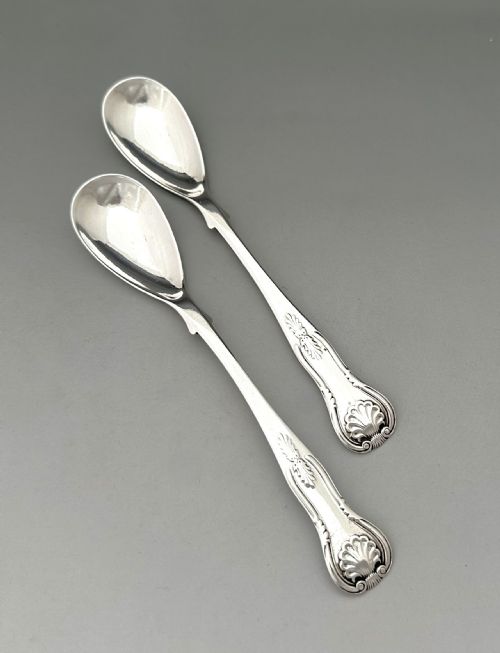
The selections span distinct periods ranging from the Regency era through Victorian, Edwardian, and George V years up to mid-century modern designs. Most examples met on this page originate from nineteenth and twentieth-century British workshops, often taking traditional fiddle, kings, or novelty forms.
Makers produced these spoons in varied regional centres including London, Edinburgh, and Birmingham to serve specific dining functions. Collectors frequently find them accompanying blue glass liners, salt cellars, and mustard pots within fitted presentation cases.
How they were made
Silversmiths utilised sterling silver and solid silver alloys, shaping the metal through traditional hammering, casting, and pressing techniques. Many pieces feature structural additions like gold plate washes inside bowl interiors or delicate handle engravings.
Some specialised items incorporate supplementary materials such as cobalt glass liners, velvet, silk, and leather within accompanying presentation boxes. Workshops employed punches to strike hallmarks denoting the metal standard, assay office, and year of production directly into the silver.
Solid Silver Condiment Spoon Retail Price Guide 2026
Typical asking prices for solid silver condiment spoon among the pieces listed under this phrase on Sellingantiques today, from the lower quarter to the upper quarter. They describe what is for sale here now, not the wider market.
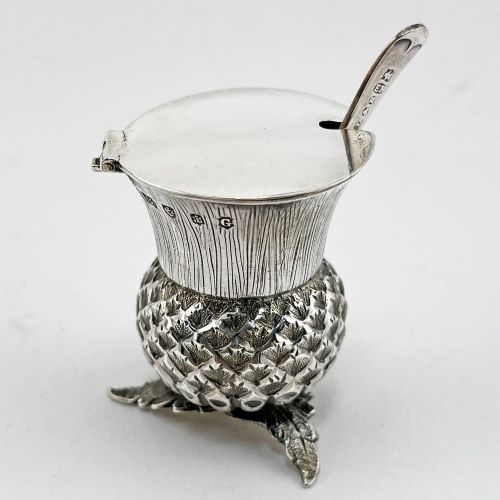
One determined silversmith shaped a tiny mustard pot as a Scottish thistle, complete with a matching spoon.
What varies in quality
Quality separates through the weight of the silver gauge, the crispness of the handle pattern casting, and the preservation of original factory gilding. Thicker gauge metal provides a substantial feel in the hand, whereas lighter items show more flexibility.
The clarity of maker marks and hallmarking punches contributes to desirability, alongside the presence of matching original boxes and glass liners. Finer examples display precise chasing and balanced proportions that reflect the skill of the silversmith.
Hamilton & Inches·Bricks & Sons·Vale Brothers and Sermon·ELKINGTON AND COMPANY·William Chawner·James and William Marshall
The Solid Silver Condiment Spoon Glossary
- Condiment spoon
- A small spoon designed specifically for serving salt, mustard, or other table relishes. These implements are sized to fit miniature cellars and pots.
- Sterling silver
- A silver alloy containing ninety-two point five percent pure silver by mass, with the remainder composed of copper or other metals. British items bearing this standard display the lion passant hallmark.
- Cruet set
- A matched assembly of small bottles, jars, or open cellars held together in a frame for the dining table. They frequently include associated spoons for mustard and salt.
- Fiddle pattern
- A nineteenth-century flatware handle style featuring a narrow stem that broadens near the end with distinct shoulder notches. It remains a common traditional British design.
- Kings pattern
- An ornate nineteenth-century flatware style decorated with a shell and scroll motif at the terminal. It appears on many larger serving and condiment pieces from the Georgian and Victorian periods.
Solid Silver Condiment Spoon: Frequently Asked Questions
What is a condiment spoon used for?
These small spoons serve mustard, salt, and other table condiments from open cellars and pots during meals. They prevent diners from using personal flatware in shared condiments.
Their compact size allows them to rest neatly beside or inside small ceramic and glass containers on the dining table.
How do I identify the age of a silver spoon?
British silver bears stamped hallmarks that include a date letter indicating the exact year of assay and manufacture. Additional marks show the city of origin and the specific maker's stamp.
Style indicators such as fiddle handles or Kings patterns also point toward specific nineteenth or twentieth-century design periods.
Are salt spoons different from mustard spoons?
Salt spoons typically feature shallow, rounded bowls suited for dry crystals, while mustard spoons often have deeper or slightly curved bowls. Both function within the broader category of condiment tableware.
Many antique sets include interchangeable designs that served multiple table functions depending on the meal.
How should I clean antique solid silver?
Gentle washing with warm water and mild soap removes daily dust and preserves the underlying silver surface. Soft cloths help maintain the natural lustre without abrading delicate engravings.
Harsh chemical dips can strip away desirable patination built up over decades of careful handling.