
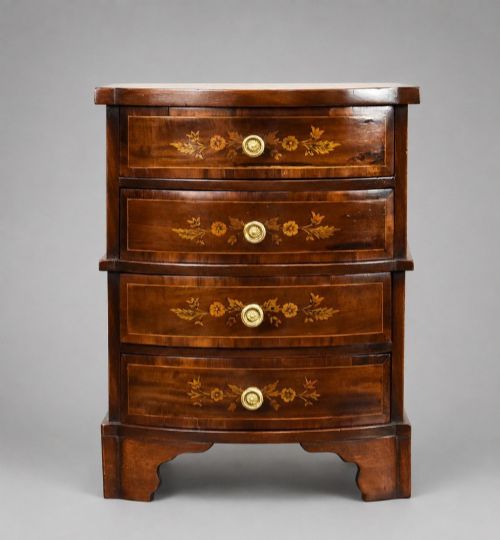


Small Wooden Caddy
A small wooden caddy brings history to your mantelpiece, offering timeless craftsmanship from Georgian, Victorian, and Edwardian periods.
Small Wooden Caddy
When you search for a small wooden caddy, you are looking at miniature storage vessels and tea containers designed for domestic use. These objects range from 18th-century tea caddies to small Edwardian boxes and miniature chests of drawers.
The versions you are most likely to meet on this page hail from the Georgian, Victorian, and Edwardian eras. They appear in forms such as dome tea caddies, sarcophagus shaped cellarettes, and miniature bow front chests of drawers.
Makers shaped these pieces from woods like mahogany, oak, and burr walnut, often incorporating brass mounts and inlaid boxwood or satinwood. Their compact proportions make them versatile accents for contemporary rooms.
How they were made
Cabinet makers constructed each small wooden caddy using dense timbers such as mahogany and oak, often selecting burr walnut for distinctive grain patterns. They joined the primary panels with traditional woodworking joints to ensure structural integrity over centuries.
Decorative surface work relied on precise inlay techniques, featuring contrasting boxwood and satinwood to create geometric or floral borders. Metal elements like brass hinges, escutcheons, and carrying mounts were hand-fitted to complete the functional design.
Several boxes survived centuries simply because their tiny brass keys remained safely tucked inside their locks.
What varies in quality
The distinction between standard examples and the finest pieces lies in the crispness of the timber selection and the precision of the inlay. Superior specimens display well-figured mahogany or burr walnut with meticulously aligned satinwood and boxwood banding.
Hardware integration also defines the upper tier, where original brass mounts fit flush into the wood without excess gaps. The subtlety of proportion and the retention of working locks with keys further elevate the standing of an individual piece.
The Small Wooden Caddy Glossary
- Caddy
- A small container originally designed for storing loose tea leaves. These boxes often feature internal compartments and lids.
- Cellarette
- A lockable container used for storing wine bottles or spirits. Miniature versions serve as tabletop or floor-standing storage boxes.
- Inlay
- A decorative technique where contrasting materials are inserted into recessed portions of a wooden base. Boxwood and satinwood frequently serve this purpose.
- Sarcophagus
- A coffin-shaped architectural style adopted for furniture and boxes during the Regency period. These vessels feature curved or angled sides.
- Marquetry
- The art of applying veneer pieces in decorative patterns to a structure. Edwardian miniature chests often employ this detailed surface work.
Small Wooden Caddy: Frequently Asked Questions
What were small wooden caddies used for?
These vessels originally stored valuable commodities like tea leaves, spices, or wine in domestic households. Locks were essential because tea was an expensive luxury.
Today, collectors use them as decorative accent pieces or for storing small personal items on desks and side tables.
How do I date a wooden caddy?
Dating relies on observing the timber species, construction methods, and prevailing stylistic details of the period. For instance, Georgian pieces often show simpler mahogany craftsmanship, while Edwardian examples display intricate marquetry.
Hardware styles and the presence of specific inlay materials also provide strong chronological markers for identification.
Are these boxes still functional?
Most of these containers retain their internal compartments and hinges, making them suitable for everyday storage. Many even keep their original locks and working keys.
Care should be taken to protect historic wood finishes and delicate brass mounts from excessive moisture or direct sunlight.
What is the difference between a caddy and a cellarette?
A tea caddy is typically a smaller box designed for holding dry tea leaves, often featuring internal lidded canisters. A cellarette is larger and built to hold bottles, sometimes taking a sarcophagus shape.
Both forms utilise fine timbers like mahogany and oak, but their original interior layouts reflect their distinct purposes.