
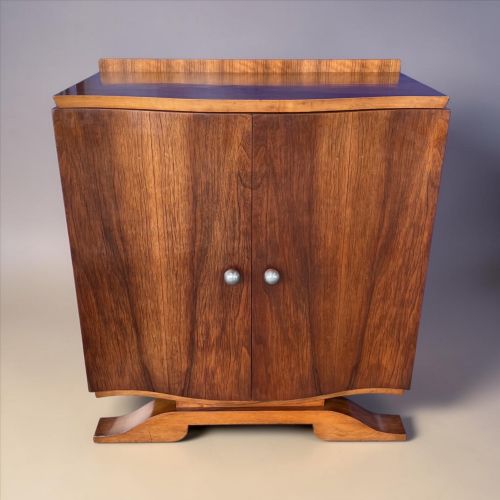


Small Walnut Sideboard
A small walnut sideboard brings rich grain and compact storage to a room, offering practical surface space without dominating the floor.
Small Walnut Sideboard
The versions you are most likely to meet on this page span the nineteenth and twentieth centuries, taking forms such as breakfront servers, chiffoniers, and narrow display cabinets. They bridge the gap between ornamental furniture and functional storage.
Makers utilised the distinctive grain of walnut to create striking front elevations, often incorporating serpentine shapes or breakfront profiles. Each piece reflects the domestic storage needs of its particular decade.
How they were made
Cabinet makers selected figured walnut and burr walnut veneers for their swirling grain patterns, laying them over solid secondary timbers to create decorative front surfaces. Marquetry inlay, brass mounts, and ormolu often added further ornamentation.
Structural integrity relied on traditional joinery methods, with drawers constructed using dovetailed joints and carcasses built to support heavy marble tops where specified. Glass panels appeared in doors designed to display contents.
French polishing or wax finishes protected the timber while deepening the natural colour and lustre of the walnut grain. Craftspeople shaped serpentine fronts and applied delicate stringing to define the edges of doors and panels.
Listings feature walnut, burr walnut, and rosewood alongside decorative ormolu and marble top additions.
What varies in quality
The choice of timber sets the baseline for quality, with highly figured burr walnut veneers commanding greater attention than plain stock. The intricacy of any inlaid marquetry and the precision of the grain matching across doors indicate the skill of the original workshop.
Hardware details such as original brass handles, lock escutcheons, and ormolu mounts elevate a piece above standard production. The fluidity of carved details or the crispness of serpentine moulding reveals the level of hand labour involved.
Gordovil Spain
The Small Walnut Sideboard Glossary
- Credenza
- A low-standing sideboard or display cabinet, often featuring glass-fronted side cupboards and central doors. Originating in Italy, it became a staple of Victorian formal rooms.
- Marquetry
- The art of applying pieces of veneer to a structure to form decorative patterns and pictures. Craftsmen used various tinted woods to achieve tonal depth.
- Ormolu
- Gilded bronze ornamentation applied to the corners and mounts of furniture. It provides a bright metallic contrast against dark walnut timber.
- Serpentine
- A furniture front curved in a wave-like shape, convex in the centre and concave at the sides. This contour requires precise woodworking skills to execute properly.
Small Walnut Sideboard: Frequently Asked Questions
Where should I place a small walnut sideboard?
These compact cabinets suit dining rooms, hallways, or living spaces where floor space is at a premium. Their shallow depth allows them to sit comfortably in narrower circulation areas.
They function well as serving surfaces during meals or as display plinths for lamps and decorative objects in a reception room.
How do I clean walnut furniture?
Dust the surface regularly with a soft, dry cloth to prevent particulate build-up in the grain. Avoid silicone-based polishes that can leave a hazy film over time.
Feed the timber periodically with a quality beeswax to maintain the moisture and natural lustre of the polished surface.
What is the difference between a credenza and a sideboard?
A credenza traditionally stands lower to the ground and frequently includes glass side cabinets for display purposes. Sideboards often feature higher serving tops and enclosed cupboard storage below.
In nineteenth-century usage, the terms sometimes overlapped as makers adapted forms for domestic dining and drawing rooms.
How do I date a walnut cabinet?
Examine the construction methods of the drawers and internal framing for clues about manufacturing eras. Hand-cut dovetails and secondary woods point toward nineteenth-century origins, whilst later pieces may show machine-assisted techniques.
Stylistic markers such as Art Deco geometric lines or Victorian carved walnut motifs help narrow down the decade of production.