



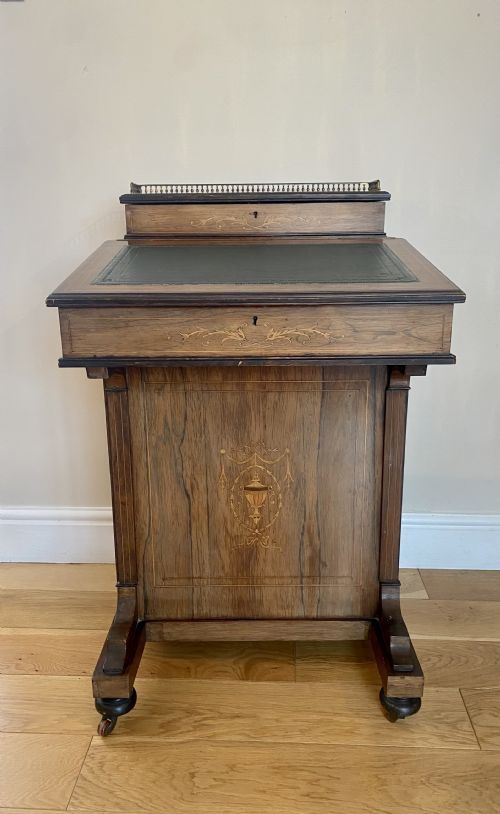


Small Rosewood Davenport
These small rosewood davenport desks offer compact writing surfaces with integrated drawers, combining rich timber grain with practical compartments for daily correspondence.
Small Rosewood Davenport
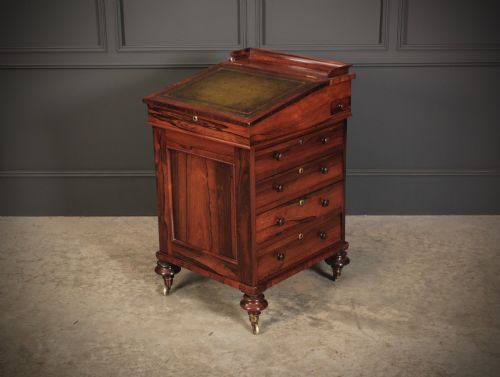
A small rosewood davenport provides a dedicated writing space within a compact footprint, featuring a sloping top and stationary storage. These desks appear across Regency, William IV, and Victorian periods, spanning the nineteenth century.
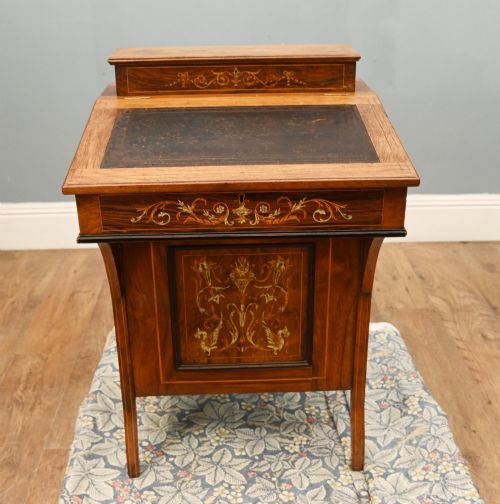
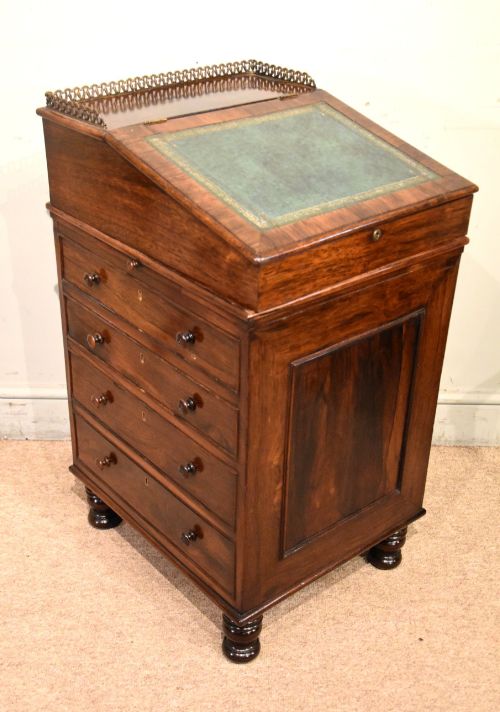
The standard configuration places drawers to the side while the sloping writing surface lifts or slides forward. Buyers find examples incorporating brass mounts, marquetry inlay, satinwood inlay, and birds-eye maple interiors.
Originating as portable or space-saving writing furniture, these pieces suit studies and drawing rooms alike. The selection ranges from early nineteenth-century Regency and William IV forms to later Victorian iterations.
Materials and construction
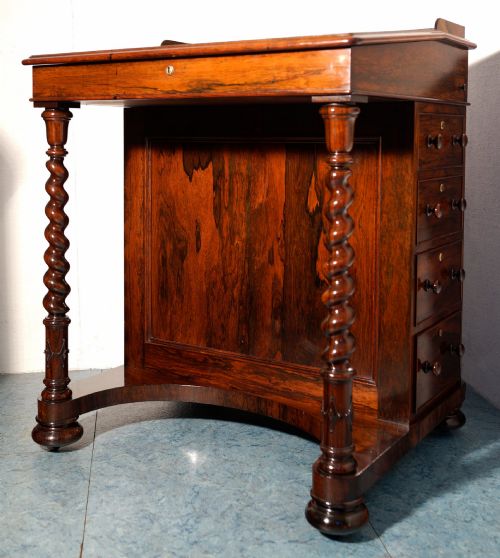
Cabinetmakers constructed these desks using dense rosewood and palisander timbers, often selecting figured veneers for the exterior surfaces. Secondary timbers lined the interior drawers while contrasting woods like satinwood provided decorative stringing and inlay.
Functional metal components included brass handles, castors, and gallery rails. Writing slopes incorporated leather inserts to provide a smooth surface for quibs and ink pens.
Specialised mechanisms allowed sliding top sections or pop-up compartments to operate smoothly within the compact cabinetry. Marquetry inlay and birds-eye maple added decorative contrast to the darker rosewood carcase.
Small Rosewood Davenport Retail Price Guide 2026
Typical asking prices for small rosewood davenport among the pieces listed under this phrase on Sellingantiques today, from the lower quarter to the upper quarter. They describe what is for sale here now, not the wider market.
Some Victorian davenports incorporate pop-up stationery compartments that rise like secret toast when unlocked.
Assessing quality and craftsmanship
The standard of timber selection and veneer matching defines the visual appeal of a small rosewood davenport. Superior examples display continuous grain patterns across the sloping lid and drawer fronts, paired with crisp marquetry or satinwood inlay.
Internal engineering marks the distinction between workshop grades, particularly in the precision of sliding top mechanisms and pop-up stationery compartments. Superior stationery boxes and drawer linings utilise secondary hardwoods rather than softwoods.
Hardware integration reflects the maker's attention to detail, from flush-fitting brass locks to hand-chased castors. The alignment of side drawers within the cabinet demonstrates the joinery skill applied to these compact writing desks.
The Small Rosewood Davenport Glossary
- Davenport
- A compact pedestal desk featuring a sloping writing surface hinged or sliding above a bank of drawers. This form became popular during the Regency period and remained a staple of Victorian study furniture.
- Palisander
- A dense, dark timber often grouped with rosewood varieties in nineteenth-century cabinetmaking. It provides a heavy carcase with pronounced grain contrast.
- Marquetry Inlay
- Decorative patterns formed by fitted pieces of veneer applied to the desk surface. This technique creates geometric or floral ornamentation using contrasting woods like satinwood.
- Birds Eye Maple
- A figured timber displaying small circular disruptions in the grain pattern. Cabinetmakers frequently utilised this pale wood for the interior pigeonholes and small drawers of writing desks.
- Slide Top
- A writing surface mechanism that extends forward to allow a more comfortable seating position. This feature appears on several Regency and William IV variants.
Small Rosewood Davenport: Frequently Asked Questions
What is a small rosewood davenport?
A small rosewood davenport is a compact nineteenth-century writing desk featuring a sloping top and side drawers.
Cabinetmakers designed them to save space while offering secure storage for writing materials and correspondence.
How do I date these desks?
Dating relies on stylistic markers from periods such as Regency, William IV, and Victorian.
Early nineteenth-century examples often exhibit restrained Regency lines, while mid-Victorian pieces incorporate richer marquetry inlay or mechanical pop-up compartments.
Where were they used?
These desks served as personal writing furniture in drawing rooms, boudoirs, and private studies.
Their compact proportions allowed placement in smaller residential spaces where a full-sized partners desk would not fit.
What woods are used besides rosewood?
While rosewood and palisander form the main exterior carcase, makers incorporated contrasting timbers for internal elements.
Satinwood provides bright stringing and inlay, and birds-eye maple frequently lines the interior stationery compartments.