
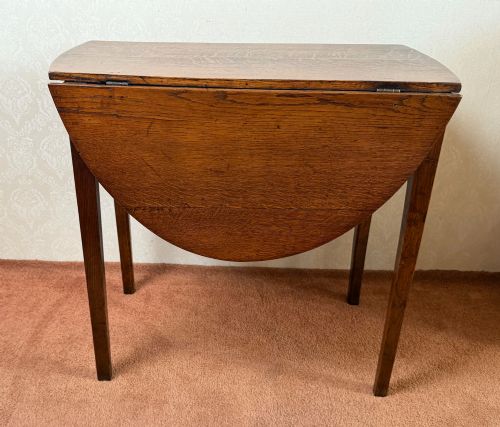
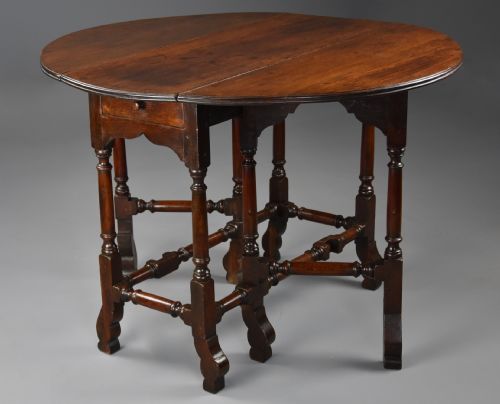
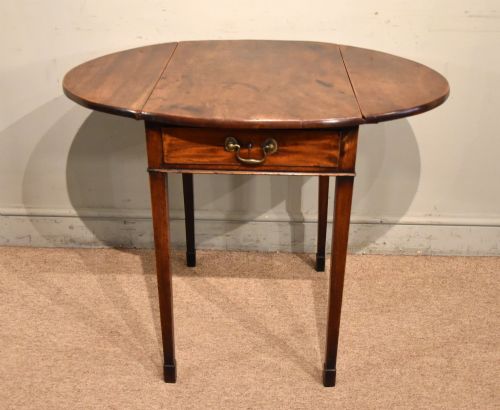
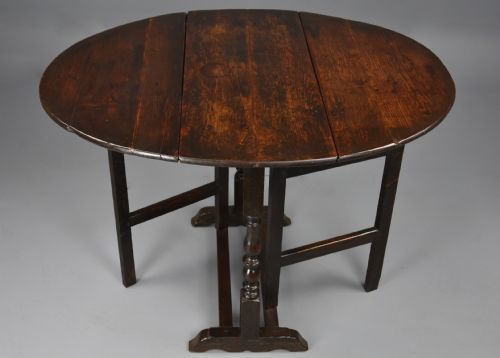
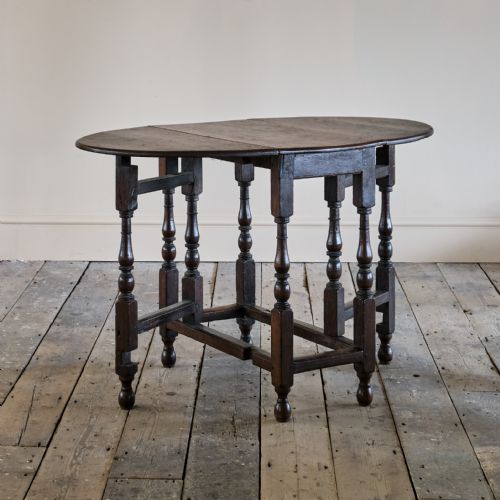


Small Oval Drop Leaf Table
A small oval drop leaf table serves modest rooms with clever folding leaves and timber warmth.
Small Oval Drop Leaf Table
A small oval drop leaf table offers a compact surface that expands when hinged flaps are lifted on swinging legs or gates. When searching for a small oval drop leaf table, buyers encounter formats ranging from gateleg tables and Pembroke tables to Sutherland tables and occasional tables.
The materials span oak, mahogany, walnut, burr walnut, and satinwood, occasionally joined by brass or ceramic elements. These pieces cross the seventeenth century, eighteenth century, nineteenth century, and twentieth century, reflecting Georgian, Victorian, Jacobean, and Edwardian periods.
How they were made
Cabinet makers utilised solid timbers like oak and mahogany, along with decorative veneers such as burr walnut, shaping oval tops designed to drop at the sides. Turned supports, including barley twist legs, provide structural holding power for the hinged leaves.
Hinges and brackets of brass allow the folding leaves to move smoothly while gateleg frames swing outward to bear weight. Surfaces display natural patinas developed through historical polishing and grain selection.
Styles span Georgian, Victorian, Jacobean, Edwardian Sheraton Revival, and 1930s traditional forms.
What varies in quality
The integrity of the timber and the depth of the original patina separate simpler utility pieces from finer examples. Superior specimens show careful matching of grain across the oval top and leaves.
The precision of the gate mechanism and the crispness of turned elements, such as barley twist legs, dictate the refinement of the construction. Solid mahogany and burr walnut generally indicate higher status than standard secondary woods.
The Small Oval Drop Leaf Table Glossary
- Drop leaf table
- A table with a fixed central section and hinged flaps that fold down at the sides. These leaves expand the surface area when supported.
- Gateleg table
- A table with folding leaves where the supporting legs swing outward on a gate action to hold the leaves upright. This design provides robust support for dining and occasional use.
- Pembroke table
- A rectangular or oval table featuring two hinged drop leaves and typically one or two small drawers. It developed during the eighteenth century for versatile placement.
- Sutherland table
- A narrow table with exceptionally slender folding leaves that drop down almost vertically. It folds into a compact footprint when not in use.
- Patina
- The surface sheen and coloration developed through age, handling, and polishing. A fine patina reveals the underlying grain of the timber.
Small Oval Drop Leaf Table: Frequently Asked Questions
How were small oval drop leaf tables used?
These tables served multiple functions in compact rooms, functioning as dining surfaces, side tables, or occasional tables as needed.
Dropping the leaves allowed the furniture to sit flat against a wall when floor space was required.
What woods appear most frequently?
Oak and mahogany dominate the older periods, appearing in gateleg and Pembroke formats.
Walnut and burr walnut emerge strongly in Victorian and later pieces, offering highly figured surfaces.
How do gateleg and Sutherland tables differ?
Gateleg tables utilise swing-out legs that support large portions of the oval top for heavier daily use.
Sutherland tables feature very thin folding leaves supported by narrow gate frames designed for lighter spaces.
How can I identify a Georgian piece?
Georgian examples often employ solid mahogany with smooth oval tops and refined Pembroke configurations.
They rely on understated lines rather than the heavy turnings found in seventeenth-century or Jacobean revival styles.