


Single Chain Fusee Clock
A single chain fusee clock is a precision timekeeper driven by a constant force mechanism, prized by collectors for its reliable movement and refined period cases.
Single Chain Fusee Clock
A single chain fusee clock represents a high standard of British horology, designed to maintain equal power to the escapement as the mainspring unwinds. When searching for a single chain fusee clock, buyers encounter both wall-mounted office styles and decorative mantel pieces.
The evidence shows these timekeepers spanning the nineteenth century, including the Regency era and the year 1850. Mantel clocks and wall clocks dominate the offerings, originating from London makers as well as provincial workshops.
Cases vary considerably in form, ranging from architectural slate and bronze to mahogany, rosewood, and satinwood. Dial designs feature painted iron and enamel beneath protective glass.
Materials and construction
The internal mechanics rely on brass movements governed by the fusee cone and connecting chain, paired with substantial metal elements. Casework utilises timber foundations such as mahogany, rosewood, satinwood, and ebonised wood.
Decorative surface treatments incorporate gilt bronze, ormolu, and patinated bronze, often reflecting styles from the Regency period to Rococo and Egyptian revivals. Dials are constructed from painted iron or enamel, protected by glazed bezels.
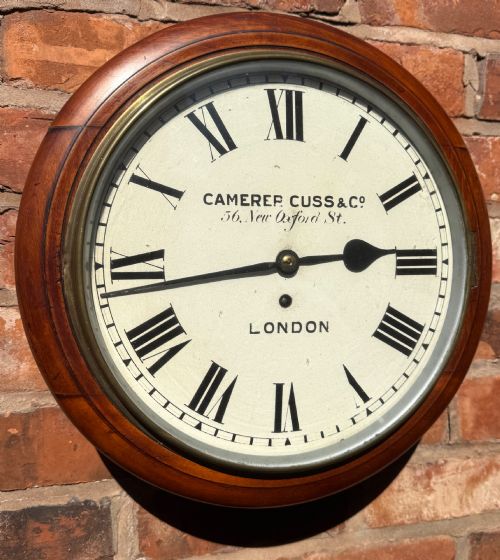
Several London makers placed their names prominently on iron dials, ensuring generations of timekeepers kept strict watch over busy drawing rooms.
Quality and execution
The distinction between tiers of quality lies in the crispness of the brass movement and the refinement of the cabinetwork. Finer examples display signed dials from notable makers, matched with sophisticated case materials like figured mahogany, satinwood, or heavy ormolu mounts.
Simpler models utilise plain timber or standard wall-hanging designs with minimal ornamentation. The integration of sculptural cast bronze or elaborate marquetry elevates the piece beyond a utilitarian timekeeper.
Camerer Cuss And Co·Barraud And Lund·Payne London·Baetens London·Fatton Eleve De Breguet·Bently And Beck·Payne And Co·Webster London·Fisher Old Bond Street·Morse London·Brockbank And Atkins·Bolton Smith London
The Single Chain Fusee Clock Glossary
- Fusee
- A conical pulley used in clocks to equalize the diminishing power of the mainspring as it unwinds. This ensures a consistent driving force to the escapement throughout the running period.
- Ormolu
- Finely ground high-carat gold applied to a bronze base using a mercury-gilding technique. It provides a rich, durable golden surface on decorative clock mounts.
- Enamel
- A glassy substance fused to a metal dial substrate through high-heat firing. It creates a smooth, glossy, and durable surface for painted numerals and markers.
- Ebonised
- Wood treated with a chemical stain or finish to imitate true ebony. It is commonly found on nineteenth-century clock cases to provide a sharp contrast against gilt mounts.
- Regency
- An architectural and decorative style prevalent in Britain during the early nineteenth century. It draws heavily on classical Greek, Roman, and Egyptian motifs.
Single Chain Fusee Clock: Frequently Asked Questions
How does a fusee movement work?
The fusee is a conical pulley connected to the mainspring barrel by a fine steel chain. As the spring unwinds and loses tension, the chain pulls on a wider part of the cone, maintaining steady torque to the gear train.
This clever mechanical compensation prevents the timekeeper from losing accuracy as the power reserve diminishes over its running cycle.
Where were these clocks placed historically?
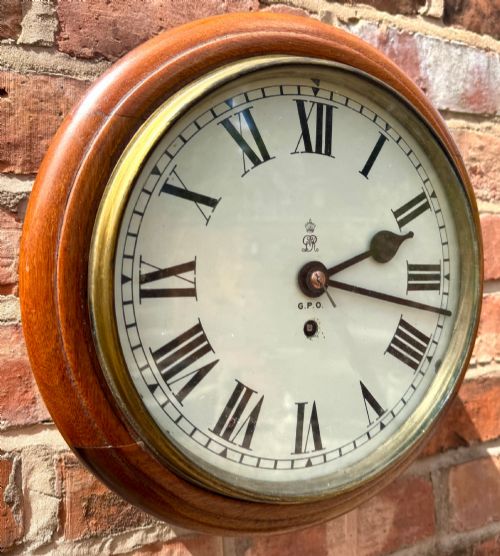
Wall-mounted versions were typically utilised in offices, railway stations, and public institutions where clear visibility and reliable timekeeping were paramount. Domestic spaces favoured mantel and library clocks placed on surfaces in reception rooms.
Smaller examples were designed for portability between rooms or for placement on writing desks.
How should I care for a fusee clock?
Keep the movement away from direct sunlight, sources of heat, and damp environments to protect both the wooden case and the internal metalwork. Professional servicing every few years ensures the chain and gear train remain properly lubricated.
Avoid attempting to adjust the suspension spring or escapement without appropriate horological experience.
How do I identify a Regency period piece?
Regency timepieces often exhibit classical architectural proportions, clean lines, and restrained application of gilt bronze or ormolu mounts. They frequently draw upon ancient Roman, Greek, or Egyptian design influences rather than later Victorian ornamentation.
Makers' signatures on the dial or movement backplate often help confirm the period of manufacture.