
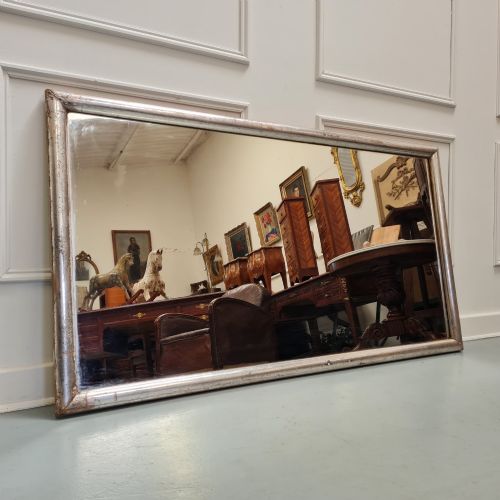
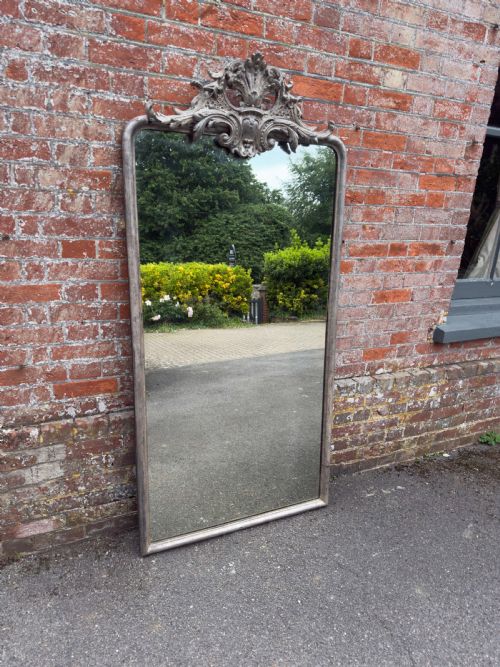


Silvered Wood Frame Mirror
A silvered wood frame mirror brings a soft, reflective luminescence to a room, drawing the eye with its historic metallic finish.
Silvered Wood Frame Mirror
A silvered wood frame mirror is a decorative looking glass housed in a timber structure treated with a silvered or metallic leaf surface. These objects range from compact wall fixtures to grand overmantels designed to anchor a principal room.
French nineteenth-century examples dominate the selection, frequently taking the form of arched top bistro mirrors or Louis Philippe designs with shaped upper corners. Italian Baroque and later twentieth-century interpretations also appear, offering varied regional interpretations of carved timber and metallic finishes.
How They Were Made
Carved wood provides the structural foundation for these pieces, often shaped into ribbed, rope twist, or faux bamboo profiles. Artisans applied a layer of gesso over the timber base to prepare a smooth, absorbent ground for subsequent gilding or silvering.
Silver leaf or liquid silvering was laid upon the prepared surface, occasionally combined with gold leaf for a mixed metallic effect. Etching directly onto the glass plate is common in French Louis Philippe and bistro examples, adding decorative motifs to the reflective plane.
Listings feature eighteenth-century origins alongside nineteenth-century French bistro and overmantel forms.
What Varies in Quality
The crispness of the hand-carved wood beneath the gesso layer distinguishes superior examples from simpler commercial production. Deep relief work and well-defined mouldings retain their sharpness despite the build-up of gesso and metallic leaf.
The integrity of the original silvering on both the frame and the glass plate determines the visual depth of the piece. Aged surfaces show a natural, mottled oxidation, whereas compromised examples often suffer from unsympathetic re-silvering or heavy losses to the gesso foundation.
A.J Rowley
The Silvered Wood Frame Mirror Glossary
- Gesso
- A plaster-like mixture applied to carved wood to create a smooth surface for silver leaf or paint. It allows for crisp moulding details.
- Overmantel Mirror
- A large horizontal mirror specifically designed to hang above a fireplace mantelpiece. These pieces often feature extended frames to anchor the wall space.
- Girandole
- A decorative wall mirror fitted with candle branches attached to the frame. The branches reflect additional candlelight into the room.
- Louis Philippe
- A nineteenth-century French style characterised by clean arched tops and restrained classical proportions. The framing is typically thinner than heavy Baroque equivalents.
- Bistro Mirror
- A commercial wall mirror used in nineteenth-century French hospitality establishments. They frequently incorporate simple wooden frames and etched glass.
Silvered Wood Frame Mirror: Frequently Asked Questions
How do I date a silvered mirror?
Dating relies on examining the construction of the wooden frame, the thickness of the glass, and the composition of the backing materials. Earlier pieces often display hand-beveled edges and irregular timber joints.
Stylistic cues such as the arched top of a Louis Philippe design or the heavy carving of an Italian Baroque piece also point to specific decades of manufacture.
What is a Louis Philippe mirror?
A Louis Philippe mirror is a nineteenth-century French form defined by its gently rounded upper corners and clean wooden framing. These pieces were built for domestic interiors and balance decorative carving with functional scale.
They frequently include gesso surfaces finished in silver or gold leaf, paired with original etched glass plates.
Can I hang an overmantel mirror on a standard wall?
Overmantel mirrors are traditionally built to rest on a fireplace shelf while being secured to the wall for safety. Hanging one independently requires assessing the weight of the carved wood and glass against appropriate wall anchors.
Their substantial proportions mean they often function best as primary focal points in principal rooms.
What causes the dark spots on old mirror glass?
Dark spots and patination occur when moisture gradually infiltrates behind the silvering layer over decades or centuries. This chemical oxidation alters the uniform reflection and creates a characteristic mottled appearance.
Many collectors prize this natural ageing process as evidence of genuine antiquity.