
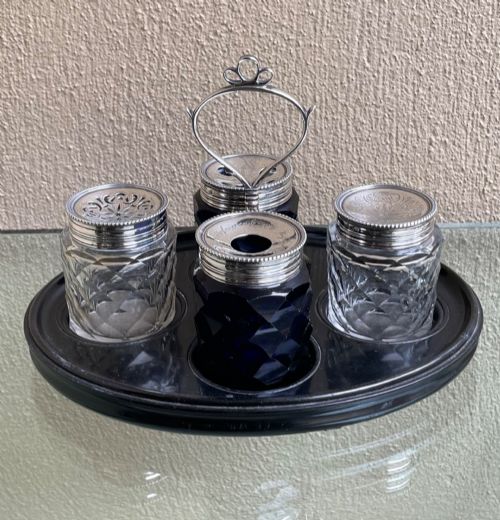


Silver Topped Glass Inkwell
A silver topped glass inkwell combines a heavy crystal or glass reservoir with a precious metal lid, offering a functional desk accessory with considerable visual weight.
Silver Topped Glass Inkwell
A silver topped glass inkwell sits upon a desk or dressing table, providing a secure vessel for liquid ink alongside a hinged cover. These items appear across Georgian, Victorian, Edwardian, and Art Deco periods, ranging from compact travelling pieces to large desktop containers.
The form frequently pairs cut glass or crystal bases with sterling silver mounts, occasionally incorporating ebony or silver gilt elements. Buyers encounter single bottles alongside larger inkstands and matching dressing table accessories.
How they were made
Makers fashioned the heavy glass and crystal reservoirs through moulding and facet cutting, creating deep geometric patterns designed to catch the light on a writing desk. The silver tops, often bearing English hallmarks, were shaped to fit snugly over the glass collars with hinged lids.
Selected pieces incorporate interior glass liners or delicate silver gilt washes within the metal lids, while others utilise dense materials like ebony to anchor the design.
Some unlucky Victorian writers discovered too late that their heavy silver lid possessed a hinge strong enough to launch dried ink across the room.
What varies in quality
The distinction between ordinary and superior examples lies in the crispness of the glass cutting and the substantial weight of the silver mount. Deeper facets and heavier gauge silver elevate the presence of the piece significantly.
Proportion also defines the better items, where the scale of the silver top balances the heft of the crystal base rather than overwhelming it.
Asprey
The Silver Topped Glass Inkwell Glossary
- Sterling silver
- A standard alloy consisting of a high proportion of pure silver, commonly marked with a lion passant on British pieces. It provides the durable metal used for the hinged lids and collars.
- Cut crystal
- Glass containing lead oxide, which increases brilliance and density, allowing for sharp geometric facets. This material forms the heavy reservoirs of desktop inkwells.
- Hallmark
- An official stamp indicating the metal standard, the assay office, and the date letter. These marks help identify the specific year and location of manufacture.
- Silver gilt
- Silver that has been coated with a thin layer of gold on the surface. This technique protected the interior of inkwell lids from the corrosive properties of wet ink.
Silver Topped Glass Inkwell: Frequently Asked Questions
How do I clean the glass reservoir?
Warm soapy water and a bottle brush remove dried ink residue safely from the interior without damaging the outer surface.
Care must be taken to keep moisture away from the hinged silver lid and any embedded cork seals.
Were these used for travel?
Certain compact examples were specifically designed for travel, featuring secure screw or locking lids to prevent leakage in transit.
Larger desktop models remained stationary in studies and offices due to their substantial weight.
How do I date an inkwell?
Assay office hallmarks on the silver lid provide the most precise indication of the year of manufacture.
Stylistic shifts in the glass cutting and overall silhouette also distinguish Georgian and Victorian pieces from later Art Deco designs.
Can I still use these for writing?
Many of these vessels remain entirely functional for holding ink and dipping pens on a modern desk.
Checking the internal collar and lid seal ensures the reservoir still holds liquid safely.