


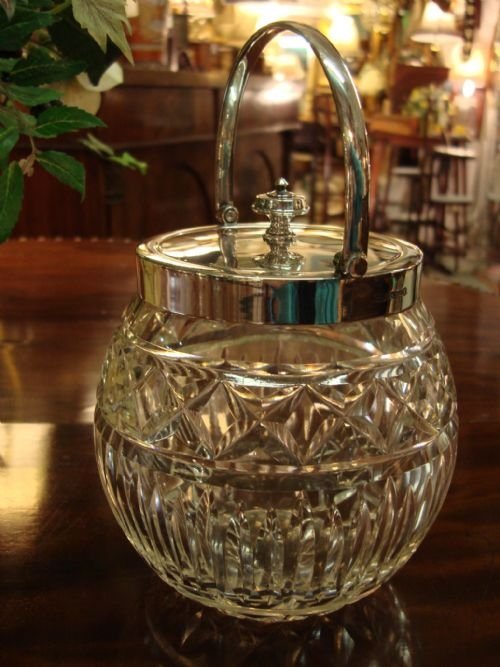
Silver Top Cookie Jar
A silver top cookie jar offers a handsome container for the table, combining gleaming metal mounts with a fitted ceramic or glass body.
Silver Top Cookie Jar
A silver top cookie jar is primarily encountered in the form of a biscuit barrel, dating from periods such as the Victorian, Edwardian, and Art Deco eras. These tablewares frequently combine metal lids and mounts with bodies of cut glass, cranberry glass, jasperware, earthenware, or stoneware.
Makers produced these containers in various geometric and drum forms, often featuring hinged lids and swing handles designed for parlour use. The evidence shows examples originating from the mid-nineteenth century through to the early twentieth century.
Buyers seeking a silver top cookie jar encounter pieces spanning George V and Neoclassical styles, incorporating materials like silver plate and hallmarked sterling silver alongside ceramic bodies.
How they were made
Craftsmen shaped the bodies through glass-cutting, ceramic moulding, and stoneware fabrication, frequently employing jasperware and cranberry glass to achieve rich colour and texture. Oak was also utilised for specialised drum form bodies.
The metal components rely on silver plate and hallmarked sterling silver, formed into secure collars, hinged lids, and handles that attach firmly to the glass or ceramic vessel.
Some twisted three-handled jars require an extra hand just to decide which way to turn the lid for a biscuit.
What varies in quality
Quality rests upon the crispness of the glass cutting, the depth of moulding in ceramic and jasperware bodies, and the substantial weight of the silver plate or sterling silver mounts. Finer examples display balanced proportions between the metal lid and the decorative body.
The integration of the metal collar to the glass or ceramic determines the structural integrity, whilst distinguished makers add provenance through marked silverwork and refined handles.
Crown Devon·Walker And Hall·Wedgwood·James Dixon And Sons
The Silver Top Cookie Jar Glossary
- Jasperware
- A fine-grained, unglazed stoneware developed with contrasting applied reliefs, frequently seen in blue or green backgrounds on nineteenth-century biscuit barrels.
- Cranberry glass
- A rich red-pink transparent glass created by adding gold chloride to the molten batch, popular for decorative Victorian tableware.
- Silver plate
- A layer of silver bonded to a base metal core, commonly used for the mounts, lids, and swing handles of period biscuit boxes.
- Cut glass
- Glass decorated by grinding facets and patterns into the surface, providing weight and brilliance to the body of the container.
- Biscuit barrel
- A covered container used for holding dry baked goods on the dining or drawing-room table, synonymous with the cookie jar.
Silver Top Cookie Jar: Frequently Asked Questions
What is a silver top cookie jar?
A silver top cookie jar is a covered container traditionally used for serving biscuits and dry goods at the table. These pieces feature a metal lid and collar paired with a glass or ceramic body.
Most surviving examples date from the Victorian and Edwardian periods, utilising silver plate or sterling silver alongside cut glass, jasperware, or earthenware.
How were biscuit barrels used?
These vessels sat on dining tables or sideboards during tea and after-dinner hospitality to keep dry baked goods fresh. The hinged lid and handle allowed guests to serve themselves easily.
They functioned as both practical storage and decorative display items in middle-class and elite homes of the nineteenth and early twentieth centuries.
How do I date a silver top cookie jar?
Dating relies on stylistic markers, material choices, and any maker marks stamped onto the silver mounts or ceramic bases. Victorian pieces often feature heavy cut glass or jasperware, while later Edwardian and George V examples introduce sleeker lines and alternative forms.
Examining the construction of the hinge and the style of the handle provides further clues to the manufacturing decade.
How do I care for a silver top cookie jar?
Care involves gentle cleaning of the glass or ceramic body with mild soap and warm water, avoiding harsh abrasives that might damage the surface. The silver-plated or sterling silver mounts require appropriate metal polish used sparingly to prevent residue accumulation near the joins.
Keeping the interior dry prevents moisture damage to the internal collar and hinge mechanisms.