

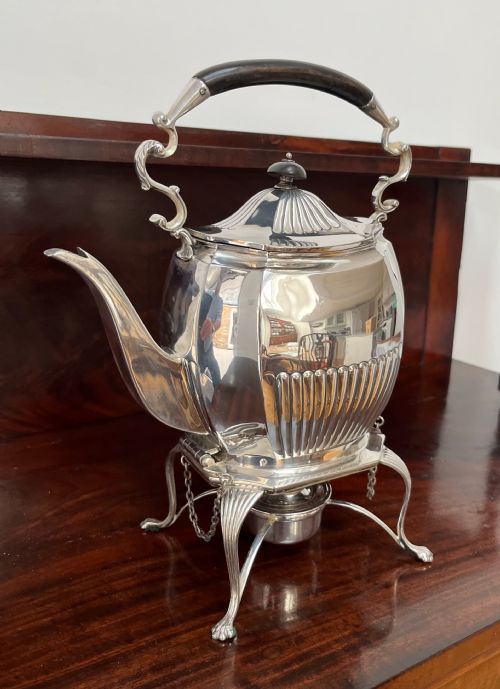


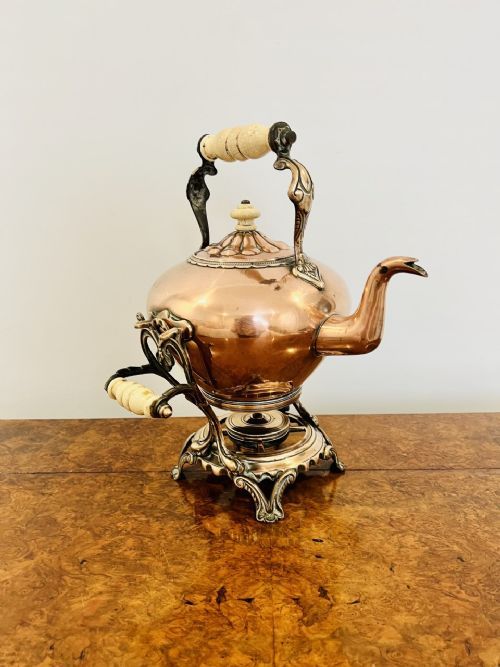


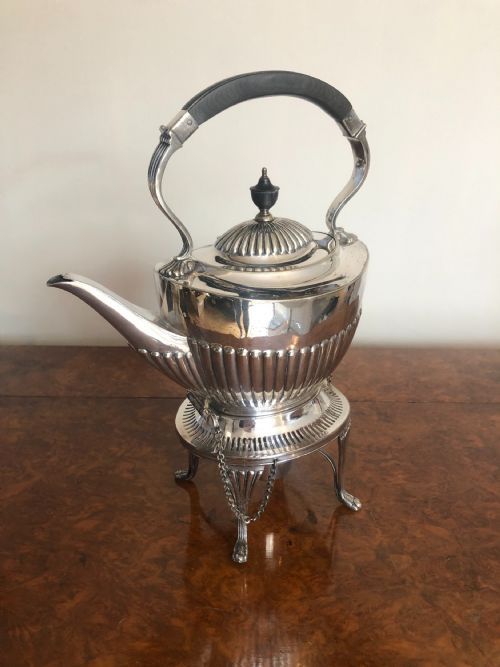
Silver Spirit Kettle Burner
These silver spirit kettle burner pieces are tea service showpieces that bring hot water to the table with period style.
Silver Spirit Kettle Burner
A silver spirit kettle burner combines a tea kettle, a supporting stand, and a small fuel burner beneath to keep water hot during tea service. These tea service showpieces appear in Edwardian, Victorian, and Georgian Revival styles, reflecting formal nineteenth and early twentieth century hospitality.
The objects listed here span from eighteen fifty to nineteen thirty, with Edwardian silver plated examples forming the majority of the current selection. Forms range from standard spirit kettles on stands to copper kettles and tea kettles produced by makers such as Fenton Brothers and Frederik Ellis Tim and Co.
Materials and construction methods
Construction relies heavily on silver plate and EPNS over a base metal, alongside copper for specific Victorian pieces. These metals are shaped into kettles and stands designed to hold a small spirit burner securely beneath the water vessel.
Handles and insulators incorporate ebony, ebonised wood, bone, and plain wood to prevent heat transfer during use. The combination of silver plated metals with dark wooden elements creates the characteristic contrast seen across these items.
The site listings feature spirit kettles spanning from eighteen fifty to nineteen thirty, encompassing Edwardian, Victorian, and Georgian Revival styles.
Distinctions in quality
Quality rests in the weight of the metal, the crispness of the revival style ornamentation, and the integrity of the silver plating over the underlying base. Superior examples exhibit balanced proportions between the kettle, the stand, and the burner mechanism.
The refinement of the wooden or bone insulators and the maker's mark add distinction to individual pieces. Simpler production items show less attention to decorative detail on the stand and mountings.
Fenton Brothers·Frederik Ellis Tim and Co
The Silver Spirit Kettle Burner Glossary
- Spirit kettle
- A tea kettle mounted on a metal stand with an integrated fuel burner underneath. This arrangement kept water at boiling point for prolonged tea drinking.
- EPNS
- Electroplated nickel silver. A common base metal process used for silver plating domestic wares during the Victorian and Edwardian periods.
- Silver plate
- A layer of silver fused or plated over a base metal such as copper or nickel. It provided the appearance of solid silver at a lower production cost.
- Ebonised wood
- Timber treated to resemble ebony. It appears frequently on kettle handles to provide a dark, heat-resistant grip.
Silver Spirit Kettle Burner: Frequently Asked Questions
What is a silver spirit kettle burner?
A silver spirit kettle burner is a tea kettle mounted on a metal stand with a small fuel burner underneath. It was designed to keep water hot at the table during tea service.
Most examples seen here date from the Victorian and Edwardian periods, utilising silver plate, EPNS, and copper with wooden or bone insulators.
How were they used?
These kettles were filled with hot water and placed over a lit spirit burner on a dining or drawing room table. The burner maintained the water temperature for guests.
Handles made of ebony or ebonised wood protected the user's hands from heat while pouring water into the teapot.
How do I date these pieces?
Dating relies on stylistic clues such as Edwardian, Victorian, or Georgian Revival design motifs, alongside manufacturing materials like EPNS and silver plate. Maker marks also help establish the decade of production.
The listings here span from eighteen fifty through to nineteen thirty, showing shifts in revival styles over those decades.
What materials are common?
The primary materials are silver plate, EPNS, and copper, forming the kettle bodies and stands. Handles and lifting grips feature contrasting elements like ebony, ebonised wood, and bone.
These materials ensured durability while preventing heat transfer to the handle during tea service.