
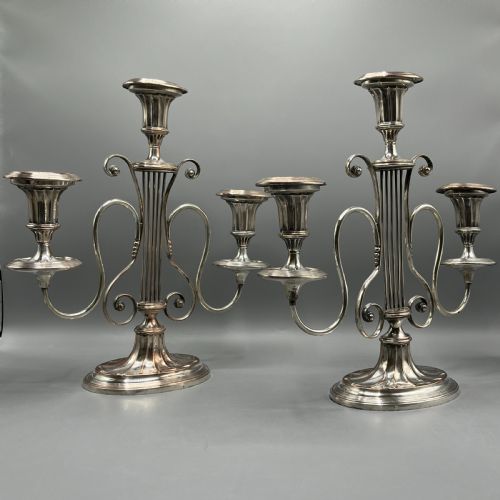


Silver Sheffield Plate Candlesticks
Silver sheffield plate candlesticks bring Georgian and Victorian elegance to a table, combining copper warmth with a fine silver surface through an early fusing technique.

Silver Sheffield Plate Candlesticks
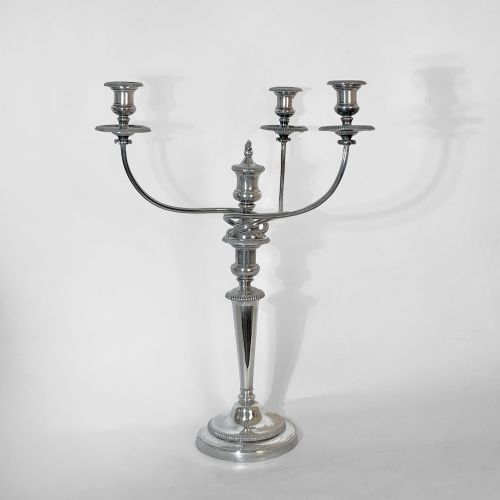
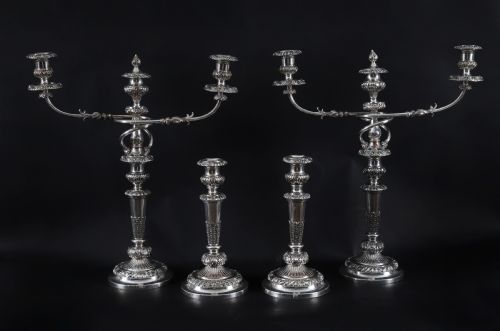
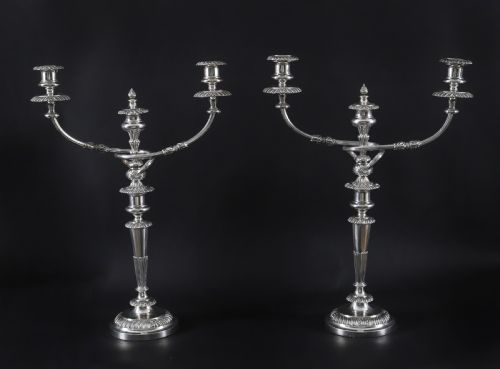
Silver sheffield plate candlesticks span the eighteenth and nineteenth centuries, taking the form of pairs, suites, and taller candelabra.
The selections on this page include standard pairs alongside extending telescopic designs, chambersticks, and three-light branch conversions.
Georgian and Victorian examples dominate, running from George III creations through to later nineteenth-century interpretations of neoclassical and rococo styles.
Materials and methods
Makers fused a thin sheet of silver to a thicker copper ingot through heat and pressure before rolling the combined metal into sheets.
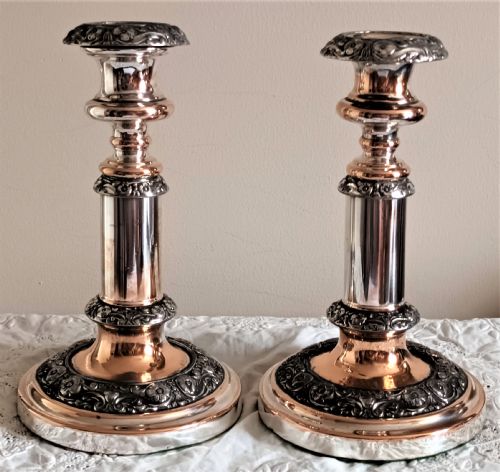
This fused plate allowed objects to be shaped by hand or die-pressed, often leaving small areas where the underlying copper shows through the wear.
Weighted bases and inserted wood cores provided necessary stability for tall stems and multi-branch candelabra.
Craftsmanship and proportion
Quality rests in the crispness of chased or cast ornamentation, particularly around removable sconces and stepped circular bases.
Telescopic mechanisms move smoothly without slack in finer pairs, holding extended heights securely.
Heavier gauge metal and balanced proportions distinguish the workshop output of named makers from standard commercial production.
Matthew Boulton·Elkington·Blagden Hodgson And Co·Thomas White·Walker And Hall·Smith Sissons And Co
The Silver Sheffield Plate Candlesticks Glossary
- Sheffield Plate
- A fused bilayer metal made by heating a sheet of silver to a copper block until they bonded.
- Telescopic
- An extending shaft design allowing the height of the candlestick to be adjusted.
- Sconce
- The detachable top nozzle inserted into the socket to catch dripping wax.
- Chamberstick
- A low portable candlestick fitted with a handle and a small saucer base.
- Candelabra
- A branched lighting fixture holding multiple candles from a central stem.
Silver Sheffield Plate Candlesticks: Frequently Asked Questions
How do I clean old sheffield plate?
Clean these pieces gently with a soft cloth and a mild silver cream formulated for plated items, avoiding harsh dips.
Because the silver layer is thin, aggressive scrubbing will expose the copper underneath.
Can I use real candles in them?
Standard taper candles fit most historical sconces, though you should check the diameter before lighting.
Ensure removable drip pans are clean to protect the surrounding metal from hot wax.
Why does copper show through the silver?
Decades of polishing gradually wear away the thin outer layer of silver to reveal the warm copper core beneath.
This telegraphing of base metal is expected on genuine old pieces and indicates genuine age.
How do I date a pair of candlesticks?
Look to the base style, capital ornamentation, and construction seams to match the prevailing design period.
Georgian pairs tend toward neoclassical columns or fluted stems, while Victorian examples embrace heavier floral casting.