



Silver Platter Dome Cover
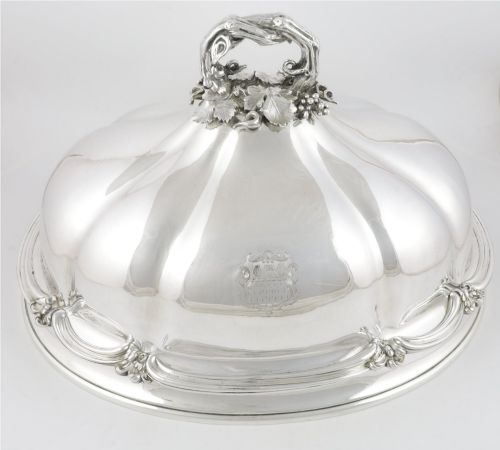
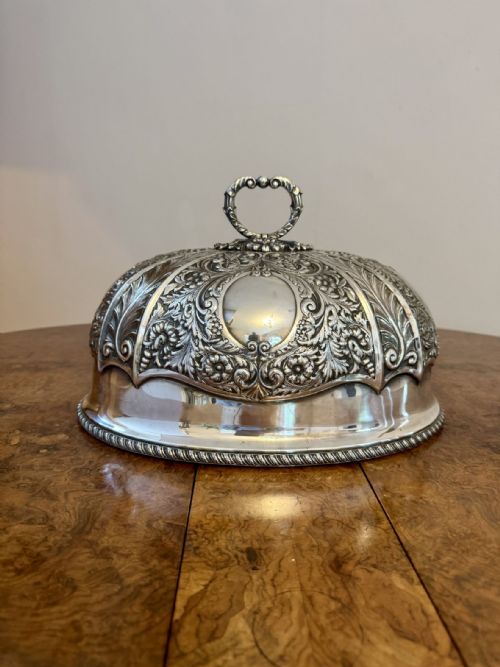
A silver platter dome cover brings grand dining table architecture straight to the sideboard, keeping joints and roasts properly warm before carving.

Silver Platter Dome Cover
When you search for a silver platter dome cover, you are looking at substantial serveware designed to cover meat joints, game, and dishes on the dining table. These pieces take the form of meat domes, meat covers, dish covers, and game covers originating from various historical eras.
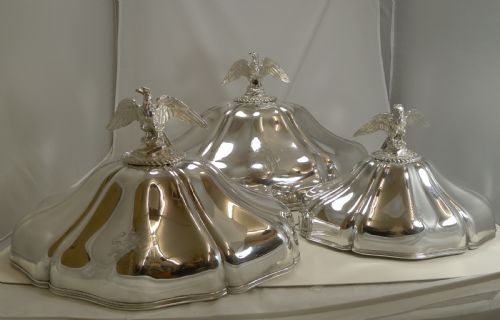
The versions you are most likely to meet on this page span the Georgian, Victorian, and Edwardian periods, with styles ranging from Regency and William IV to French Restoration. They appear in forms varying from single small domes to matched graduated sets intended to cover multiple platters.
Makers and workshops from these eras produced covers using Old Sheffield Plate, silver plate, EPNS, and solid silver over base metal or copper cores. Such pieces reflect the dining customs of the nineteenth century when warm food required heavy protective covers between the kitchen and the dining room.
Materials and construction
Makers constructed these items using Old Sheffield Plate, traditional silver plating, and solid silver, frequently building upon a base metal or copper foundation. The fusion process in Old Sheffield Plate involves a thin sheet of silver applied to a copper core, often revealing subtle copper bleed through the surface over time.
Techniques relied on heavy hammering, rolling, and soldering to shape large domes and attach cast handles, finials, or heraldic crests. Workshops such as those of Roberts Cadman, Henry Wilkinson, Matthew Boulton, and Durand in Paris employed skilled metalworkers to form these substantial covers.
One notable dome carries the weight of a Duke's household, linking a simple dinner table cover directly to the Duke of Somerset.
Assessing quality and craftsmanship
Quality in these pieces rests on the weight of the metal, the crispness of applied cast handles or crests, and the integrity of the plating. Superior examples maintain thick silver layers over the copper or base metal, showing minimal wear through to the underlying material.
The presence of distinguished maker marks, engraved armorials, or original graduated sets elevates the status of a dome. Finer items exhibit balanced proportions and robust construction designed to withstand heavy daily use in grand households.
Roberts Cadman·Henry Wilkinson·Durand
The Silver Platter Dome Cover Glossary
- Old Sheffield Plate
- A composite material made by fusing a thin layer of silver to a copper base, utilised extensively before the invention of electroplating. Pieces from this method often show faint traces of copper along high points and edges.
- Meat Dome
- A large, domed cover designed to fit over a meat platter on the dining table to retain heat. These items are also referred to as meat covers, game covers, or dish covers.
- EPNS
- Electroplated Nickel Silver, a common base metal alloy coated with a layer of silver through an electrolytic process. This technique became widespread during the Victorian era for utilitarian and decorative serveware.
- Graduated Set
- A collection of multiple domes in descending sizes designed to nest together or cover platters of varying dimensions. Such sets were produced for large dining establishments and wealthy households.
- French Restoration
- A stylistic period spanning the early nineteenth century characterised by refined neoclassical influence and decorative restraint. Pieces from this aesthetic often feature clean lines alongside restrained ornamentation.
Silver Platter Dome Cover: Frequently Asked Questions
What is a silver platter dome cover used for?
These large covers were placed over meat platters, roasts, and game dishes on the dining table to keep food warm during lengthy meals.
They also served to present the food dramatically when lifted by the butler or host just before carving.
How do I identify OldSheffield Plate?
Old Sheffield Plate is distinguished by a fused layer of silver over a copper core rather than an electroplated coating.
Closer inspection often reveals faint traces of the reddish copper showing through where the silver layer has worn thin over decades of polishing.
Can I use these domes on the table today?
These pieces function well for modern dinner parties as serving accessories or decorative centrepieces on sideboards.
They require gentle cleaning with appropriate silver care products to preserve the historic plating and finish.
What periods do these covers come from?
The available pieces predominantly date from the nineteenth century, including Georgian, Regency, William IV, Victorian, and Edwardian eras.
Earlier items tend to use Old Sheffield Plate, while later nineteenth-century examples often employ standard silver plating or EPNS.