




Silver Plate Tea Urn
A silver plate tea urn brings grand hospitality to the table, offering a stately centrepiece designed for serving hot water.
Silver Plate Tea Urn
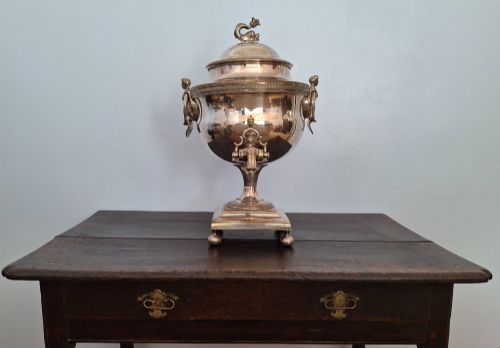
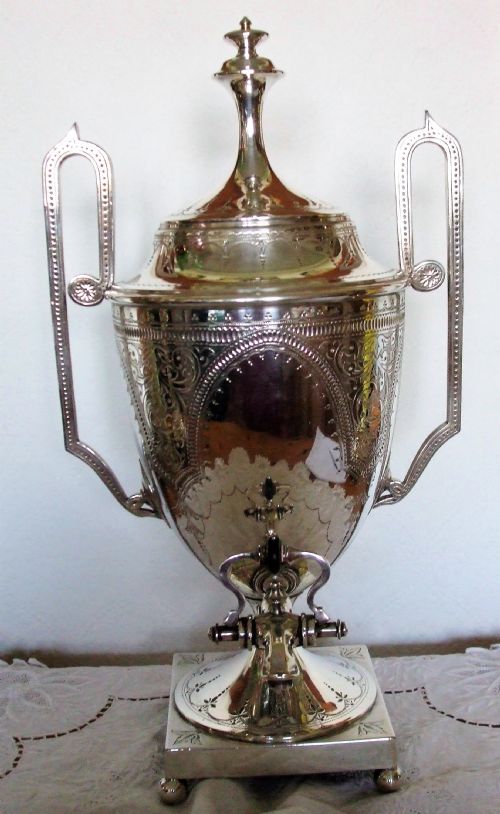
A silver plate tea urn serves as a commanding vessel for hot water, frequently designed as a traditional samovar featuring a tap at the base. These pieces span several eras, with Edwardian and Victorian examples appearing frequently alongside Georgian and Regency designs.
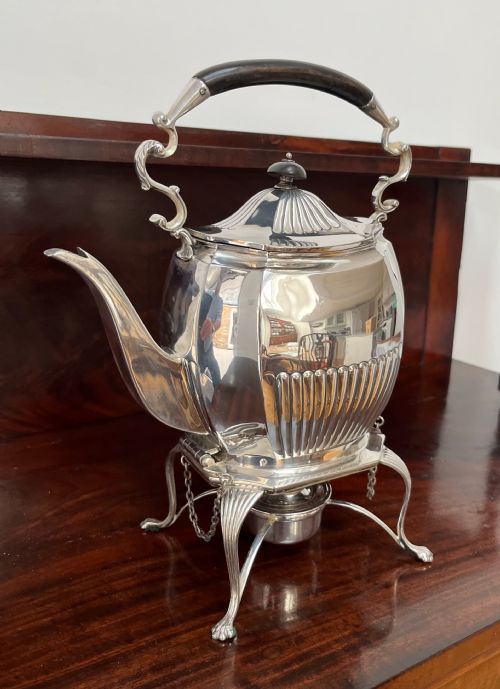
Buyers also encounter spirit kettles on stands with burners, grouped closely with tea urns and samovars under the broader heading of teaware. The forms range from classical vase shapes to detailed Adams style pieces originating from English, French, and German makers.
Originating for formal domestic hospitality, these vessels combine metal bodywork with practical taps and burner components. The selection draws on periods stretching from the early nineteenth century through to the Edwardian era and the 1930s.
Materials and construction
Makers utilised silver plate, nickel silver, and EPNS over base metal foundations, applying traditional plating techniques to achieve a bright metallic finish. Sheffield silver plating appears regularly across the records.
Handles and finials incorporate contrasting materials such as ebony, ebonised wood, bone, and plain wood to manage heat transfer. These organic touches sit alongside metal stands, spirit burners, and spigots.
Listings feature periods spanning from the Georgian era through Victorian, Edwardian, and into the 1930s.
Assessing quality in silver plate tea urns
Quality rests upon the crispness of the chased or neoclassical ornament and the structural integrity of the stands and burners. Maker attribution also plays a role, with established firms commanding attention.
The durability of the silver plating over the underlying metal and the retention of original fittings, such as bone insulators and wooden handles, dictate the standing of an individual piece.
Walker & Hall·Risler and Carré Paris·Fenton Brothers·Frederik Ellis Tim & Co·Hutton & Sons·John Round & Sons·Willis & Sons·Henry Bourne·WMF
The Silver Plate Tea Urn Glossary
- Samovar
- A heated metal urn traditionally used to boil and heat water for tea. These vessels typically include an internal heating tube or a tap.
- Spirit Kettle
- A small kettle mounted on a metal stand above a spirit burner. They provide a portable method for keeping water hot at the table.
- EPNS
- Electroplated Nickel Silver, a common base material used for silver plated items from the nineteenth century onward. It provides a durable foundation for the silver layer.
- Old Sheffield Plate
- An early method of fusing a thin sheet of silver to a thicker copper base before rolling. This technique produces a distinctive material seen on early nineteenth century pieces.
Silver Plate Tea Urn: Frequently Asked Questions
What is a silver plate tea urn used for?
These vessels were designed to hold and dispense hot water for tea service in large drawing rooms or dining spaces. The built-in tap allowed hosts to fill teapots efficiently without leaving the table.
They functioned both as practical kitchenware and as grand decorative objects that signalled hospitality and status during formal gatherings.
How do I tell a Georgian tea urn from an Edwardian one?
Georgian and Regency examples tend to lean heavily into neoclassical motifs, featuring urn shapes, delicate handles, and pedestal bases derived from ancient architecture. Edwardian pieces often revive these earlier styles while incorporating sturdier stands and alternative manufacturing methods.
Looking closely at the mounting style, feet, and overall proportions usually reveals the stylistic vocabulary of the specific period.
Are spirit kettles the same as tea urns?
Spirit kettles are smaller vessels suspended on a metal frame above an integrated burner, allowing the water to be kept boiling directly in the room. Tea urns are generally larger, static vessels equipped with a spigot at the front.
Both categories fall under nineteenth and early twentieth century teaware but serve slightly different scales of hospitality.
How should I clean a silver plated tea urn?
Cleaning requires a soft cloth and a gentle silver polish formulated specifically for plated items to avoid wearing through the thin silver layer. Harsh abrasives must be avoided entirely.
Regular dusting and minimal polishing preserve the underlying finish and maintain the subtle patina accumulated over the decades.