

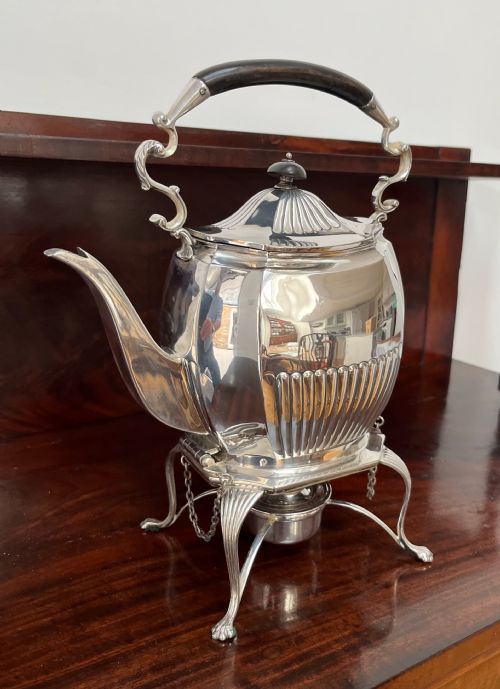


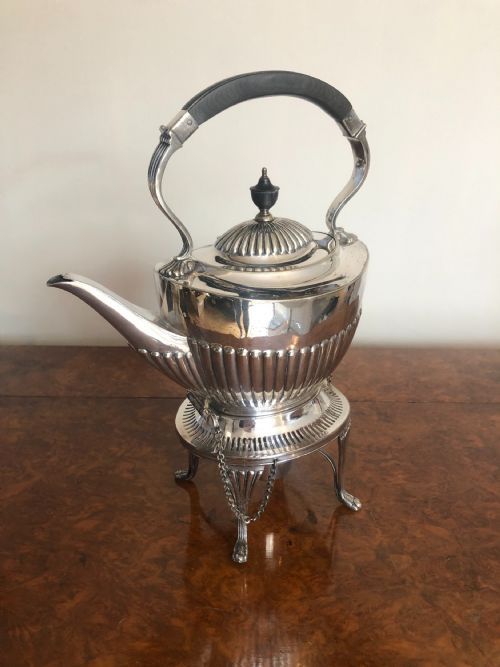
Silver Plate Spirit Kettle
A silver plate spirit kettle brings hospitality to the table, offering hot water kept warm by a small burner on a dedicated stand.
Silver Plate Spirit Kettle
A silver plate spirit kettle is a traditional teaware piece designed to sit on a matching stand above a spirit burner. These items appear primarily in Edwardian and Victorian styles, alongside Georgian Revival and Art Deco examples.
The form usually includes a kettle body, a supporting frame, and a burner for heating water at the table. Variants range from standard tea kettles and urns to cauldron and octagonal shapes.
Edwardian and late nineteenth-century examples dominate the selection, often featuring engraved decoration such as ferns or garlands. Makers combined functional teaware with decorative metalwork to create centrepieces for domestic tea service.
Materials and construction methods
Makers utilised silver plate over base metals, frequently marked as EPNS, combined with insulating handles and knobs made from ebony, ebonised wood, bone, or wood. These non-conductive materials protected hands from heat while water boiled.
Metal fabrication involved shaping the kettle body and stand, often incorporating engraved or chased surface details like Chinoiserie patterns or floral motifs. Stands were built to securely hold both the vessel and the lit spirit burner beneath.
Distinguishing quality in period pieces
Quality relies on the depth and crispness of surface decoration, such as hand-engraved fern leaves or geometric aesthetic movement motifs. Heavier gauge metal and balanced stands indicate superior manufacturing standards.
The integration of insulated handles using materials like bone or ebony demonstrates attention to detail. Established makers often added distinctive crests, shaped legs, or unusual octagonal forms that elevate the piece.
Fenton Brothers·Frederik Ellis Tim and Co·Walker and Hall·Mappin and Webb·Elkington and Co·Deakin and Sons·WMF·Thomas Prime·Goodfellow and Son·Benetfink
The Silver Plate Spirit Kettle Glossary
- EPNS
- Electroplated Nickel Silver. This designates a base metal core coated with a thin layer of silver through an electrical process.
- Spirit burner
- A small container beneath the kettle holding liquid fuel to heat water. It sits within the metal stand.
- Samovar
- A large heated urn used for boiling water. Certain larger tea vessels share this form.
- Aesthetic movement
- A late nineteenth-century design style focusing on artistic visual qualities. Pieces often feature stylised natural motifs.
Silver Plate Spirit Kettle: Frequently Asked Questions
How do you use a spirit kettle?
Fill the kettle with water and place it securely on the metal stand above the unlit burner. Fill the small burner with appropriate spirit fuel, light it carefully, and allow the flame to heat the water at the tea table.
Extinguish the flame using its cover once the water reaches the desired temperature. The stand keeps the hot vessel elevated safely away from table surfaces during tea service.
How do I identify an Edwardian spirit kettle?
Edwardian examples typically date from around 1900 to 1910, showing lighter proportions and refined Edwardian or Georgian Revival styling. Look for hallmarks or maker marks associated with this early twentieth-century period.
Compare the engraved details and stand construction with Victorian pieces, which often display heavier naturalistic or aesthetic movement ornamentation.
What materials are used in the handles?
Handles incorporate insulating materials to prevent heat transfer from boiling water to the user's hand. Common materials include ebony, ebonised wood, bone, and standard wood.
These inserts are fitted into metal mounts on the kettle handle loops, preserving both comfort and period authenticity.
How should I clean silver plate teaware?
Clean silver plate gently using a dedicated silver cloth or mild cleaning product formulated for plated items. Avoid harsh abrasives that might wear away the thin silver layer over the base metal.
Dry thoroughly after cleaning to maintain the shine of the metal and protect any wooden or bone insulating components on the handle.