
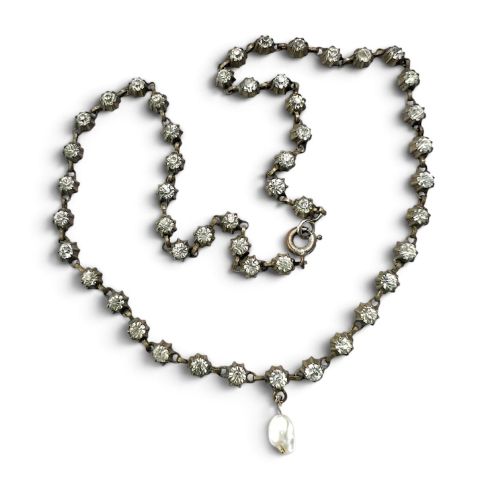
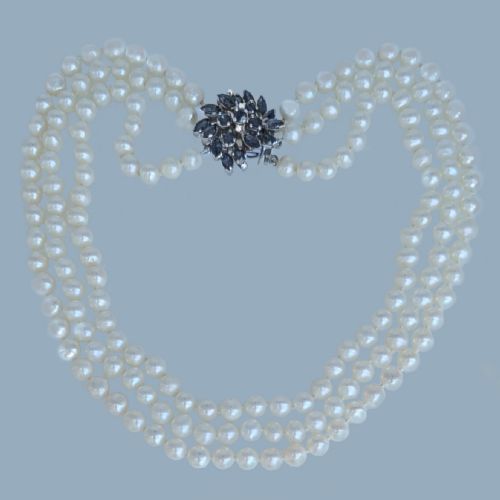
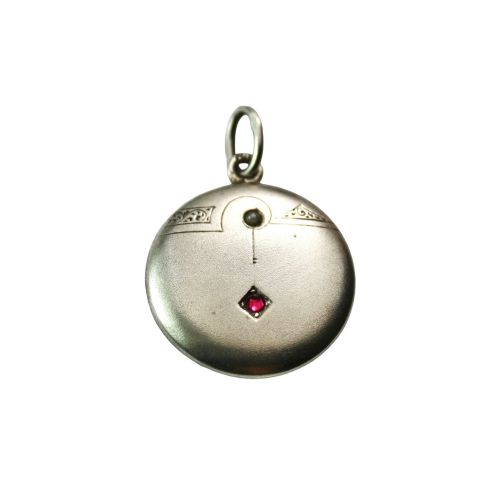


Silver Pearl Necklace
A silver pearl necklace brings together lustrous organic pearls and gleaming metalwork in designs spanning the Victorian era through to the mid-twentieth century.
Silver Pearl Necklace
A silver pearl necklace encompasses everything from delicate drop pendants on slender chains to dramatic multi-strand pearl arrangements secured by ornate clasps. When searching for a silver pearl necklace, buyers encounter diverse expressions of historic design, notably the organic motifs of Art Nouveau and the geometric discipline of Art Deco.
The pieces appearing most frequently range from Victorian paste and pearl configurations to early twentieth-century Arts and Crafts pendants and mid-century cultured pearl strands. These items often incorporate supplementary gemstones such as amethyst, turquoise, moonstone, and garnet alongside the central pearls.
Originating across Britain, Europe, and Austro-Hungary, these necklaces reflect the prevailing aesthetic movements of their respective decades. Surviving examples demonstrate how skilled makers combined silver settings with both natural saltwater specimens and early cultured pearls.
Distinctions in Quality
The distinction between standard commercial output and superior craftsmanship lies in the complexity of the metalwork and the integrity of the enamel and gem setting. Pieces bearing documented attributions to notable design workshops typically display superior chiselling, more balanced proportions, and more inventive stone combinations.
Material selection significantly dictates overall standard, with natural pearls and unblemished plique-à-jour enamel commanding greater regard than simulated stones and basic stamped metal mounts. The survival of original clasps, boxes, and matching chain lengths also contributes to the desirability of individual pieces.
Listings feature periods spanning the nineteenth century, Victorian era, Edwardian years, Art Nouveau, Arts and Crafts, Art Deco, and mid-century modern design.
Archibald Knox·Liberty and Co·Murrle Bennett·Theodor Fahrner·Heinrich Levinger·Levinger and Bissinger·Mikimoto·Knoll and Pregizer·Wilhelm Fuhner·Eduard Loss·George Hunt·Otto Prutscher·Artificers Guild·Meyle and Meyer
The Silver Pearl Necklace Glossary
- Plique-à-jour
- An enamelling technique where enamel is applied within a open wire frame without a backing, allowing light to shine through the transparent colours.
- Silver Gilt
- Silver that has been coated with a thin layer of gold, providing a warm tone often utilised in Arts and Crafts and Austro-Hungarian pieces.
- Blister Pearl
- A pearl that has grown attached to the inside shell of an oyster, resulting in a domed shape with a flat back often used in pendant designs.
- Paste
- Hand-cut and polished lead glass used historically as an alternative to precious gemstones, valued for its clarity and colourful scintillation.
- Filigree
- Ornamental work consisting of fine wire, usually of silver or gold, soldered together in intricate openwork patterns.
Silver Pearl Necklace: Frequently Asked Questions
How do I date a silver pearl necklace?
Dating relies upon stylistic markers such as the flowing organic lines typical of Art Nouveau versus the strict symmetry of Art Deco. Material choices and construction methods, including box clasps and wire configurations, further help place a piece within periods like the Edwardian era or the nineteen-fifties.
Examining the pearls themselves can also offer clues, as natural saltwater pearls predominate in earlier nineteenth-century items while cultured varieties become standard after the early decades of the twentieth century. Hallmarks and maker marks stamped onto the silver elements provide definitive chronological anchors.
What is the difference between natural and cultured pearls?
Natural pearls form entirely without human intervention when an irritant enters an oyster in the wild, resulting in solid nacre growth. Cultured pearls involve a human-inserted nucleus that encourages the mollusc to coat it in layers of nacre over time.
In historic jewellery, natural pearls are typical of antique Victorian and early Edwardian pieces, whereas cultured pearls appear with increasing frequency from the nineteen-twenties onwards. Both types exhibit distinct internal structures visible under magnification.
How should I care for antique silver and pearls?
Pearls are organic gems that require gentle handling because household chemicals, perfumes, and cosmetics can damage their delicate nacre surface. Wiping them with a soft, damp cloth after wearing helps maintain their natural lustre without causing abrasion.
Silver settings should be cleaned sparingly using non-abrasive cloths formulated for precious metals, avoiding liquid dips that might seep behind pearls or degrade enamel work. Storing each necklace flat in a lined box prevents the chains from tangling and protects the pearls from scratching against other items.