
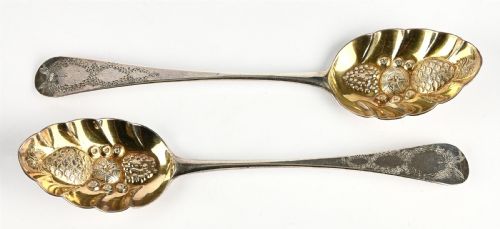


Silver Fruit Serving Spoons
Silver fruit serving spoons are grand utensils for the dessert table, prized for their decorative bowls and chased fruit motifs.
Silver Fruit Serving Spoons
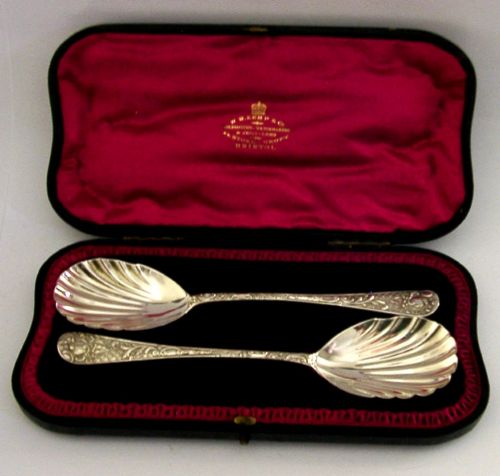
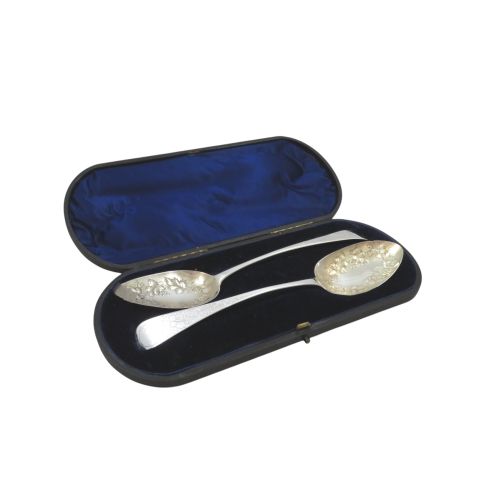
Silver fruit serving spoons are designed for dishing dessert, featuring wide bowls suited to soft fruits and berries. When exploring silver fruit serving spoons on this page, buyers frequently encounter pairs housed in fitted presentation boxes lined with velvet, silk, or satin. These items emerge from Georgian, Victorian, and Edwardian periods, often taking the form of berry spoons or naturalistic leaf designs.
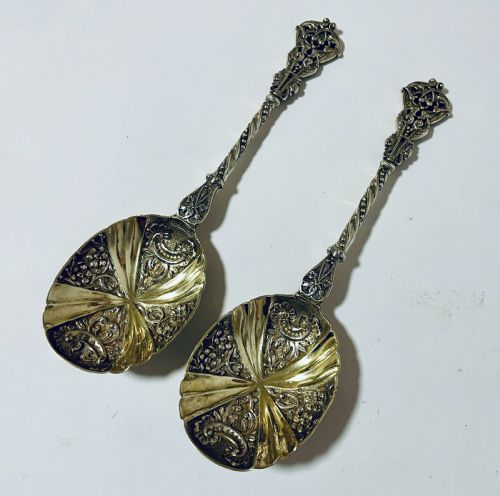
The selection spans individual items and matched pairs, alongside larger sets that include nutcrackers and grape scissors. Many pieces originate from the eighteenth and nineteenth centuries, displaying regional English, Irish, and continental styles such as Flemish Baroque and Art Nouveau. Bowls frequently show pierced decoration, repoussé fruit work, or shell shapes.
Makers and silversmiths adapted these utensils for parlour use, pairing solid sterling silver and silver gilt with fitted cases for storage. The inventory captures both functional single items and elaborate cased sets intended for formal dining tables. Collectors meet everything from George III examples to early twentieth century pieces.
Quality factors
The standard of a piece rests upon the crispness of the hand-chased fruit and foliage ornament across the bowl. Finer examples retain deep, sharp relief work without softening from excessive polishing over the decades. The complexity of the piercing and the presence of fully struck hallmarks further distinguish superior items.
The inclusion of the original fitted case with intact silk or velvet lining elevates a set, particularly when accompanied by matching accessories like grape scissors or nutcrackers. Solid sterling silver and silver-gilt variants generally hold greater distinction than silver plate equivalents. The weight of the metal and the balance of the handle contribute to the overall execution.
Some Victorian spoons arrived at the dining table dressed as autumn leaves, complete with gilded stalks.
peter & Anne Bateman·William Chawner II·Sebastian Crespell·Hukin & Heath·Whiting Co.
The Silver Fruit Serving Spoons Glossary
- Berry spoon
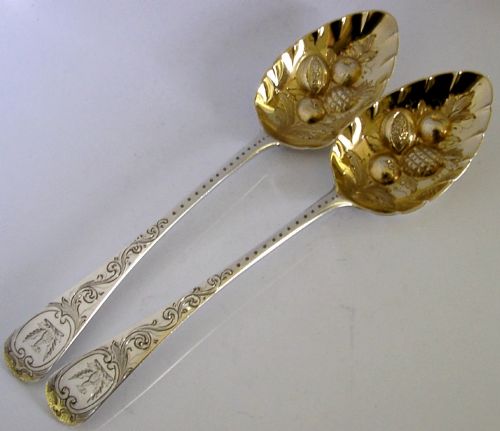
- A large serving spoon, often Georgian, retrofitted or originally chased with fruit and berry motifs in the bowl. These pieces were frequently kept in velvet-lined boxes.
- Silver-gilt
- Sterling silver that has been coated with a thin layer of gold, providing a rich yellow lustre. This treatment was common on dessert and fruit flatware.
- Repoussé
- A metalworking technique where the design is hammered into relief from the reverse side. It creates the raised fruit clusters seen on many Victorian serving spoons.
- Hallmark
- An official stamp struck into precious metals to indicate the standard of silver, the assay office, and the date letter. English pieces commonly feature these marks on the reverse of the stem.
- Piercing
- The art of cutting openwork designs through the metal of the spoon bowl. This technique was utilised to create decorative lattice or scrolling patterns.
Silver Fruit Serving Spoons: Frequently Asked Questions
What is a berry spoon?
A berry spoon is a large serving implement featuring a broad bowl decorated with embossed or chased fruit designs. They were principally used for serving soft fruits at the end of a meal.
Many Georgian examples were later embellished with fruit motifs during the Victorian era. They often appear in matched pairs inside fitted presentation cases.
How do I clean antique silver spoons?
Cleaning requires a soft microfibre cloth and a mild, non-abrasive silver polish formulated for antiques. Avoid aggressive rubbing that might wear down chased details or remove gilt layers.
Store them in their original velvet or silk-lined boxes when not in use to minimise tarnishing. Regular, gentle dusting preserves the natural patina accumulated over centuries.
Were these spoons used for dining?
These utensils served a specific role in formal dining during the dessert course. They allowed hosts to transfer fruits, berries, and sweetmeats from a central dish to individual plates.
Their substantial size and decorative bowls set them apart from standard eating spoons. They remained a staple of middle and upper class dining tables through the Georgian and Victorian periods.
How can I date my silver spoon?
Dating relies heavily upon the hallmarks struck into the metal, which include maker's marks, city assay marks, and date letters. Comparing the style of engraving and handle shape provides additional clues.
Georgian pieces often display bright-cut engraving, while Victorian examples tend towards naturalistic fruit and leaf motifs. Consulting specialist silver reference books helps decipher specific date ciphers.