


Silver Enamel Clock
A silver enamel clock brings miniature precision and bright colour together, catching the light on a desk or dressing table.
Silver Enamel Clock
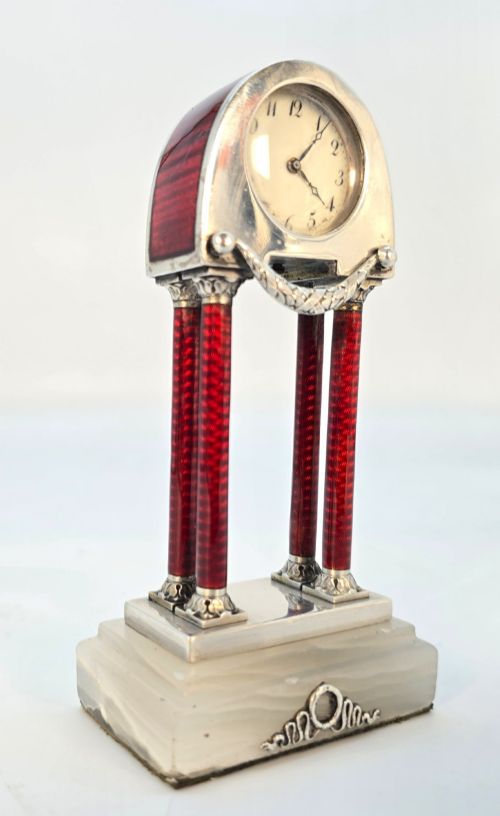
A silver enamel clock takes many forms across the evidence, appearing as miniature carriage clocks, desk clocks, pocket watches, and travel timepieces. These pieces date from the nineteenth century through the Edwardian period, the First World War, and into the Art Deco era.
The most likely version to meet here is a small carriage clock or desk timepiece cased in silver and detailed with coloured enamel work. Origins span England, France, Austria, and Hungary, showing varied regional tastes in portable timekeeping.
How a silver enamel clock was made
Silver, sterling silver, and silver gilt form the structural cases for these timepieces, often paired with glass panels to reveal the movement. Makers integrated enamel, sometimes in guilloche patterns, directly onto the silver casing or dial.
Movements rely on steel, brass, and nickel components, occasionally housed in pewter or gilt metal frames. Artisans combined metalwork and vitreous enamelling techniques to create portable clocks for desks, travel, and pockets.
Military pilots checked time in flight using cockpit watches issued to the Royal Flying Corps during the First World War.
What varies in quality
The sophistication of the enamel work dictates the distinction between standard production and finer pieces. Complex guilloche patterns or hand-painted floral motifs require higher skill than plain coloured surfaces.
The weight and finish of the silver case, alongside the complexity of the movement such as an eight-day reserve or date work, separate basic travel timepieces from luxury boudoir models.
Georg Adam Scheid·David Veasey·Liberty and Co·Archibald Knox·Henry Matthews·Elliott Brothers
The Silver Enamel Clock Glossary
- Guilloche
- An ornamental pattern engraved into metal beneath translucent enamel. This technique adds depth and light reflection to the clock face or case.
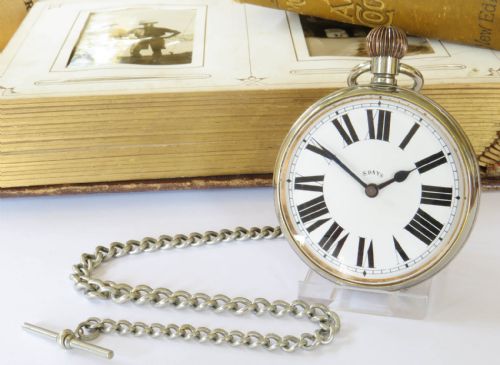
- Goliath pocket watch
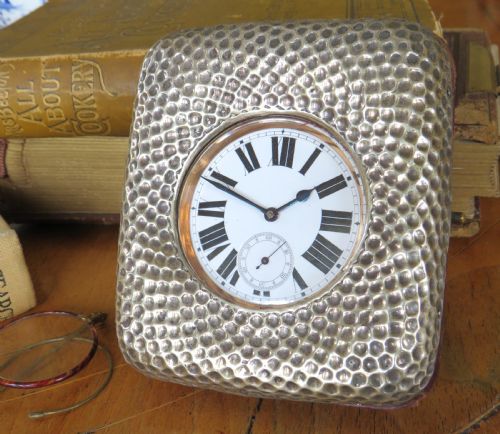
- An oversized pocket watch frequently mounted in a fitted travel case or stand to function as a desk clock.
- Carriage clock
- A small, portable spring-driven timepiece with a carrying handle, originally designed for travel in horse-drawn carriages.
- Vermeil
- Sterling silver plated with a thin layer of gold. This treatment provides a rich golden appearance while retaining a silver base.
Silver Enamel Clock: Frequently Asked Questions
How do I wind a silver enamel carriage clock?
Most miniature carriage clocks and travel timepieces utilise a small key inserted into the back plate to tension the mainspring.
Take care not to overwind the movement, turning the key gently until resistance signals the spring is fully set.
Were these clocks meant for travel?
Many examples in the evidence served as travel clocks or pocket watches housed in protective leather or metal cases.
Their compact size allowed wealthy owners to carry timepieces securely during journeys by carriage or early motor car.
How do I tell an Edwardian clock from an Art Deco one?
Edwardian and nineteenth-century pieces tend to feature floral enamel, ornate chasing, and traditional carriage clock shapes.
Art Deco clocks from the nineteen-twenties and thirties favour geometric lines, bold blue enamel, and streamlined desk forms.
What is a goliath watch?
A goliath is a substantially larger version of the standard pocket watch, measuring well beyond usual pocket dimensions.
These large watches were fitted into velvet-lined travel cases or metal stands to sit upright on a desk.