
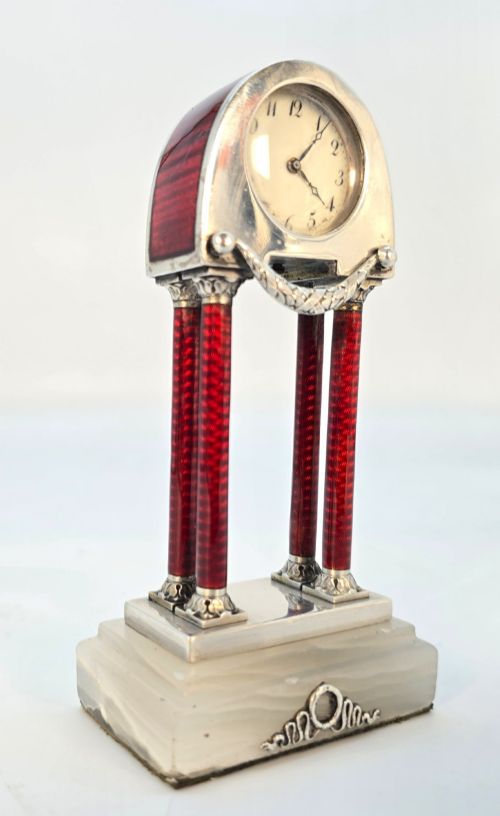


Miniature Silver Carriage Clock
A miniature silver carriage clock brings portable timekeeping into domestic spaces with precious metal and glass.
Miniature Silver Carriage Clock
A miniature silver carriage clock is a compact portable timekeeper designed for desks, bedside tables or travel, reflecting the functional elegance of the 19th century and early 20th century. When exploring this selection, buyers encounter pieces spanning the Victorian, Edwardian, Art Nouveau, Arts and Crafts and Art Deco periods, originating from English, French, Swiss and Viennese workshops.
Most examples adopt straightforward rectangular or portico silhouettes housed in silver or sterling silver cases, sometimes accompanied by original leather or shagreen travel boxes. Forms range from plain polished metal to decorated surfaces, offering a clear view of the dial through glass panels.
Materials and construction
Cases are formed from silver and sterling silver, sometimes finished with silver gilt or detailed with chased, repoussé and hammered textures. Many examples incorporate decorative elements such as blue guilloché enamel, floral enamelling, glass panels, tortoiseshell, onyx or leather.
Movements are fitted into these precious metal shells to provide reliable portable timekeeping. Makers applied specific stylistic touches associated with periods like Art Nouveau and Edwardian design to the metalwork.
Listings feature silver, sterling silver, enamel, glass, leather, onyx, tortoiseshell and brass across Victorian, Edwardian and Art Deco styles.
Assessing quality and finish
Quality rests in the crispness of the silver work, whether chased, repoussé or hammered by hand, and the preservation of delicate enamel panels. Finer examples display precise detailing in the metal case and clean integration of glass viewing panels.
The presence of original fitted cases, such as leather boxes or shagreen travel holders, adds to the completeness of a piece. Restoration of the movement also distinguishes working examples from those requiring attention.
Georg Adam Scheid·J Batson and Son·Henry Matthews·William Comyns
The Miniature Silver Carriage Clock Glossary
- Guilloché enamel
- A decorative technique where intricate geometric patterns are engraved beneath translucent enamel. This finish catches the light across dial surrounds and case backs.
- Repoussé
- A method of shaping metal by hammering from the reverse side to form raised relief designs. It appears on ornate silver carriage clock cases from the late 19th century.
- Portico
- An architectural clock case design featuring supporting pillars or columns framing the dial. Viennese makers utilised this classical form for miniature desk clocks.
- Shagreen
- Prepared sharkskin or rayskin with a granular surface used to cover protective travel cases. English makers applied this luxury material to house portable timepieces safely.
- Sterling silver
- An alloy consisting of silver and other metals to increase durability while maintaining purity. Most English hallmarked carriage clocks are cast in this standard.
Miniature Silver Carriage Clock: Frequently Asked Questions
How do I wind a miniature carriage clock?
Most portable timepieces use a small key attached to the rear mechanism to tension the mainspring.
Care should be taken not to overwind the movement to protect the internal components.
Were these clocks meant for travel?
These compact timepieces were designed for bedchambers, boudoirs and journeys.
Many survive alongside original leather or shagreen travel boxes intended for protection on the move.
How do I date an Edwardian silver clock?
English examples often bear hallmarks indicating the assay office and year of manufacture.
Stylistic cues such as floral enamel and softer lines also point to the Edwardian era.
What is the difference between a carriage clock and a timepiece?
Traditional carriage clocks often include striking or alarm complications alongside the movement.
Timepieces are designed solely to show the hours and minutes without additional striking trains.