


Silver Book Marker
A silver book marker slips between fragile pages, offering a tactile method of holding a place that outlives paper.
The Form and Character of a Silver Book Marker
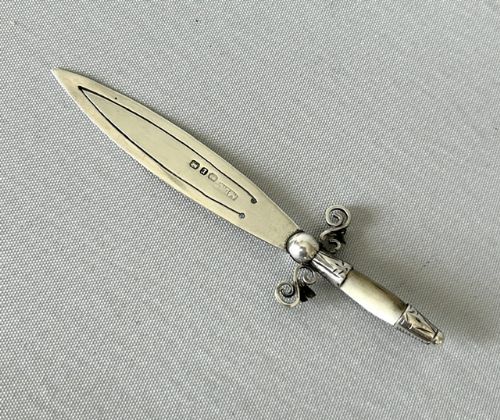
Every silver book marker found here is forged from sterling silver, spanning periods from the late Victorian era through the Edwardian years and into the twentieth century. These objects function as page markers, taking both straightforward utility shapes and elaborate figural or novelty designs.
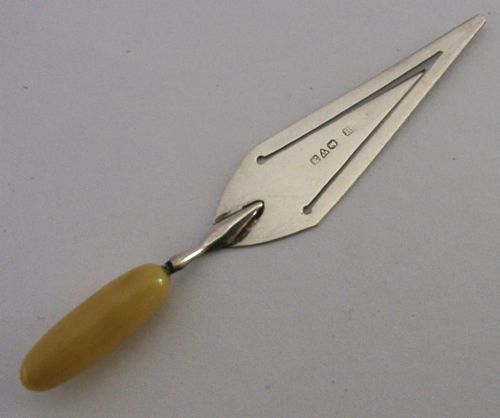
Trowel forms dominate the historical record, frequently fitted with stone handles, while figural subjects introduce animals, hands, and characters. Pieces range from plain engraved surfaces to highly specific commemorative commissions and detailed miniature sculptures.
The objects stem predominantly from British silversmithing traditions, with dates clustering tightly around the turn of the twentieth century. Collectors encounter everything from austere geometric blade forms to whimsical novelty creations designed to amuse the reader.
Materials and Construction Techniques
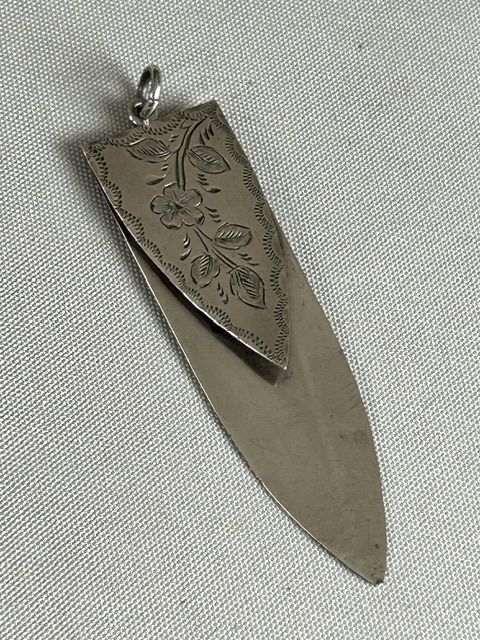
Silversmiths utilised solid sterling silver for the blades and structural components of each silver book marker, ensuring sufficient durability for repeated use within heavy bindings. Surfaces receive hand engraving, chasing, or enamelling to build decorative contrast across the metal.
Many examples incorporate decorative stones set directly into the handle or terminal, including Scottish agate, Connemara marble, carnelian, and green jade. These natural minerals undergo shaping and polishing before being pinned or mounted to the metal shafts.
Readers in nineteen-thirty could mark their place with a tiny silver Kewpie doll peering out from the pages.
Distinctions in Execution and Design
Quality rests upon the crispness of the casting and the depth of the hand engraving across the silver surface. Simple stamped blades sit at one end of the spectrum, while finely articulated animal figures and detailed miniature trowels represent the upper tier of craftsmanship.
The inclusion and selection of decorative hardstones significantly elevate a piece, particularly when fitted with banded agates or translucent jade. Maker attribution and legible hallmarks provide additional distinction, separating standard production items from workshop-specific commissions.
Charles Horner·Sampson Mordan
The Silver Book Marker Glossary
- Sterling silver
- A standard alloy consisting of ninety-two point five percent silver and seven point five percent other metals, chosen for durability. This composition appears across every marked piece in the inventory.
- Hallmark
- An official stamp applied to precious metals indicating the standard of purity, the assay office, and the date of manufacture. These small marks allow precise dating of the silver book marker.
- Trowel bookmark
- A page marker shaped precisely like a miniature garden trowel, often featuring a decorative stone handle. This specific silhouette is among the most recurrent forms in the archive.
- Novelty bookmark
- A piece designed to represent an animal, human figure, or recognisable object rather than a standard geometric blade. Examples include camels, elephants, pointing hands, and Kewpie dolls.
- Hardstone
- A semi-precious gemstone cut and polished for decorative use in jewellery and small objects. Agate, carnelian, and jade serve this function on Victorian and Edwardian markers.
Frequently Asked Questions
How do I use a silver book marker?
Slide the flat blade gently between the pages where reading pauses, allowing the decorative terminal or handle to rest on top of the book. The thin profile prevents distortion of the paper binding.
Ensure the book closes naturally without placing undue pressure on protruding stones or delicate figural elements attached to the handle.
When were these bookmarks made?
The available pieces and historical records date primarily from the late Victorian period through the Edwardian era and into the nineteen-thirties. The peak years of production cluster around eighteen-ninety to nineteen-ten.
Earlier nineteenth-century examples exist, but turn-of-the-century novelty and hardstone designs represent the majority of surviving pieces.
What materials are used besides silver?
Makers frequently combined sterling silver with natural decorative stones such as Scottish agate, Connemara marble, carnelian, and New Zealand jade. Enamel also appears on select twentieth-century examples to add colour.
These additions create contrast against the polished silver blade and provide varied textures for the handle.
How do I clean a silver book marker?
Remove dust and oils using a soft microfibre cloth designed for precious metals. Avoid aggressive dipping solutions that can damage inserted stones or dissolve historic patination.
Store the object away from direct moisture and rubber materials to prevent tarnishing of the silver surface.