
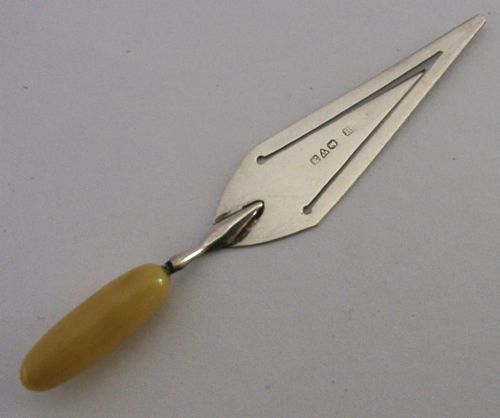


Silver Trowel Bookmark
A silver trowel bookmark is a charming novelty page marker shaped like a miniature gardening tool, highly sought after by collectors of small silver.
What the pieces are
A silver trowel bookmark takes the form of a diminutive garden trowel, designed specifically to slip between the pages of a book. These items emerge primarily from the Victorian, Edwardian, and Art Deco periods, spanning the late nineteenth century into the nineteen-twenties and nineteen-thirties.
The most common examples encountered on this page combine sterling silver blades and handles with decorative natural or synthetic inserts, frequently appearing as novelty presentation pieces originating from silversmiths in Birmingham, Glasgow, and Edinburgh.
How they were made
Silversmiths formed the blades and handles from solid sterling silver, often incorporating hallmarks denoting assay offices such as Birmingham and Glasgow alongside specific manufacturing dates. Many pieces integrate fitted panels of banded agate, mother-of-pearl, red carnelian, New Zealand jade, or casein into the handle or blade.
Makers utilised techniques of cutting, polishing, and mounting hardstones directly into the silver framework, producing miniature tools with functional shapes and decorative stonework.
Retail Price Guide 2026
Typical UK retail prices for silver trowel bookmark, calculated from the Sellingantiques database of over a million retail prices indexed since 2003. This retail price guide relies exclusively on Sellingantiques data; no external sources or auction records are used, so the figures do not describe the wider market.
Someone decided that marking your page in a weighty Victorian novel required the miniature implement of a master gardener.
What varies in quality
Quality rests upon the choice of inserted materials and the distinctness of the silversmith's marks. Pieces featuring neatly fitted banded agate, mother-of-pearl, or jade sit above plain silver versions in visual complexity.
The crispness of the miniature trowel shape and the prominence of named makers like Charles Horner or Crisford & Norris distinguish finer examples from unmarked or generic novelty productions.
Charles Horner·Crisford & Norris·Adie & Lovekin·William Henry Leather·W.H. Collins
The Silver Trowel Bookmark Glossary
- Sterling silver
- A silver alloy containing 92.5 percent silver by mass, forming the primary metal body of these bookmarks. It provides durability and a bright finish for small decorative items.
- Novelty bookmark
- An object designed in a playful or unusual shape, departing from standard flat page markers. Trowel bookmarks represent a specific subcategory of this nineteenth and twentieth-century genre.
- Banded agate
- A form of quartz displaying distinct natural stripes or bands of colour. Silversmiths set these polished stones into handles to create contrast against the polished silver.
- Assay mark
- A stamp or series of stamps applied to precious metals indicating the standard of purity, the maker, and the office of testing. These marks help date the silver trowel bookmark precisely.
Frequently Asked Questions
What is a silver trowel bookmark?
A silver trowel bookmark is a small novelty page marker fashioned to resemble a gardening trowel in miniature. They were produced as decorative reading accessories during the Victorian and Edwardian eras.
These pieces combine solid sterling silver construction with handles or blades inset with materials like agate, mother-of-pearl, or jade.
When were silver trowel bookmarks made?
The pieces available span from the late Victorian period through the Edwardian era and into the nineteen-thirties. Most surviving examples date between eighteen-ninety and nineteen-thirty.
Assay office hallmarks stamped on the silver frequently pinpoint the exact year of manufacture.
How do I identify the maker?
Makers' marks appear as small stamped initials or symbols on the silver blade or handle. Renowned firms such as Charles Horner, Adie & Lovekin, and Crisford & Norris stamped their distinct marks on many surviving pieces.
Matching these punch marks against silversmith records reveals the workshop of origin.
What materials are used besides silver?
While the main body consists of solid sterling silver, makers incorporated decorative natural stones and organic materials. Banded agate, mother-of-pearl, red carnelian, New Zealand jade, and casein appear inset into the handles.
These additions introduced colour and texture to the miniature garden tool design.