

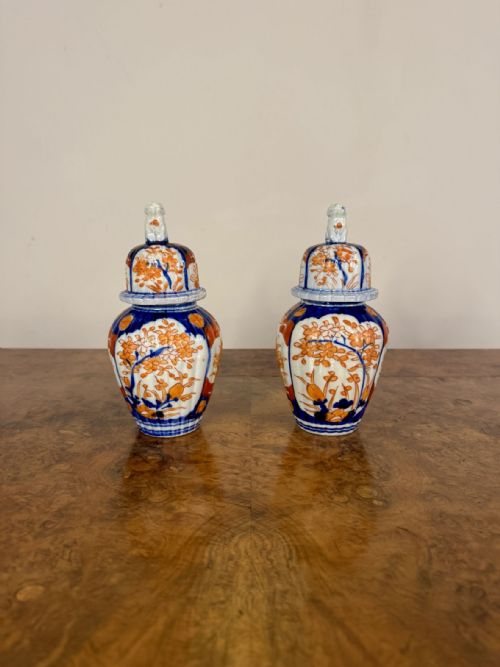


Shishi Finial Vases
These shishi finial vases are striking covered vessels topped with guardian lion sculptures, bringing bold historic ceramic artistry to any interior.
Shishi Finial Vases
When you search for shishi finial vases, you encounter covered vessels, jars and urns defined by their guardian lion sculptures perched upon the lids. These pieces span the eighteenth, nineteenth and early twentieth centuries, reflecting classic Japanese Imari output as well as European interpretation.
The versions you meet most frequently on this page are nineteenth century Japanese Imari lidded vases. They arrive in various scales, from imposing forty-five inch display examples to balanced pairs, frequently shaped in octagonal baluster forms.
How they were made
Potters shaped these ceramics from porcelain, forming robust bodies and intricate lidded structures topped by modelled shishi finials. Artisans then applied underglaze cobalt blue alongside rich enamel colours and gold leaf highlights.
Makers utilised cobalt blue underglaze for foundational depth, layering iron red enamel and gilding across the decorated surfaces. European potteries also produced comparable styles, emulating the traditional Japanese Imari aesthetic.
Shishi Finial Vases Retail Price Guide 2026
Typical asking prices for shishi finial vases among the pieces listed under this phrase on Sellingantiques today, from the lower quarter to the upper quarter. They describe what is for sale here now, not the wider market.
The listings on this site feature porcelain materials decorated with cobalt enamel, iron red enamel and gold leaf across the nineteenth century.
What varies in quality
The distinction between average and exceptional pieces rests upon the precision of the hand-painting and the crispness of the modelled shishi finial. Superior examples display dense, vibrant cobalt enamels and meticulously applied gold leaf that remains sharp and intentional.
Proportion and scale also dictate worth, as large baluster forms and balanced pairs demand greater technical skill from the potter and painter. Furthermore, the complexity of the octagonal geometry and the preservation of the original matching cover elevate the piece.
Samson
The Shishi Finial Vases Glossary
- Shishi
- A mythical guardian lion, often depicted as a stylized dog, positioned atop the lid of these vases to ward off evil spirits.
- Imari
- A traditional Japanese style of porcelain originating from Arita, characterised by a palette of underglaze blue, iron red and gold.
- Baluster
- A vase form with a rounded body that tapers toward the base and swells gracefully before rising to a narrow neck.
- Enamel
- Opaque glass-like material applied over the glazed porcelain surface and fired at a lower temperature to add vibrant secondary colours.
- Underglaze
- Pigment applied directly to the raw clay body before the transparent glaze is applied and the entire vessel is fired.
Shishi Finial Vases: Frequently Asked Questions
How were these vases used historically?
Historically, large covered vases served as grand decorative statements within wealthy homes and state rooms. Their lids kept the interior clean while the imposing scale demonstrated fine taste.
Pairs were frequently placed upon mantelpieces, pedestals or dedicated wooden stands to anchor the symmetry of a room.
How do I style a lidded vase at home?
Position a large baluster vase on a low table, sideboard or sturdy wooden stand to allow its height and detailed painting to stand out. Pairs look particularly striking when flanking a fireplace or anchoring the ends of a long console.
Keep surrounding decor simple so the rich cobalt blue and gold leaf ornamentation remains the primary focus of the space.
How can I tell nineteenth century pieces apart?
Examine the palette, weight and consistency of the porcelain body, noting the depth of the underglaze cobalt blue and the application of iron red enamel. Nineteenth century examples often display rich gilding and hand-painted motifs typical of the Meiji period.
European interpretations, such as those made in the eighteenth century style by other factories, reveal subtle differences in clay density and brushwork technique upon close inspection.