

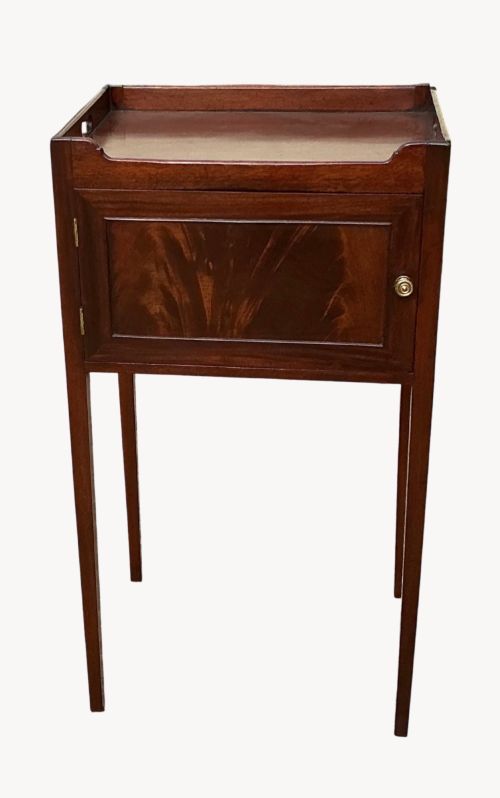


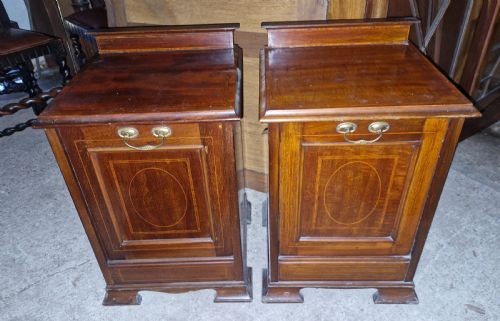


Sheraton Style Nightstands
Sheraton style nightstands bring refined neoclassical elegance to the bedroom, combining delicate inlays with practical bedside storage.

Sheraton Style Nightstands
Sheraton style nightstands encompass bedside cabinets, cupboards, and compact side tables inspired by late eighteenth-century design principles. The selection ranges from authentic period pieces to later revival items produced during the Edwardian era and the early twentieth century.
Buyers most frequently encounter Sheraton Revival pieces alongside Victorian and Edwardian interpretations. These items often feature enclosed cupboards, bowfront profiles, or small drawer configurations suited to period bedroom layouts.
Forms vary from straightforward mahogany bedside chests to elaborate satinwood cabinets decorated with contrasting timber inlays. Origins span the eighteenth, nineteenth, and early twentieth centuries, reflecting enduring appreciation for this light, classical aesthetic.
Materials and Construction
Construction relies heavily on timbers such as mahogany and satinwood, chosen for their grain and warmth. Cabinetmakers applied decorative veneers and solid sections to achieve smooth, flat surfaces ready for ornamentation.
Surface enrichment typically involves marquetry inlay, timber inlay, and contrasting stringing lines in boxwood or ebony. Hand-painted detailing and brass hardware complete the construction, adding precise linear contrast to the primary wood.
Listings feature pieces spanning from the 18th Century through the Edwardian period and into the early 20th Century.
Evaluating Quality
Quality reveals itself in the crispness of the inlay work and the selection of cabinet timbers. Superior examples display precise alignment in boxwood and ebony stringing, with well-figured mahogany or satinwood grain chosen deliberately for the top and door panels.
Structural integrity and proportion distinguish better pieces. Refined proportion, balanced drawer construction, and intact brass handles separate standard production items from finer cabinetmaking.
Gillows
The Sheraton Style Nightstands Glossary
- Sheraton Revival
- A late nineteenth and early twentieth-century design movement that reinterpreted the light, classical furniture forms associated with eighteenth-century designer Thomas Sheraton. This style frequently utilised satinwood and detailed timber inlays.
- Satinwood
- A lustrous, hard timber native to Ceylon and India, prized for its golden-yellow colour and smooth sheen. It served as a primary face veneer on high-status neoclassical furniture.
- Bowfront
- A convex, outwardly curved front profile popular on chests and cabinets from the Georgian period onwards. This shape softens the corners of bedside furniture.
- Marquetry Inlay
- The art of applying small pieces of veneer to a structure to form decorative patterns or pictorial designs. It creates contrasting surface decoration using various coloured woods.
- Stringing
- Thin strips of contrasting wood inlaid into grooves on a cabinet surface to create borders and geometric outlines. This technique defines panel edges and drawer fronts.
Sheraton Style Nightstands: Frequently Asked Questions
What is a Sheraton style nightstand?
These pieces are compact bedside cabinets, cupboards, or small tables designed with neoclassical proportions and classical motifs. They originate from various periods including the Georgian era and later revival movements.
Cabinetmakers built them using mahogany or satinwood, often embellishing the surfaces with contrasting timber inlays and delicate brass hardware.
How do I tell original pieces from revival pieces?
Dating relies on examining construction methods, timber secondary woods, and the wear patterns accumulated over time. Georgian and eighteenth-century pieces display period-specific joinery and hand-cut elements.
Revival pieces from the Edwardian era or the early twentieth century often utilise machine-prepared timbers while successfully copying earlier aesthetic details.
Are these nightstands practical for modern use?
Their compact dimensions make them suitable for contemporary bedrooms requiring modest bedside storage. Cupboard doors and small drawers accommodate nighttime essentials.
Placing them in modern settings introduces warmth through natural timber grains and neoclassical decorative inlays.
What woods are typical for these cabinets?
Mahogany and satinwood form the primary structural and surface materials for this category. Cabinetmakers selected them for their ability to take fine veneers and polished finishes.
Details often incorporate boxwood and ebony inlays, adding linear contrast to the lighter background timbers.