
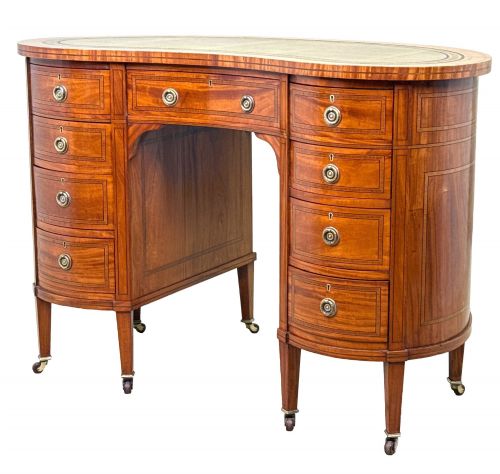
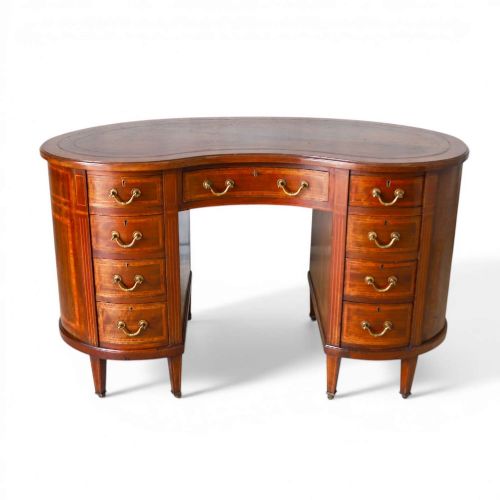


Sheraton Style Kidney Table
These sheraton style kidney table pieces offer curved grace and classic proportions, prized for fitting neatly into a room while providing a useful surface.
Sheraton Style Kidney Table
A sheraton style kidney table brings together the distinctive bean-shaped curved outline inspired by eighteenth-century neoclassical design with later nineteenth and twentieth-century cabinetmaking. Buyers searching this phrase look for writing desks, occasional tables, and writing tables that curve gently to wrap around the user.
The versions met most often on this page date from the Victorian period, late Victorian era, and nineteen hundred, executed in forms ranging from kneehole desks to small occasional pieces. They combine practical surface areas with a slender profile that sits well away from flat walls.
Origins span English workshops of the nineteenth century through to Edwardian and later revival periods. The characteristic shape dictates a compact footprint, making these pieces adaptable for smaller rooms or studies where standard rectangular furniture dominates.
Materials and construction
Construction relies heavily on mahogany and satinwood timbers, frequently enhanced with boxwood inlay and contrasting stringing to accentuate the curved outline. Cabinetmakers shaped the complex kidney curve using solid frames veneered with finely figured woods.
Working surfaces often feature inset leather tops, sometimes tooled with gilt borders, providing a durable writing surface within the curved wooden surround. Details such as brass mounts and brass handles appear across desks and bijouterie tables.
Listings feature satinwood, mahogany, and rosewood timbers, spanning the Victorian era, nineteen hundred, and nineteen thirty.
Judgements of quality
Quality rests in the precision of the curved joinery and the choice of timber figure, particularly where satinwood or mahogany veneers wrap smoothly around the tight radius of the kidney shape. Superior examples display crisp inlay work that follows the perimeter without distortion.
The integration of secondary timbers and the handling of interior drawer construction reveal the workshop standard behind the piece. Finer desks incorporate well-fitted drawers with clean linings and subtle banding that complements the overall proportions.
Gillows
The Sheraton Style Kidney Table Glossary
- Kidney shape
- A curved, bean-like furniture form that narrows in the middle and flares at the ends. This silhouette allows the user to sit closer to the centre of the desk or table.
- Sheraton Revival
- A late nineteenth and early twentieth-century design movement inspired by the neoclassical furniture of Thomas Sheraton. It favours light timbers, slender tapered legs, and delicate inlay.
- Inlay
- A technique where pieces of contrasting wood, such as boxwood, are inserted into recessed cavities on the surface to create decorative patterns. It defines much of the ornamentation on these tables.
- Bijouterie table
- A glass-topped display table designed for small valuables and curiosities. Some variations of the curved form serve this specific exhibition purpose.
Sheraton Style Kidney Table: Frequently Asked Questions
What is a sheraton style kidney table?
It is a curved, bean-shaped table or desk inspired by neoclassical furniture designs. These pieces often feature inlaid veneers and slender legs.
They function as writing desks, occasional tables, or display pieces designed to occupy minimal floor space.
How were these tables used originally?
Many served as writing desks or ladies' vanity and correspondence tables, positioned so the user sat comfortably within the curved recess.
Occasional and bijouterie versions were placed in drawing rooms for display or holding small objects.
How do I date a kidney desk?
Dating relies on timber choice, construction methods, and stylistic cues such as Victorian proportions or Sheraton Revival inlay work. Most pieces date from the nineteenth and early twentieth centuries.
Secondary woods and the style of the brass hardware also help narrow the period.
Where should I place one at home?
Their curved profile allows them to float away from walls or sit comfortably in corners where rectangular furniture looks awkward.
They work well in studies, bedrooms, or living rooms as writing surfaces or accent tables.