
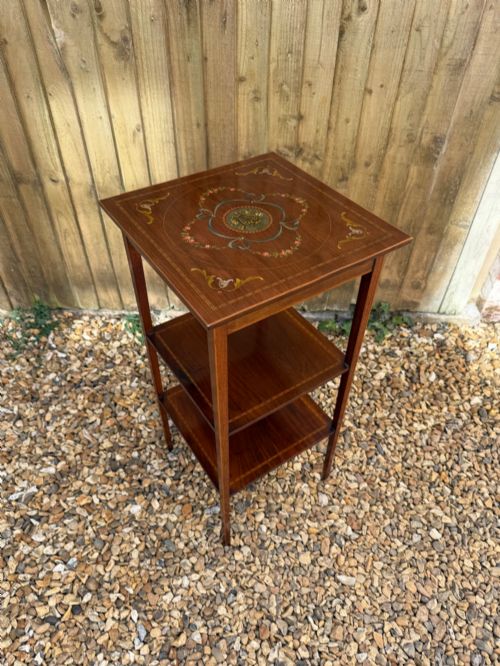
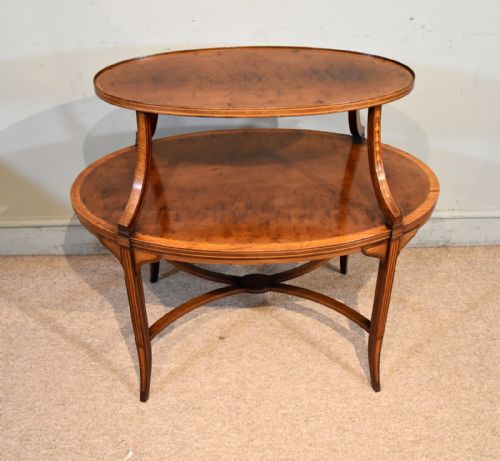


Sheraton Revival Etagere
These sheraton revival etagere pieces bring tiered display surfaces and delicate inlay into period interiors.
Sheraton Revival Etagere
A sheraton revival etagere is a multi-tiered display piece drawing on late eighteenth-century design vocabulary. You encounter these most frequently as two or three-tier tables and occasional pieces dating from the Edwardian period through to the early decades of the twentieth century.
The form prioritises lightness and visibility, offering stacked surfaces supported on slender uprights. Makers produced these tiered tables primarily in mahogany and satinwood, often shaping the tops as ovals, circles or rectangles to suit drawing rooms and boudoirs.
While the core inventory centres on tiered etageres and occasional tables, related forms such as corner cabinets also appear within the wider selection. These pieces reflect a sustained late nineteenth and early twentieth-century interest in reviving refined neoclassical proportions.
Materials and construction
Makers constructed these pieces using timber veneer over solid secondary woods, selecting mahogany and satinwood as the primary visible surfaces. Cabinetmakers then added contrasting stringing and detailed marquetry using boxwood inlay to create geometric and floral motifs.
Structural elements frequently incorporated brass details, particularly on castors or mounts, while certain examples introduced painted decoration directly onto the wood. Glass also appears in related glazed cabinet forms, completing a repertoire of light decorative materials.
Some nineteenth-century makers spelt the tier-stand as etegair, proving that spelling was once as optional as a third shelf.
What separates the best examples
Quality rests principally in the precision of the timber selection and the crispness of the inlay work. Finer pieces demonstrate meticulous hand-cut marquetry and tightly figured satinwood or mahogany veneers that maintain structural integrity across multiple tiers.
The balance of the uprights and the refinement of the turned or tapered supports distinguish superior workshops from standard commercial production. Proportion and restraint in the decorative scheme mark the distinction between an ordinary table and a distinguished period example.
The Sheraton Revival Etagere Glossary
- Etagere
- A piece of furniture consisting of a set of open shelves or tiers for displaying small objects. This form gained renewed popularity during the late nineteenth and early twentieth centuries.
- Satinwood
- A durable timber with a golden-yellow sheen and natural lustre, highly prized for fine veneer work. Cabinetmakers used it extensively in contrasting bands and panels.
- Marquetry
- The art of applying pieces of veneer to a structure to form decorative patterns and pictures. Craftsmen utilised various coloured woods to achieve pictorial depth.
- Stringing
- A narrow line of contrasting timber inlaid into the surface of furniture to create borders and panels. This technique defines the edges of shelves and table tops.
- Edwardian
- Pertaining to the period of the reign of King Edward VII, spanning the early years of the twentieth century. Furniture from this era often reinterprets earlier Georgian and Sheraton styles.
Sheraton Revival Etagere: Frequently Asked Questions
What is an etagere used for?
An etagere serves primarily as an open tiered stand for displaying small decorative objects, porcelain and books. The stacked shelves allow items to be viewed from multiple angles within a principal reception room.
Historically, these tiers held ornamental collectibles rather than heavy utilitarian items. Their open construction suits spaces where light and visual permeability are desired.
How do I date a Sheraton Revival piece?
Dating relies on examining construction methods, secondary timbers, and the specific characteristics of the hardware and veneer work. Pieces associated with this revival typically date from the late nineteenth century through to the Edwardian period.
Makers of this era combined older neoclassical design motifs with contemporary manufacturing techniques. Comparing the timber grain and inlay style with dated examples helps establish the decade of manufacture.
Where should I place an etagere?
These tiered tables fit naturally into drawing rooms, studies or hallways as freestanding occasional pieces. Their slender proportions allow them to occupy corners or wall spaces without dominating the room.
Because the shelves are open on all sides, positioning them away from heavy foot traffic protects the delicate inlaid surfaces. Placing them where light catches the satinwood grain enhances their decorative impact.
What is the difference between satinwood and mahogany?
Satinwood is a lighter, golden timber with a natural reflective quality that makes it ideal for decorative veneers and contrasting inlay. Mahogany offers a deeper reddish-brown tone and provides a sturdy structural base for cabinetwork.
Many pieces combine both timbers, using mahogany for the main frame and satinwood for panels or banding. This contrast defines much of the visual character seen in revival pieces.