

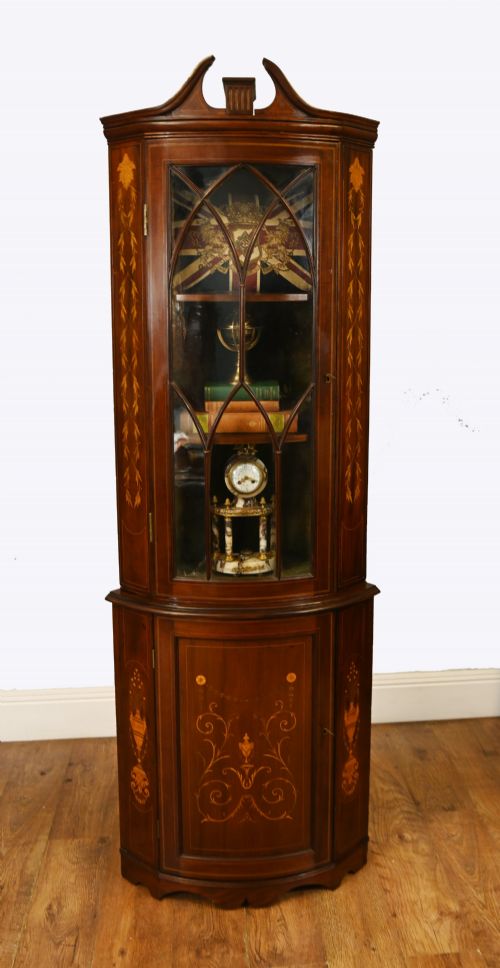
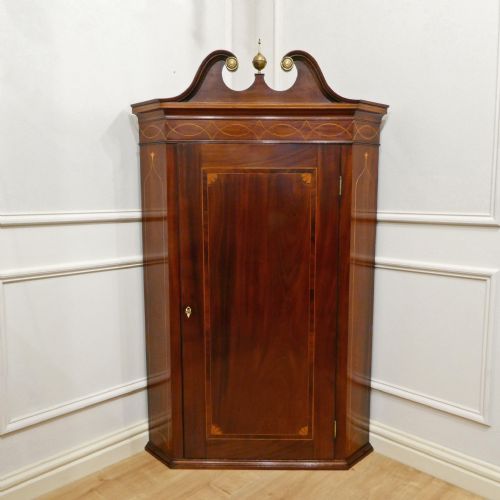


Sheraton Corner Cupboard
A Sheraton corner cupboard brings architectural order to a difficult room, putting otherwise wasted angles to work with polished timber and subtle inlay.
Sheraton Corner Cupboard
A Sheraton corner cupboard is a fitted or freestanding cabinet designed to occupy ninety-degree junctions in a room, combining practical storage with neoclassical elegance. When searching this phrase, a buyer meets examples spanning the eighteenth-century Georgian period through to later Victorian, Edwardian, and Sheraton Revival interpretations.
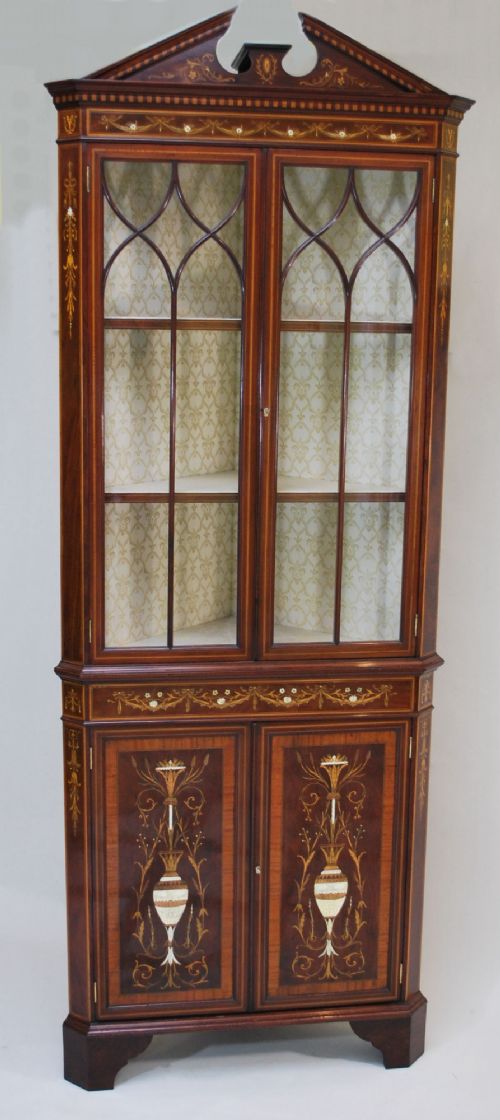
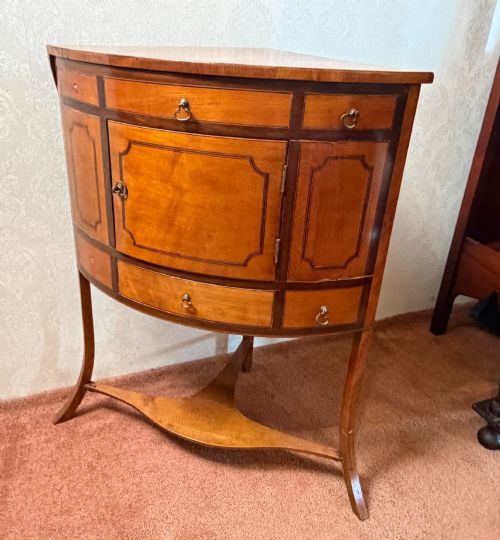
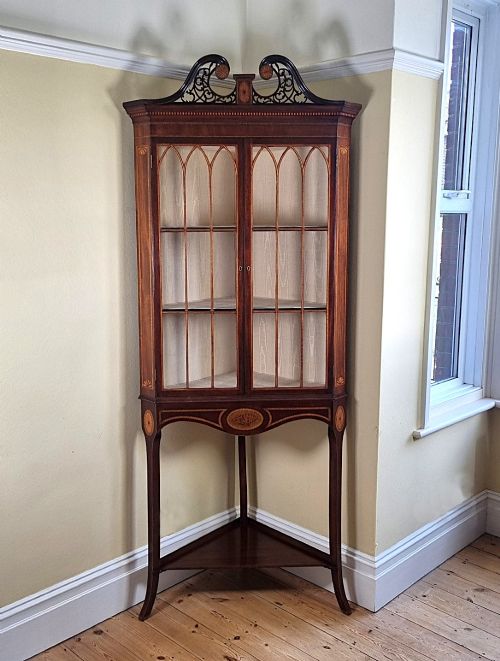
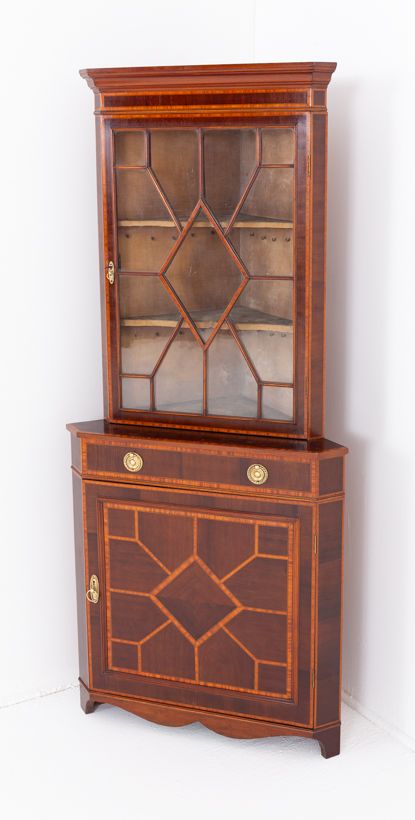
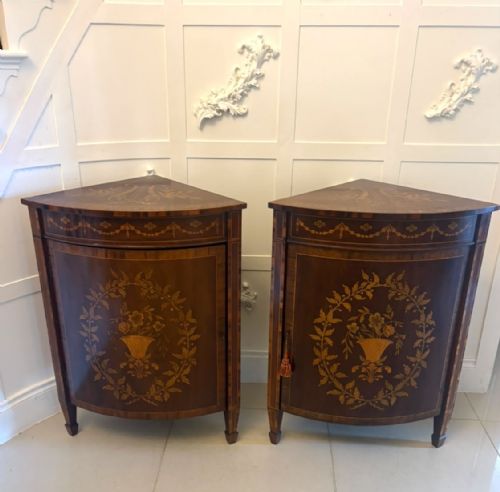
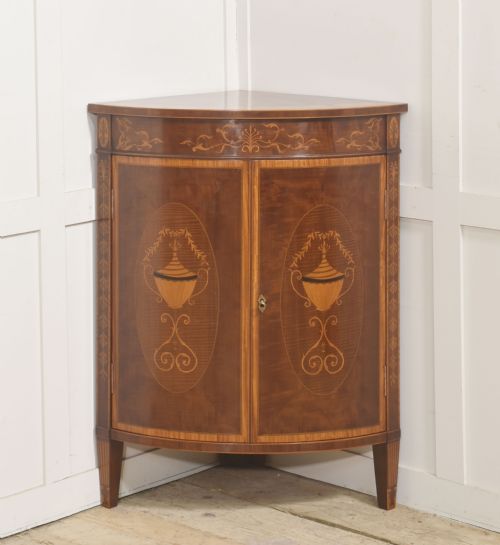
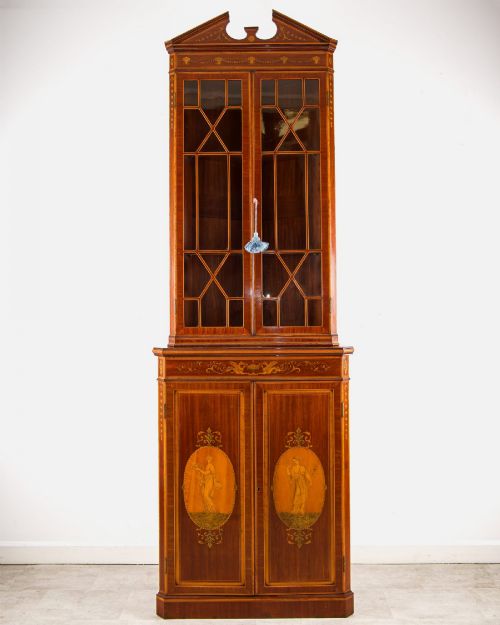
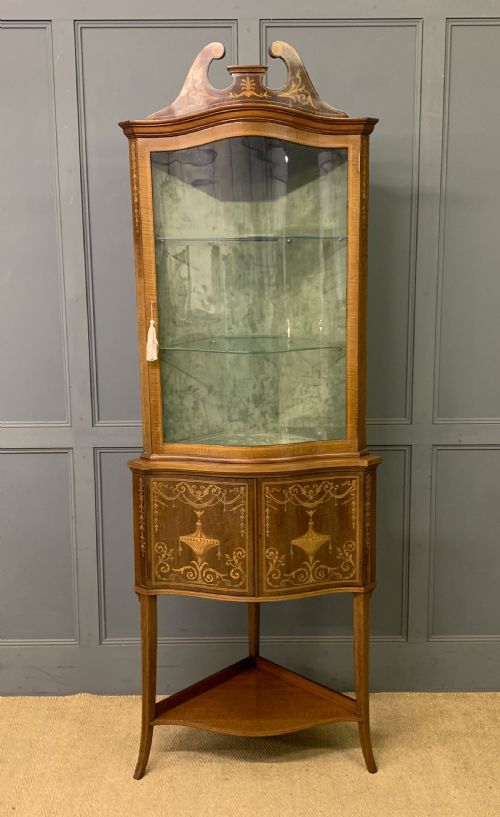
The versions most commonly encountered on this page date from the Edwardian era and around nineteen hundred, executed in mahogany with delicate stringing and contrasting wood inlays. Formats range from wall-hanging single doors and bow-fronted standing cupboards to double-door display cabinets fitted with glass panels and astragal bars.
How they were made
Cabinet makers utilised solid mahogany and rosewood as primary structural timbers, often selecting figured veneers for door panels and curved bow fronts. Surfaces frequently incorporate satinwood and boxwood inlay to create geometric banding, neoclassical swags, and shell motifs.
Glazed doors rely on timber astragal bars forming geometric or arched panes, whilst brass hinges, escutcheons, and locks secure the doors. Interior shelving is typically arranged to display ceramics or glassware within the angled space.
Many a Victorian home gained extra dining space simply by tucking a curved mahogany cupboard into an otherwise forgotten corner.
What varies in quality
The standard of a Sheraton corner cupboard rests on the selection of timber figures and the crispness of the contrasting inlay. Finer pieces demonstrate precise hand-cut stringing and well-matched grain patterns across curved bow doors.
Construction details distinguish workshop output, particularly the dovetailing of drawers, the thickness of secondary woods, and the integration of original brass hardware. Proportions remain balanced, ensuring the projecting cornices and bracket feet complement the triangular carcass.
The Sheraton Corner Cupboard Glossary
- Astragal glazing
- The wooden bars that divide glass panes within a door. These strips form delicate geometric patterns across display cabinets.
- Bow front
- A convex, curved front on a cabinet or chest. This shape softens the hard angles of a room.
- Inlay
- Contrasting wood or metal fitted into a carved recess on the surface. Satinwood and boxwood frequently create these decorative motifs.
- Sheraton Revival
- A late nineteenth and early twentieth-century style imitating neoclassical furniture designs. These pieces often feature marquetry and lighter timbers.
- Stringing
- Thin lines of contrasting wood inlaid around edges and panels. This technique frames the primary mahogany or rosewood surfaces.
Sheraton Corner Cupboard: Frequently Asked Questions
Where should I place a corner cupboard?
These cabinets suit empty room junctions where standard rectangular furniture wastes space. They anchor a corner whilst drawing the eye upward with polished timber.
Hanging versions mount directly to walls above tables or sideboards, whilst standing and floor models rest firmly in the angle of the room.
How do I distinguish Georgian from revival pieces?
Original eighteenth-century pieces display secondary woods typical of the period, such as oak or pine carcass linings, alongside hand-forged iron or brass fixings. Timber patination shows deeper oxidation built up over generations of care.
Revival pieces from the Edwardian era often utilise machine-sawn internal elements and standardised hardware, reflecting the manufacturing methods of nineteen hundred.
What is the difference between hanging and standing cupboards?
Hanging cupboards feature flat lower backs designed to screw directly into wall studs, freeing up floor space below. They suit smaller rooms or hallways where a full-height cabinet would obstruct movement.
Standing cupboards rest on bracket feet or a distinct base stand, providing larger internal capacity and sometimes incorporating a second lower cupboard tier.
Can I use a corner cupboard for display?
Glazed variants with astragal bars provide enclosed shelving specifically intended for porcelain, silver, or glassware. The angled interior bounces light from multiple directions.
Solid-door cupboards conceal shelving behind timber panels, making them practical for general household storage rather than visual exhibition.