
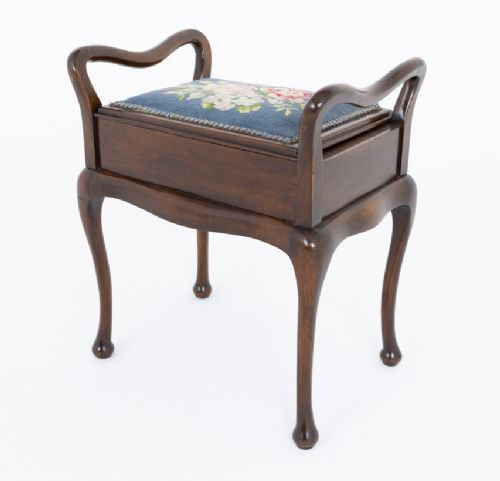


Sheet Music Storage Stool
A sheet music storage stool keeps your scores close at hand while providing a sturdy seat at the instrument.

Sheet Music Storage Stool
When you search for a sheet music storage stool, you are looking at practical seating designed to hold bound volumes and sheet music beneath the lid or behind a fall front. These pieces combine utilitarian function with the refined cabinet-making of the Victorian and Edwardian eras, serving both pianist and home alike.
The forms span standard single piano stools, wider duet stools, and specialised variants such as Canterbury stools and ottomans. Their origins trace back through decades of domestic music-making, showing styles from plain oak to Edwardian Sheraton Revival.
How they were made
Cabinet-makers built these stools using solid timbers and veneers of mahogany and walnut, frequently incorporating boxwood inlay for decorative contrast. Structural stability was paramount to withstand the daily weight of sitting and opening heavy internal compartments.
Interiors were engineered for function, utilising lift-up seats and fall fronts to secure music scores neatly out of sight. Finishing touches relied on traditional upholstery methods, employing fabrics and velvet to pad the top of the seat.
Listings feature pieces from the Victorian and Edwardian periods, constructed in mahogany, walnut, and oak.
What varies in quality
The distinction between a standard stool and a finer piece rests on the crispness of the cabinet-making and the selection of timber veneers. Subtle details like fine boxwood inlay and well-executed joinery elevate an ordinary seat into a considered piece of period furniture.
Mechanism design also sets examples apart, particularly the smooth operation of fall fronts and lift-up seats. The integrity of the original upholstery and the choice of facing woods determine the overall coherence of the design.
The Sheet Music Storage Stool Glossary
- Fall front
- A hinged door that drops forward to reveal interior storage compartments for music sheets. This mechanism allows easy access to scores without disturbing items placed on top of the stool.
- Canterbury stool
- A compartmentalised piece designed to hold folios and sheet music upright. It often combines open partitions below with an upholstered seat above.
- Duet stool
- An extended seat built to accommodate two musicians side by side. These wider variants frequently incorporate generous internal storage for larger collections of music.
- Boxwood inlay
- Contrasting pale wood inserted into dark timber veneers to form delicate linear patterns. This decorative technique is characteristic of Edwardian Sheraton Revival pieces.
Sheet Music Storage Stool: Frequently Asked Questions
How do I identify a Victorian music stool?
Victorian examples often feature darker timbers like walnut and heavier proportions compared to later pieces. They may incorporate specialised forms such as fall fronts or Canterbury partitions.
These characteristics reflect the domestic styles popular during the nineteenth century before the lighter Edwardian aesthetic took over.
What is the difference between a single and duet stool?
A single stool provides seating for one person with a compact footprint beside the piano. A duet stool is built wider to seat two players simultaneously and offers greater internal storage capacity.
Both types utilise the same fundamental construction methods in woods like mahogany and oak.
Where should I place a music stool in my home?
These pieces sit naturally beside a piano or keyboard, functioning as both a functional seat and a storage cabinet. Their classic timber finishes also allow them to serve as standalone occasional seats or small ottomans in a living room.