


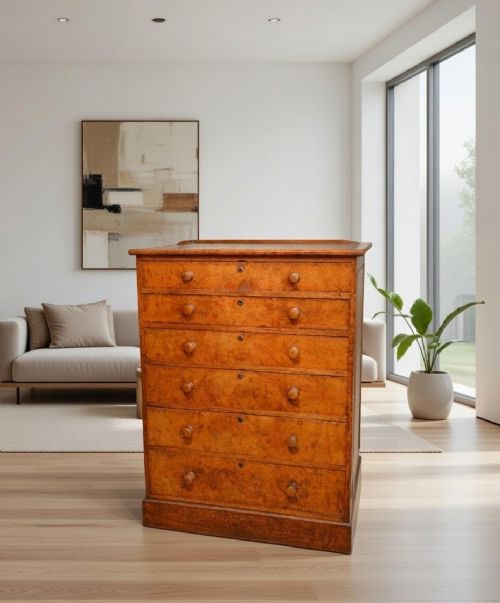
Secretaire Wellington Chest
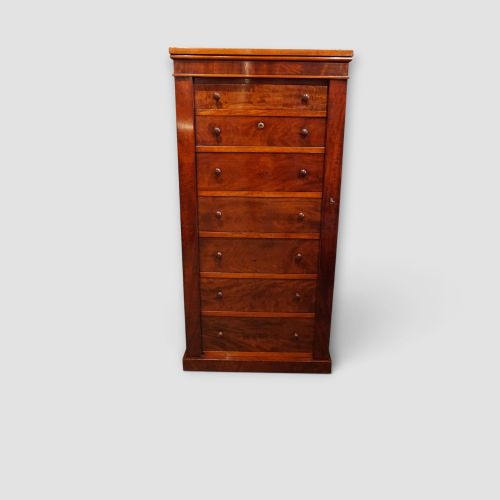
A secretaire wellington chest combines the compact height of a narrow drawer stack with a concealed drop-front writing surface.
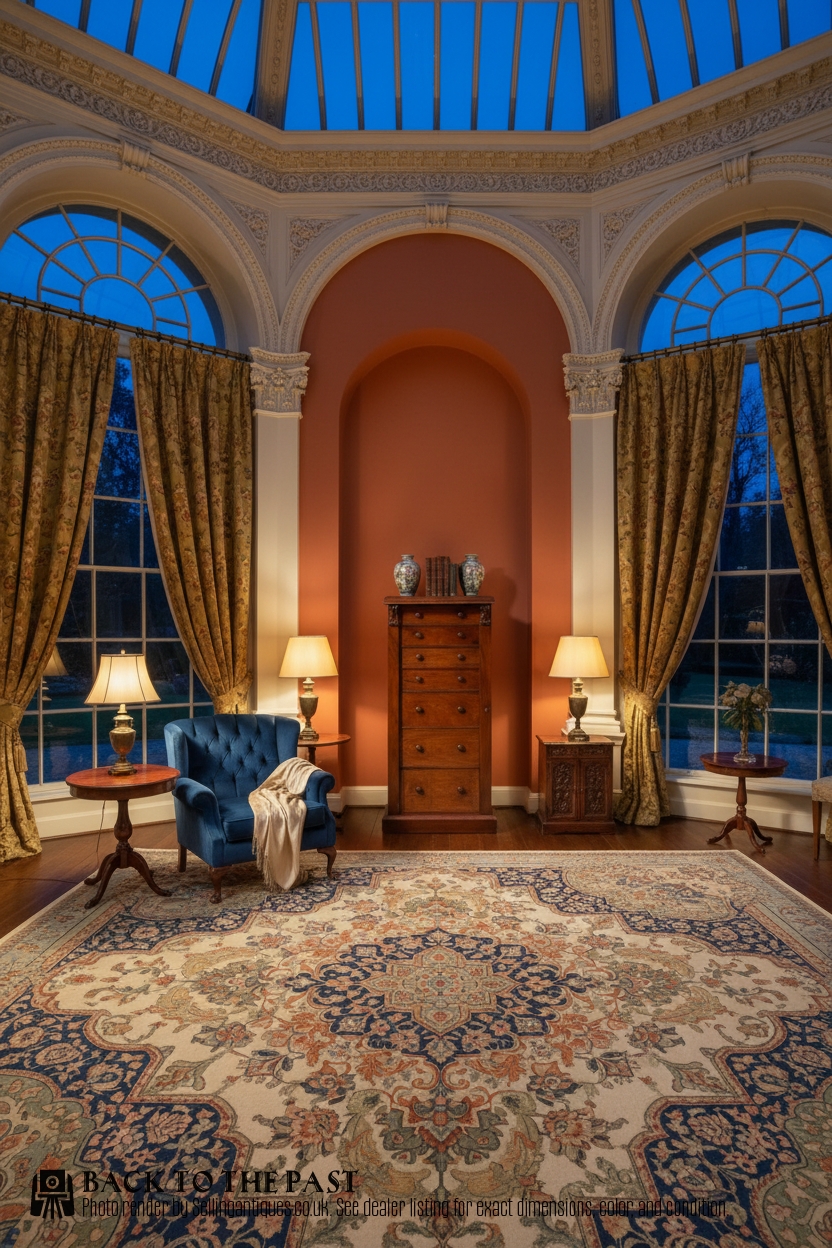
Secretaire Wellington Chest
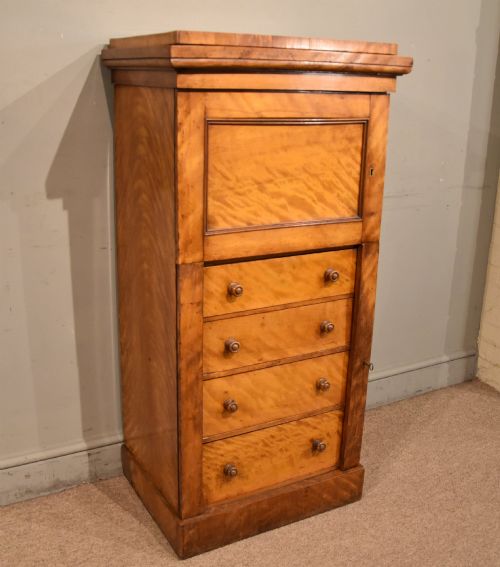
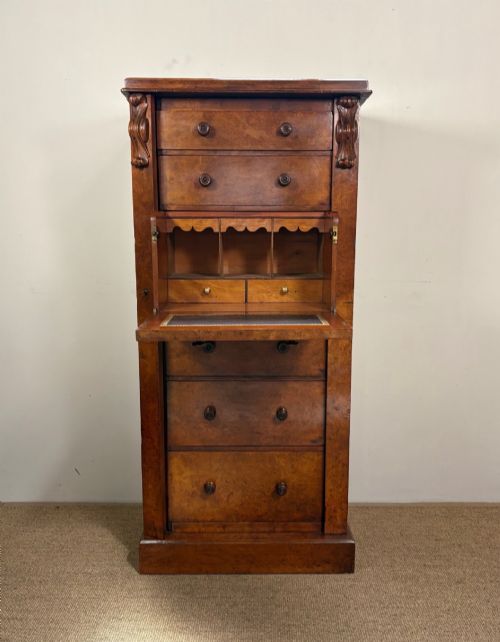
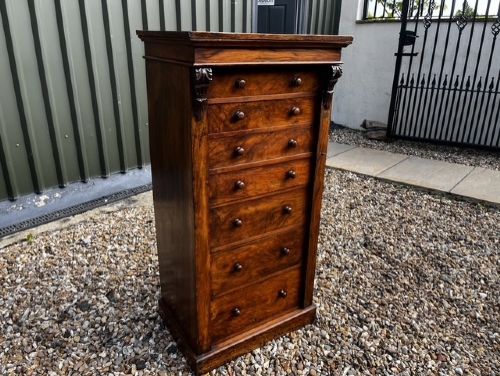
A secretaire wellington chest stands tall and narrow, traditionally fitted with a hinged vertical locking stile that secures the entire bank of drawers from the side. Within these proportions, one of the upper drawers drops forward on quadrant arms to reveal a writing surface and small internal compartments.
The pieces available on this page belong primarily to the Victorian and Regency periods, spanning the nineteenth century from roughly eighteen twenty-five onwards. Mahogany and rosewood form the majority of surviving examples, often complemented by walnut, burr walnut, flame mahogany veneer, and pollard oak.
Materials and Construction
Cabinetmakers constructed these chests using solid timber frames faced with carefully chosen veneers such as flame mahogany, figured walnut, and rosewood. Secondary timbers received the heavy grain treatments and polishing required to achieve deep colour and lustre across the drawer fronts and the locking pilasters.
The signature locking mechanism relies on a hinged wooden flap attached to one side of the carcass, which swings into place over the drawer edges and fastens with a brass lock. Brass hardware appears frequently on handles, hinges, and escutcheons, securing both the exterior drawers and the internal writing compartment.
Materials recorded across the archive include brass, leather, mahogany, rosewood, walnut, flame mahogany veneer, satin birch, and satinwood.
Assessing Craftsmanship
Quality reveals itself in the selection of wood veneers and the precision of the joinery around the locking pilaster. Finer examples display symmetrical burr walnut or intense flame mahogany grain that continues seamlessly across the closed drawer fronts.
Internal secondary woods, dovetailed drawer construction, and the smooth operation of the dropping writing mechanism separate standard utility pieces from high-workshop production. The integration of the locking stile and the quality of the brass fittings further indicate the maker's original standard.
Druce & Co.
The Secretaire Wellington Chest Glossary
- Wellington chest
- A tall, narrow chest of drawers characterised by a hinged wooden locking bar on one side that secures all the drawers when locked.
- Secretaire
- A desk or chest containing a pull-out or drop-front writing drawer fitted with small compartments and pigeonholes.
- Pilaster
- A vertical architectural element or wooden strip applied to the side of the chest, which forms the hinged locking flap in this specific furniture form.
- Flame mahogany
- A veneer cut from the fork of the mahogany tree, producing a distinctive, highly figured flame-like pattern across the wood surface.
- Burr walnut
- Timber taken from a tree growth or burl, yielding complex, swirling grain patterns highly prized for cabinet fronts.
Secretaire Wellington Chest: Frequently Asked Questions
What is a secretaire wellington chest?
A secretaire wellington chest is a tall, narrow set of drawers featuring a locking side pilaster and an integrated pull-down writing compartment.
The design allows owners to keep correspondence and valuables secure behind a single side-locking bar while maintaining a minimal floor footprint.
How do you open the locking flap?
The locking flap is secured by a key-operated lock located on the vertical wooden stile at the right or left edge of the drawer stack.
Turning the key releases the hinged stile so it swings clear of the drawer ends, allowing individual drawers and the drop-front writing section to open.
Which woods are most common?
Mahogany and rosewood dominate the early nineteenth-century examples, whilst walnut and burr walnut become more prevalent during the Victorian era.
Finer versions often utilise flame mahogany veneer, pollard oak, satin birch, or maple to highlight the vertical proportions of the carcass.
Where were they placed in a home?
Their narrow footprint made them suitable for bedrooms, dressing rooms, and smaller studies where space for a traditional kneehole desk was limited.
The combination of storage drawers and a writing surface provided a private writing station without requiring a dedicated piece of library furniture.