
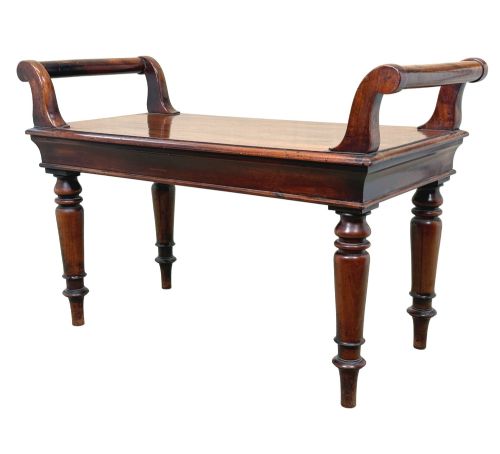
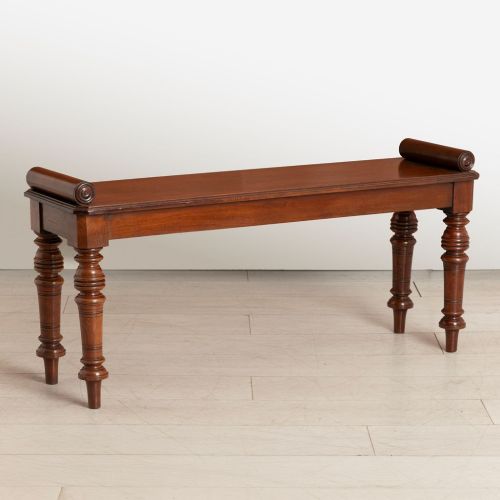


Scrolled Arm Window Seat
These scrolled arm window seat pieces are classic long seating forms designed for alcoves, combining mahogany, walnut, and upholstery to anchor a room.
Scrolled Arm Window Seat
A scrolled arm window seat is a long seating form designed to sit beneath a window or at the foot of a bed. Buyers searching for a scrolled arm window seat encounter nineteenth century and Edwardian pieces, often formed from mahogany or walnut with upholstered pads.
The evidence shows forms ranging from simple benches and duet stools to more elaborate salon settees and French carved frames. Regency, Victorian, and Georgian Revival styles dominate the available selection.
Makers utilised various timber frames alongside padded tops covered in damask, velvet, or traditional upholstery fabric. These dual-purpose forms serve as window seats, hall benches, and dressing stools.
Materials and construction
Frames are constructed predominantly from solid mahogany and walnut, shaped with carved details and cabriole legs. Wood selection dictates the weight and structural integrity of each bench.
Upholstery relies on traditional textiles such as velvet, damask, and standard fabric over padded seating foundations. Brass elements occasionally appear as decorative accents or hardware on the frames.
Mahogany and walnut form the primary timber framework across these listings, accompanied by upholstery fabrics including velvet and damask.
Evaluating quality and proportion
The refinement of the carved woodwork and the crispness of the scroll arms distinguish finer examples. Superior pieces display thoughtful timber selection and balanced proportions across the legs and frame.
The integration of the upholstery into the wooden structure affects the overall visual harmony. Pieces that retain harmonious scale between the timber base and the padded seat demonstrate greater workshop skill.
The Scrolled Arm Window Seat Glossary
- Regency
- A British design style dating from the early nineteenth century characterised by classical revival motifs. It draws inspiration from ancient Greek and Roman forms.
- Damask
- A reversible figured fabric traditionally woven on a jacquard loom with patterns visible on both sides. It provides a formal texture often utilised for traditional upholstery.
- Cabriole leg
- A furniture leg that curves out and then in, resembling the leg of an animal. This form appears frequently on eighteenth and nineteenth century seating.
- X-frame
- A structural furniture base formed by intersecting curved or straight wooden members shaped like the letter X. It adds stability and a distinct architectural profile.
- Duet stool
- An elongated seating form designed to accommodate more than one person at a time. These pieces often function in music rooms or at the foot of beds.
Scrolled Arm Window Seat: Frequently Asked Questions
Where do you place a window seat?
These long seating forms traditionally sit directly beneath large windows to create a quiet spot for reading or viewing. They also function effectively at the foot of a bed or along a wide hallway.
Their narrow footprint allows them to occupy transitional spaces where a standard sofa would prove too deep. Placing one in an alcove makes practical use of architectural recesses.
What is the difference between a window seat and a bench?
A window seat typically incorporates upholstered padding designed specifically for extended sitting, often accompanied by raised ends or scrolled arms. Benches can be entirely wooden or feature simpler pads.
Many historical examples bridge this distinction by functioning interchangeably as dressing stools, hall benches, or salon seating depending on their upholstery.
How do I identify a Victorian window seat?
Victorian pieces usually feature dense timbers like mahogany or walnut combined with heavier carved decoration or rich fabric upholstery. They often reflect revival styles popular during the nineteenth century.
Examining the construction methods and the wear on the wood helps confirm a nineteenth century origin rather than a later revival date.
Are these seats comfortable for daily use?
The comfort level depends on the firmness of the traditional padding and the height of the scrolled arms. Many incorporate sturdy upholstered tops suitable for sitting.
Because they were built primarily for occasional seating near windows or in dressing rooms, their proportions favour posture and support over lounging.