




Scroll Arm Chaise
A scroll arm chaise is a reclining seat designed for luxurious repose, uniting architectural timber frames with sweeping, upholstered comfort.
Scroll Arm Chaise
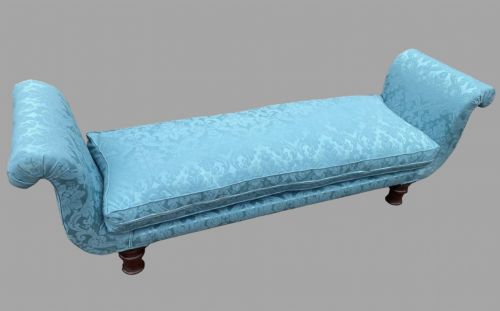
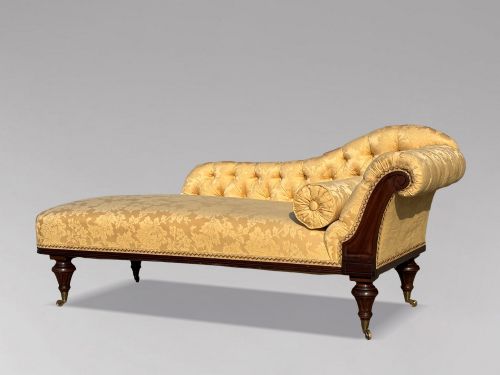
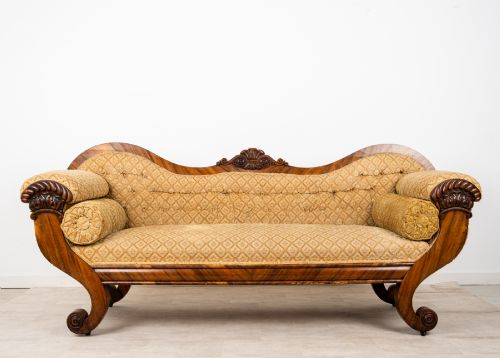
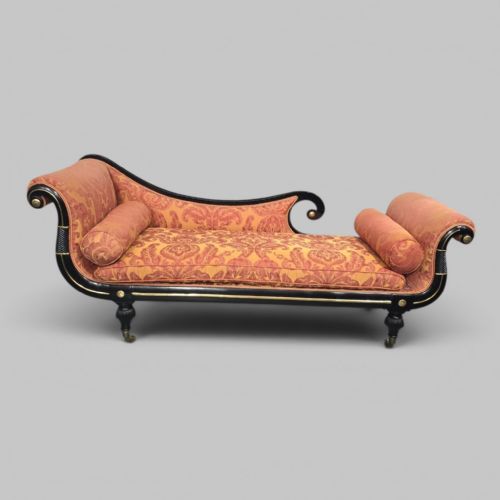
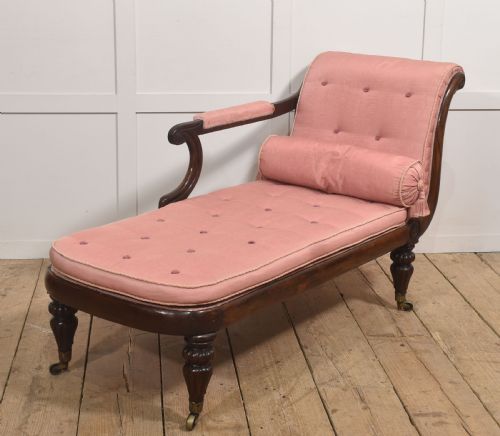
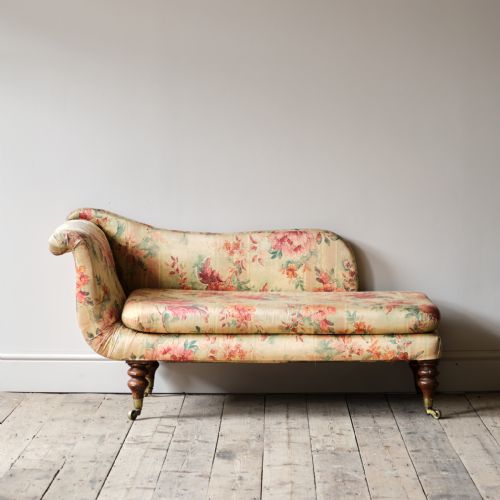
A scroll arm chaise combines the upright support of a sofa with the extended length of a daybed, creating a single piece intended for reclining in nineteenth-century drawing rooms and libraries. When you search for a scroll arm chaise, you encounter examples spanning the Regency, William IV and Victorian periods, with mahogany and rosewood framing dominating the selection.
The most common version meeting you on this page is the single-ended chaise longue featuring one prominent scrolled end and a sloping backrest, alongside double-ended settees and daybeds. These forms reflect diverse stylistic influences, from Grand Regency and William nineteenth-century French Empire to robust mid-Victorian craftsmanship.
Origins range from English country houses to metropolitan cabinet makers, incorporating Woods such as satin walnut, walnut, and ebonised timber alongside mahogany and rosewood. Upholstery varies from contemporary silk damask and velvet to simple woven fabrics, often tailored to complement the rich grain of the exposed woodwork.
How they were made
Cabinet makers built the primary structural frames using dense hardwoods like mahogany and rosewood, frequently employing ebonised wood or satin walnut for specific decorative effects. The characteristic scroll ends required steam-bending or expert carvers working timber blocks to achieve sweeping, continuous curves without structural weakness.
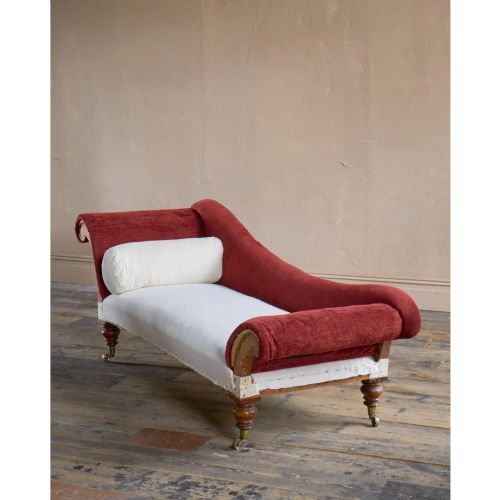
Upholstery was applied directly over traditional webbing and stuffing techniques, enclosing the sprung or stuffed foundations within materials like velvet, damask fabric, and simpler upholstery fabric. Brass castors were frequently fitted to the feet, allowing these heavy timber frameworks to be repositioned across carpeted drawing rooms.
Even miniature chaise lounges were built with fully sprung frames, proving that nineteenth-century comfort applied equally to the parlour dog.
What varies in quality
The ambition of the timber carving and the crispness of the scroll execution separate standard production from exceptional examples. Finer pieces demonstrate deep, tactile moulding on the showwood frames and meticulously matched mahogany or rosewood veneers.
Proportion and structural integrity define the upper tier, where the architectural sweep of the backrest harmonises precisely with the rolled end. The choice of covering fabric, whether period-appropriate damask or rich velvet, completes the distinction between utilitarian seating and high-status drawing room furniture.
Holland and Sons·Gillows·Willian Trotter
The Scroll Arm Chaise Glossary
- Scroll end
- A sweeping, curved wooden terminal that defines the head or back of the chaise. This architectural feature anchors the visual weight of the piece.
- Showwood
- The exposed polished timber frame surrounding the upholstered areas. Cabinet makers shaped and carved these sections to display the grain of mahogany or rosewood.
- Daybed
- An elongated seating form designed for lying down rather than upright sitting. It shares structural lineage with the chaise longue and the settee.
- Récamier
- A specific style of daybed featuring two raised ends and an open side, named after the famous French portrait subject. It is an occasional alternative to the single-ended chaise.
- Damask
- A reversible figured fabric traditionally woven with intricate patterns. It frequently appears as the primary upholstery material on nineteenth-century seating.
Scroll Arm Chaise: Frequently Asked Questions
How were scroll arm chaises used historically?
These pieces served as daytime resting places for reading, letter-writing, and recovering from illness in formal reception rooms. They offered a semi-reclining posture that bridged the gap between a conventional armchair and a bed.
Positioned centrally in large drawing rooms or against parlour walls, they allowed ladies in voluminous nineteenth-century dresses to recline comfortably without disturbing their attire.
How do I tell a Regency chaise from a Victorian one?
Regency and William IV examples typically display classical restraint, featuring rich mahogany or rosewood veneers, bold carved scroll ends, and sabre or turned legs influenced by ancient Roman and Greek designs. They date from the early nineteenth century.
Victorian pieces from the 1850s onward often introduce heavier proportions, darker ebonised or walnut woods, and more exuberant, deep-buttoned upholstery with elaborate showwood carvings.
Can I use a scroll arm chaise in a modern interior?
Their sculptural timber frames and elongated silhouettes make them natural focal points in contemporary living spaces, functioning effectively as daybeds or statement settees. They anchor open-plan rooms or provide generous lounging space in studies.
Pairing the rich tones of rosewood or mahogany with minimalist surroundings highlights the quality of the nineteenth-century cabinet work without overwhelming the floor plan.