


Scientific Recording Instrument
These scientific recording instrument examples are brass and wood meteorological machines built to log atmospheric pressure and weather changes over time.
Scientific Recording Instrument
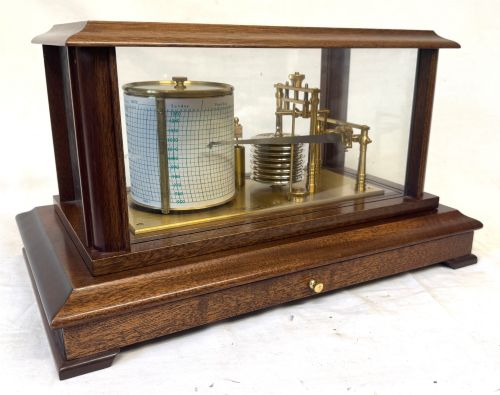
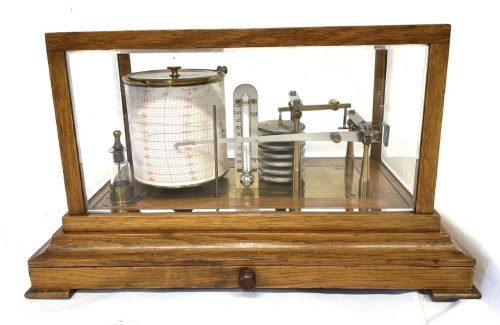
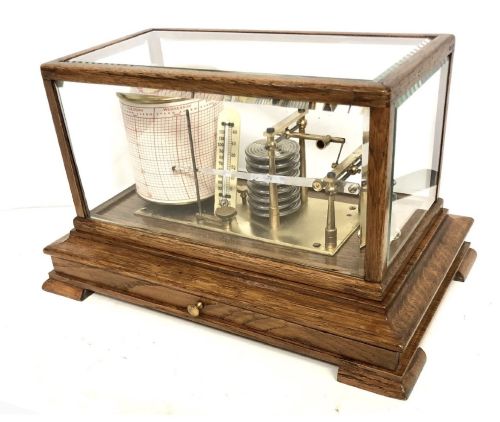
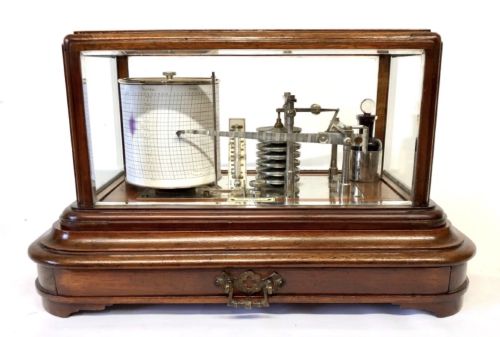
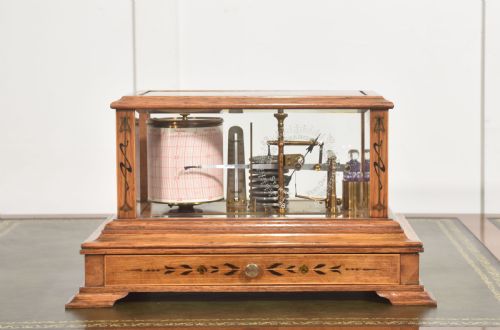
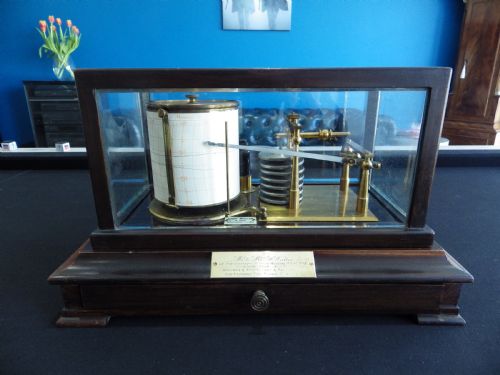
A scientific recording instrument primarily takes the form of a barograph, an apparatus designed to continuously chart barometric pressure on rotating paper drums. These machines emerge from Victorian, Edwardian and interwar workshops to provide a permanent ink record of meteorological shifts. Buyers encounter mahogany, oak and walnut five-glass cases fitted with clockwork movements, thermometers and small chart drawers.
Beyond standard pressure recorders, the selection includes recording rain gauges that capture precipitation data mechanically. Many pieces combine a barometer dial directly into the timber housing alongside the recording drum. Makers housed these mechanisms beneath bevelled glass panels to allow a clear view of the operating levers and needles.
The objects stem from periods spanning the late nineteenth century through to the mid-twentieth century. Workshop output reflects both utility and domestic display, merging scientific observation with polished cabinetry. Collectors find pieces bearing retailer signatures alongside specialised meteorological manufacturers.
Materials and Construction
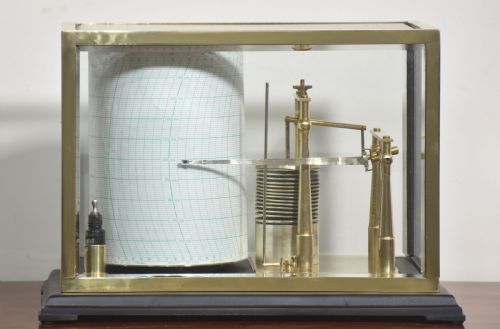
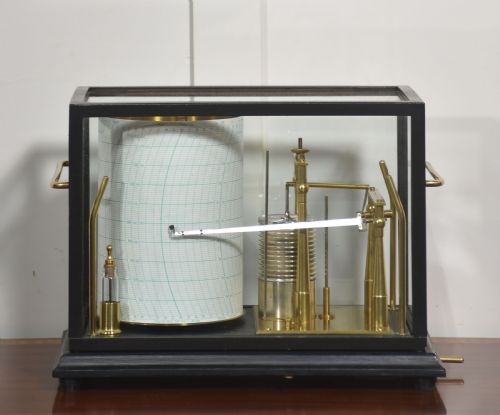
Constructors housed the delicate aneroid metal vacuum chambers and recording arms inside heavy timber cabinets built from mahogany, oak and walnut. Makers utilised brass for levers, spindles and movement plates, pairing these metallic components with steel springs and ink-holding pens. Cases relied on thick bevelled glass panes fitted into sturdy wood frames to protect the internal clockwork.
Timber housings frequently incorporated dovetailed chart drawers beneath the main recording platform to store unused paper cylinders. Workshops added brass carrying handles, hinged lids and occasionally Art Nouveau floral inlay to domesticate the scientific apparatus. Movement mechanisms depended on precise brass gear trains driven by wound clockwork drums.
Listings feature recording instruments constructed across eight distinct decades, spanning from the Victorian era through to the interwar period.
Evaluating the Apparatus
Internal mechanical execution dictates the standing of an individual barograph. Renowned makers employed finely milled brass movements and precise linkage arms that respond smoothly to barometric fluctuations. Original paperwork and intact chart drawers further elevate the integrity of a surviving recording machine.
Russell Norwich·Gaupp And Co Hongkong·Hezzanith·Short And Mason·Negretti And Zambra·C F Casella·Baines Harrogate·R Fuess·Harrods Of London·Short And Mason Limited·Robson Of Newcastle·Antoine Redier·Jules Richard·Callaghan And Co·Depree And Young Ltd·Dobbie Son And Hutton·Richard Freres
The Scientific Recording Instrument Glossary
- Barograph
- A self-recording barometer that traces atmospheric pressure onto a revolving paper chart. It uses stacked aneroid metal boxes to detect pressure changes.
- Aneroid
- Containing no liquid, this describes a barometer mechanism that relies on expanding and contracting sealed metal vacuum chambers.
- Chart drawer
- A shallow compartment built into the wooden base of an instrument case to store spare recording graphs.
- Beveled glass
- Glass panes with cut and polished angled edges, commonly fitted into the five-glass wooden hoods of these instruments.
Scientific Recording Instrument: Frequently Asked Questions
How does a barograph work?
Stacked aneroid metal vacuum chambers expand or contract as atmospheric pressure rises and falls outdoors. A series of brass levers magnifies this physical movement, guiding an inked nib across paper secured to a clockwork rotating drum.
This continuous mechanical tracing creates a weekly record of weather patterns without requiring human intervention during the logging cycle.
Where were these instruments placed?
Victorian and Edwardian households positioned these wooden cases on library tables, hall sideboards or dedicated bracket shelves. Their polished timber housings and glass panels allowed guests to observe the internal clockwork and pressure needles.
Scientific institutions and railway offices also utilised them to log official meteorological data for operational records and forecasting.
How do I read the paper charts?
The vertical axis on the paper graph indicates atmospheric pressure measured in inches or millibars. Horizontal grid lines represent the progression of days and hours as the drum rotates on its clockwork axis.
By following the ink trace left by the pen arm, observers can track whether pressure is dropping rapidly to signal approaching storms or rising steadily for fair weather.
Are these instruments still functioning?
Many surviving examples retain their original clockwork movements and remain entirely operational. Regular winding of the drum and replacement of the ink supply allow the mechanical arms to trace current pressure changes accurately.
Periodic cleaning of the brass gear train ensures the delicate levers move freely without sticking along the paper cylinder.