


Satsuma Ware Bowl
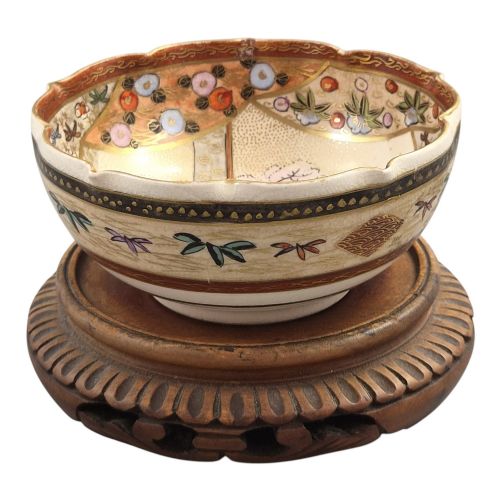
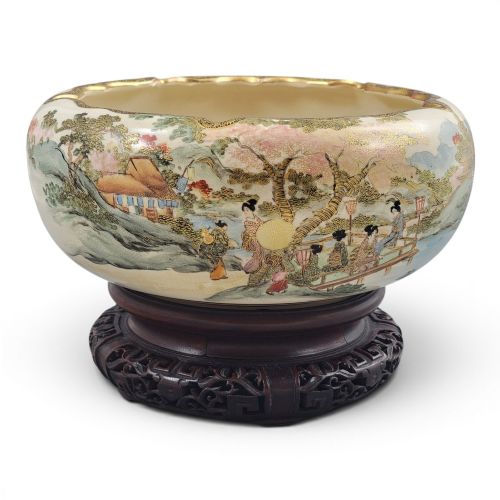
These Satsuma ware bowl pieces are finely decorated earthenware ceramics sought after for their elaborate gilding and vibrant enamel work.
Satsuma Ware Bowl
A satsuma ware bowl stands as a distinct category of Japanese ceramic art that appears primarily across the 19th Century, Victorian, Edwardian, and 1900 periods. Buyers searching for a satsuma ware bowl encounter pieces ranging from small Hanami vessels to monumental decorative bowls, bowls and saucers, and sugar bowls. The examples on this page predominantly originate from the Meiji period and Japanese Meiji period styles, reflecting traditional Kyoto and Yokohama studio production.
The decorative schemes on these earthenware forms typically display meticulous hand-painted scenes such as flowers and birds, women and children under camellia trees, thousand flowers or millefleur patterns, and moonlit samurai battles. Many pieces incorporate the Shimazu crest or Shimazu mon, signalling prominent workshop associations. These vessels serve primarily as decorative ceramics, bringing intricate narrative and floral iconography into an interior setting.
How they were made
Makers formed these pieces using earthenware, applying a characteristic ivory-coloured crackle glaze as the foundation for subsequent decoration. Artists then built up complex imagery utilising enamel, gold leaf, gilt, and gold gilt to accentuate specific narrative or floral motifs. Wood elements occasionally accompany these ceramics in surviving domestic contexts.
The application of paint and gold required steady brushwork to delineate figures, armour, plumage, and botanical details across curved surfaces. Firing secured the enamel and metallic pigments onto the porous earthenware body, often resulting in signed surfaces that credited individual masters and studios.
Listings for this phrase feature pieces from the 19th Century, Edwardian, Victorian, and 1900 periods, utilising earthenware, enamel, gold leaf, wood, and gilt.
What varies in quality
Quality in these ceramics rests upon the density and precision of the enamel work and the finesse of the gilding. Finer pieces display exceptionally intricate millefleur coverage or complex figural compositions involving samurai or domestic scenes rendered by named workshops.
The presence of identifiable signatures from renowned masters or respected Kyoto and Yokohama studios elevates a piece above standard workshop output. Furthermore, the clarity of the crackle glaze and the crispness of the Shimazu mon indicate the level of care taken during production.
Shizan·Kinkozan·Nikko·Hododa·Shozan
The Satsuma Ware Bowl Glossary
- Earthenware
- A porous pottery body fired at lower temperatures, serving as the physical base for Satsuma decoration before glazing and painting.
- Enamel
- Opaque vitreous coloured glass applied to the ceramic surface to create vibrant painted scenes of flora, fauna, and figures.
- Gilt
- A thin layer of gold or gold leaf applied to accentuate borders, motifs, and backgrounds on the ceramic body.
- Millefleur
- A dense decorative pattern composed of countless tiny painted flowers covering the entire exterior and interior surfaces.
- Shimazu mon
- The heraldic badge or crest of the Shimazu clan, frequently found on Satsuma ceramics associated with the Satsuma Domain.
Satsuma Ware Bowl: Frequently Asked Questions
How do I identify a satsuma ware bowl?
Look for a pale earthenware body covered in a fine network of crackled glaze, combined with intricate enamel painting and heavy gilding. Many authentic examples also feature painted artist signatures or the Shimazu crest.
Studio locations such as Kyoto and Yokohama frequently appear in connection with these pieces, pointing to specific regional manufacturing traditions during the Meiji period.
What is the Meiji period connection?
The Meiji period marks the era of intense artistic production and export for Japanese ceramics, during which Satsuma ware gained international acclaim. Artisans refined their enamel and gilding techniques to satisfy overseas demand for highly decorative works.
Pieces from this era often bear signatures from celebrated masters and workshops operating in Kyoto and other key ceramic centres.
How were these bowls used historically?
These vessels functioned primarily as decorative ceramics for display rather than for daily domestic service. Their elaborate figural scenes and delicate gold work made them prized ornamental objects in Victorian and Edwardian interiors.
Specialist forms such as sugar bowls, saucers, and Hanami vessels indicate both display purposes and refined entertaining contexts.
How should I care for my bowl?
Keep the piece away from direct sunlight and moisture to protect the delicate enamel and gold leaf from degradation. Dust the surface gently with a soft, dry cloth rather than using liquid cleaning products.
Handle the ceramic carefully by its base, as the porous earthenware body and raised surface decoration remain vulnerable to impact.