


Satinwood Serpentine Drawers
Satinwood serpentine drawers bring together golden timber and curving fronts, offering collectors a refined silhouette that suits both period and modern interiors.
Satinwood Serpentine Drawers
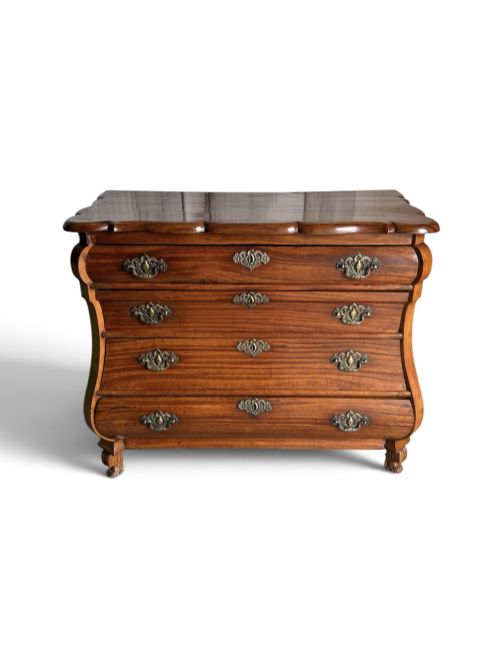
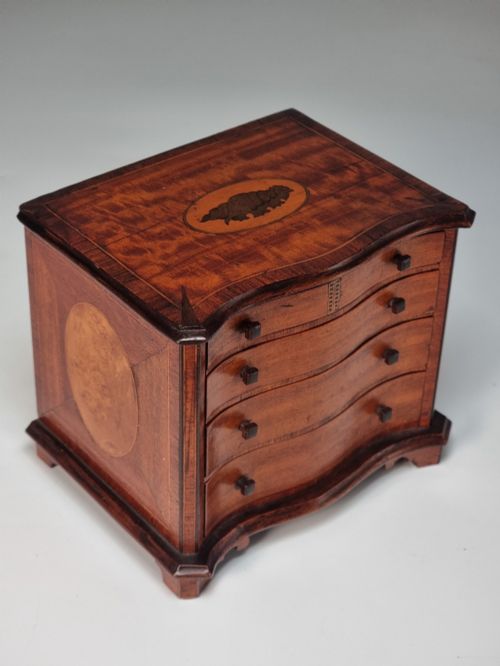
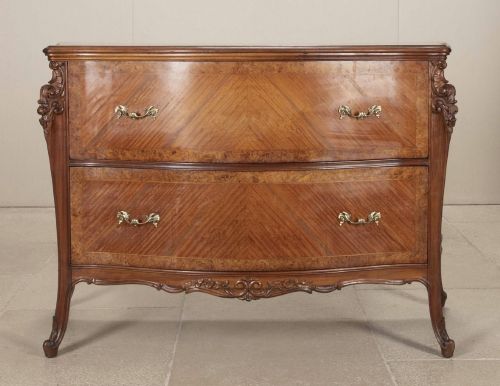
Satinwood serpentine drawers combine a distinctive undulating front curve with the pale, lustrous timber characteristic of fine cabinet-making. You will encounter various forms across this inventory, from compact miniature chests and dressing pieces to full-size commodes and desks.
The examples recorded here span multiple eras, including the eighteenth century, nineteenth century, Sheraton Revival, and Edwardian period. Pieces frequently incorporate contrasting crossbanding, such as mahogany, ebony, or burr walnut, alongside marquetry and hand-decoration.
Origin and regional style vary noticeably among the pieces, ranging from George III English workshop traditions to Dutch Colonial and nineteenth-century Italian designs. Buyers searching for satinwood serpentine drawers typically find chests of drawers and commodes built with meticulous attention to proportion.
Construction materials and techniques
Makers utilised dense native and exotic timbers, laying satinwood veneers over sturdy secondary woods to achieve the characteristic shimmering golden surface. Cabinet-makers also incorporated contrasting woods like harewood, ebony, and mahogany for banding, stringing, and geometric or floral marquetry.
Shaping the serpentine front required expert timber bending and precise sawing to maintain structural integrity along the curving facade. Brass hardware, including handles, escutcheons, and bracket feet supports, was fitted by hand to complement the polished wood surfaces.
One tiny miniature chest patiently waited over a century after creation to be recorded with a specific maker's signature and date.
Quality variations in cabinet-making
The fidelity of the serpentine curve sets the standard for construction, requiring clean, symmetrical sweeps across the front of the drawers rather than awkward distortions. Superior pieces display thoughtful grain matching in the satinwood veneer, ensuring the timber's natural chatoyancy flows uninterrupted across the curves.
Inlaid details and marquetry quality distinguish exceptional examples, with crisp, tight joints between contrasting woods indicating superior craftsmanship. Furthermore, the retention of original brass hardware and the smoothness of the drawer construction contribute significantly to the standing of a piece.
A. F. Lloyd, Bideford
The Satinwood Serpentine Drawers Glossary
- Serpentine
- A furniture front shaped with a central convex curve flanked by two concave curves. This contour requires advanced carpentry skills to execute cleanly across multiple drawers.
- Satinwood
- A hard, durable timber with a natural sheen and golden-yellow colour. It became highly popular in eighteenth and nineteenth-century neoclassical furniture.
- Marquetry
- The art of applying decorative pieces of veneer to a structure to form intricate designs. Craftsmen use various dyed and natural woods to create pictorial or geometric patterns.
- Crossbanding
- A strip of veneer applied around the border of a drawer front or tabletop with the grain running perpendicular to the main panel. This technique provides a neat visual frame.
- Commode
- A low chest of drawers or cabinet originating in France during the eighteenth century. The term often describes decorative pieces designed for formal reception rooms.
Satinwood Serpentine Drawers: Frequently Asked Questions
How do I care for satinwood furniture?
Keep satinwood surfaces away from direct sunlight and excessive heat to prevent the pale timber from darkening or splitting. Regular dusting with a soft, dry cloth maintains the polish without needing heavy chemical polishes.
Maintain stable humidity levels in the room where the furniture sits. Sudden environmental changes cause the underlying woods and veneers to expand at different rates.
What is the difference between Sheraton Revival and George III pieces?
George III pieces date from the reign of King George III and represent original eighteenth-century craftsmanship. They were built for contemporary domestic use and reflect the evolving neoclassical tastes of the period.
Sheraton Revival furniture dates from later periods, often the late nineteenth or early twentieth century. These pieces reinterpreted eighteenth-century designs, drawing inspiration from Thomas Sheraton's published pattern books.
How can I tell if the marquetry is original?
Examine the integration of the inlaid sections with the surrounding satinwood veneer under good lighting. Original marquetry shows consistent ageing, mellowing, and wear patterns shared uniformly across the entire surface.
Look for microscopic gaps or filler around the edges of the inlay, which can indicate later repairs or replacements. Genuine period pieces display meticulous hand-cut precision that matches the construction standards of the workshop.
Where were serpentine commodes typically placed?
Serpentine commodes served as prominent decorative and storage furniture in formal drawing rooms, bedchambers, and reception halls. Their finished backs and refined fronts allowed them to stand free in a room when space permitted.
Because of their decorative presence, these chests frequently held prized porcelain, silver, or dressing items. They combined practical drawer storage with a display surface for wealthy households.