

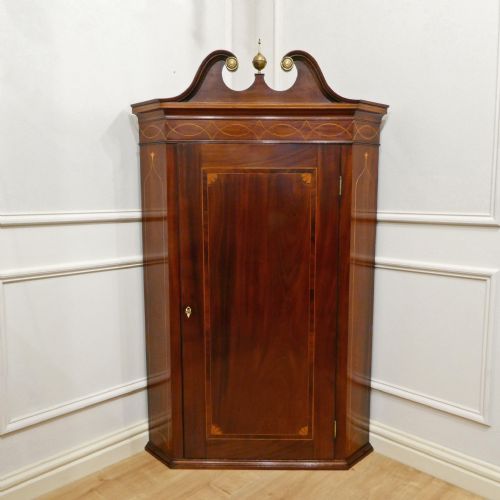


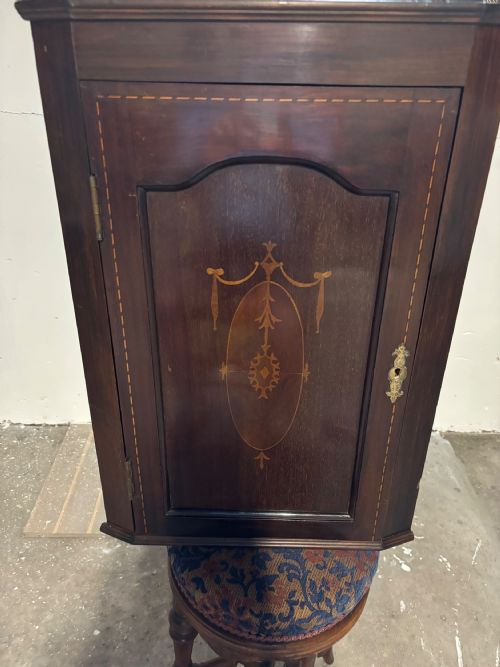


Satinwood Inlaid Corner Cabinet
These satinwood inlaid corner cabinets bring bright timber and clever geometry to neglected corners, offering period charm with practical storage.
Satinwood Inlaid Corner Cabinet
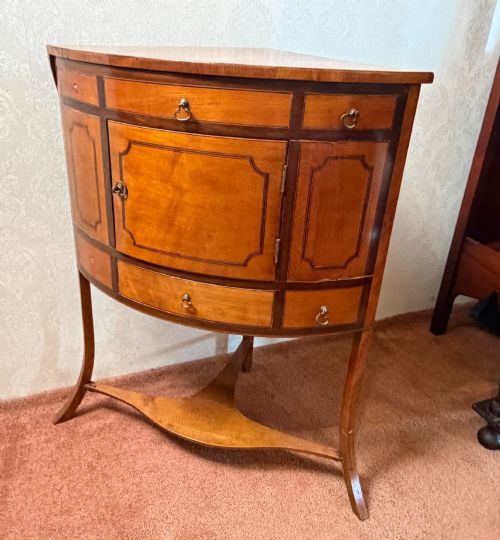
When searching for a satinwood inlaid corner cabinet, one encounters a range of forms spanning the Georgian period, the Victorian era, and the Edwardian decades. These pieces serve to utilise awkward room angles effectively, presenting curved, bow-front, or glazed display facades.
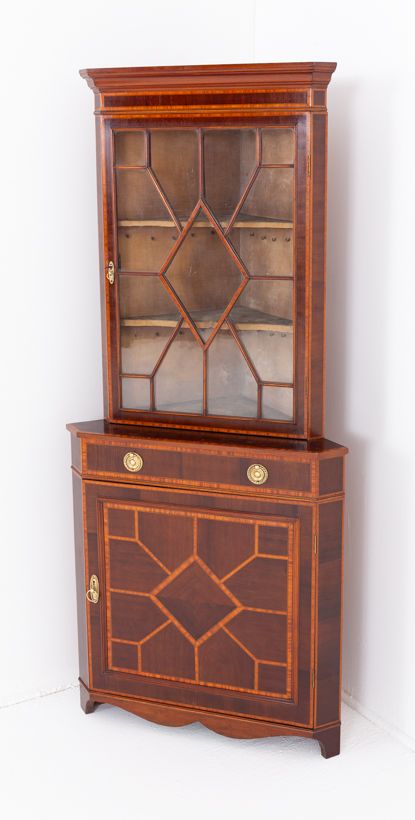
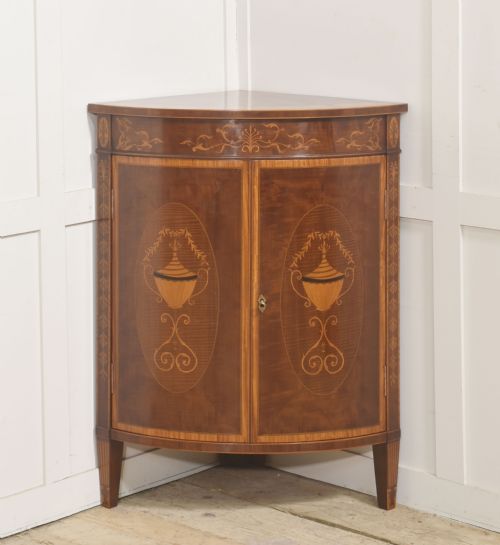
The versions most commonly met on this page belong to the Edwardian period and the Sheraton Revival style, frequently constructed from mahogany with contrasting satinwood inlay. Standing double-height display cabinets and wall-hanging cupboards both appear regularly among the selections.
Makers adapted these designs for various domestic rooms, producing everything from modest hanging cupboards to substantial standing corner units. The integration of satinwood banding and marquetry panels defines the visual character across all surviving examples.
How they were made
Cabinet makers relied primarily on mahogany as the structural timber, utilising its stability for the solid carcases and curved door frames. Satinwood and boxwood were then introduced through intricate veneers, stringing, and marquetry panels to create striking geometric and floral contrasts.
Glass panels were fitted into glazed doors for display variations, while brass hardware such as hinges and escutcheons secured the doors and drawers. Construction methods included dovetailed joints for internal shelving and precise cabinet-making techniques to achieve the tight angles required for room corners.
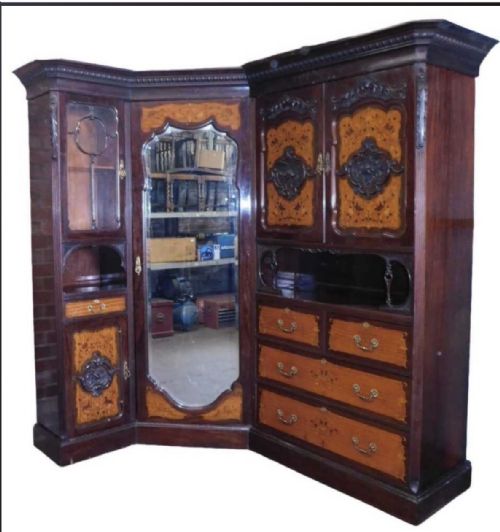
The selection includes wall-hanging cupboards, standing double-height display units, occasional tables, and compactum wardrobes.
What varies in quality
The standard of the inlay work separates simpler pieces from superior examples, particularly where marquetry combines multiple exotic timbers like boxwood and satinwood. Crispness in the botanical motifs and precision in the banded borders demonstrate the skill invested by the original maker.
The choice of primary timber and the selection of grain figure across the mahogany panels dictate much of the visual depth. Cabinets possessing original brass hardware, well-fitted glazed doors, and balanced proportions command greater appreciation among collectors.
Edwards and Roberts
The Satinwood Inlaid Corner Cabinet Glossary
- Satinwood
- A durable, hard timber possessing a lustrous, golden-yellow sheen that takes a fine polish. It was widely employed in cabinet making for veneers and contrasting inlay bands.
- Marquetry
- The art of applying decorative pieces of veneer to a structural structure to form pictorial or geometric designs. Craftsmen utilised various stained and natural woods to achieve contrasting tones.
- Sheraton Revival
- A late nineteenth and early twentieth century design movement that reinterpreted the lighter, neoclassical furniture forms of the eighteenth century. Pieces from this revival often incorporate delicate satinwood inlay on mahogany surfaces.
- Encoignure
- A French term for a corner cabinet or cupboard designed to fit snugly into a room angle. The phrase appears in trade descriptions for sophisticated decorative examples.
- Stringing
- Thin lines of contrasting timber inlaid into shallow channels on the furniture surface. This technique outlines panels and drawers to emphasise the structural geometry.
Satinwood Inlaid Corner Cabinet: Frequently Asked Questions
How were corner cabinets used?
These cabinets maximised floor space in smaller rooms while keeping precious porcelain, glass, or documents safely stored away. Hanging versions utilised wall space above tables, whereas standing double-height units provided substantial storage across two separate compartments.
In domestic settings, they brought elegance to empty angles in dining rooms, drawing rooms, and parlours. Their internal shelves allowed owners to display valued tableware or keep everyday items close at hand.
How do I date a corner cabinet?
Dating relies on examining the timber species, the style of inlay, and the construction methods used inside the carcase. Georgian and George III pieces generally display heavier proportions and simpler geometric banding, whereas Edwardian and Sheraton Revival examples often feature lighter mahogany frames with intricate marquetry and glazed display doors.
Secondary woods visible inside, such as oak or pine, also offer clues to the period of manufacture. Hardware styles, including brass escutcheons and hinges, help confirm whether a piece belongs to the eighteenth century or its later nineteenth and twentieth century revivals.
Where should I place one?
A corner cabinet naturally suits any unused room angle, transforming dead space into a decorative focal point. Hanging models work well positioned above an occasional table or sideboard, while standing floor units anchor a bare corner in a dining room or hallway.
Ensure the chosen wall angles match the square or curved footprint of the cabinet before installation. Lighting from an adjacent window or lamp highlights the satinwood inlay and enhances the grain of the mahogany.
What is the difference between hanging and standing models?
Hanging corner cabinets attach directly to the wall, leaving the floor entirely clear beneath them. They are typically single-door cupboards designed for lighter loads and smaller decorative items.
Standing models rest firmly on the floor, frequently incorporating a lower cupboard base beneath an upper display section. These larger two-piece units offer significantly more storage capacity and a heavier physical presence in a room.