







Sarkoy Kilim Rug
Sarkoy kilim rug weaves bring striking Balkan and Turkish folk artistry into a room through flat-woven textiles.
Sarkoy Kilim Rug
A sarkoy kilim rug represents a specific tradition of flat-woven floor coverings originating from the intersection of Balkan and Turkish folk art. These textiles combine traditional Balkan design motifs with Turkish weaving techniques, resulting in distinct geometric and pictorial patterns.
Most examples encountered on this page date from around 1920, alongside pieces from 1860 and 1930. They appear in formats ranging from standard rugs to large room-sized carpets and square shapes.
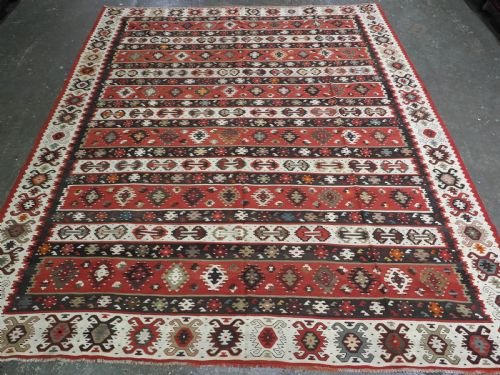
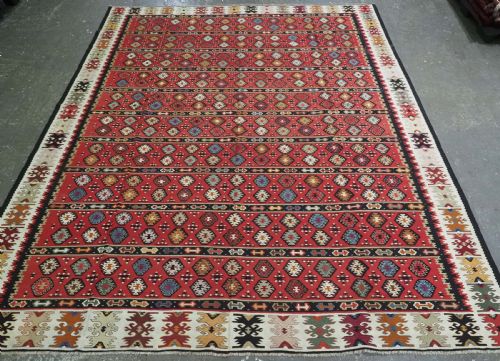
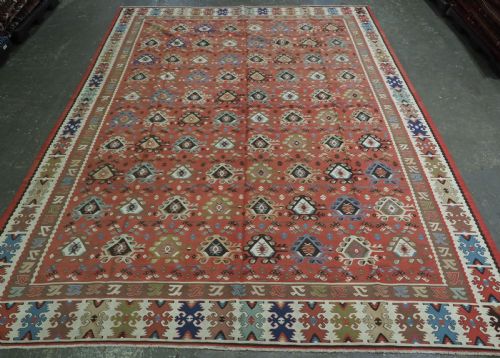
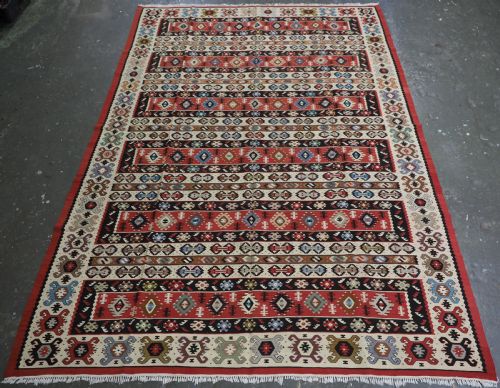
The decorative schemes span classic designs, flowering trees, lattice patterns, repeat medallions, and banded compositions. These rugs serve both as functional floor coverings and as notable examples of tribal and folk textile history.
How they were made
These textiles are constructed primarily using wool and cotton materials in a flat-weave technique without a pile. The weavers interlaced warp and weft threads to build up the patterned surface.
The visual depth of each sarkoy kilim rug relies on specific dye palettes, noted in various examples through soft reds, ivory borders, soft pinks, and powder blue grounds. The structural integrity depends on tight flat-weaving methods passed down through regional traditions.
Listings span three specific years: 1860, 1920, and 1930, with 1920 representing the most common date.
What varies in quality
The distinction between ordinary and exceptional pieces rests primarily on the complexity of the design and the preservation of the palette. Examples featuring scarce lattice patterns, flowering trees, or unusual repeat medallions command attention for their visual ambition.
Colour execution plays a central role in overall quality, with bolder clear tones or deliberately soft colour schemes distinguishing better examples. Large room-sized formats and pieces retaining well-balanced ivory borders also demonstrate superior scale and composition.
The Sarkoy Kilim Rug Glossary
- Kilim
- A flat-woven carpet or rug made without a pile, produced by tightly interweaving warp and weft strands.
- Banded design
- A decorative layout characterised by horizontal stripes or bands running across the width of the rug.
- Warp
- The stationary vertical threads stretched on a loom that form the foundational structure of the textile.
- Weft
- The horizontal threads passed through the warp to create the visible pattern and colour fields.
- Medallion
- A central ornamental motif, often geometric or floral, placed as the focal point of the composition.
Sarkoy Kilim Rug: Frequently Asked Questions
Where were sarkoy kilims made?
These textiles originate from the Balkan and Turkish regions, reflecting a shared heritage of folk art traditions. The weaving style bridges aesthetics found in both areas.
Makers utilised local motifs and traditional flat-weaving methods to produce distinct regional carpets.
How do I date a sarkoy kilim rug?
Dating relies on stylistic markers, materials, and documented production periods typically centred around the early twentieth century. Many surviving examples date from approximately 1920.
Earlier pieces from the mid-nineteenth century and later examples from 1930 exhibit subtle shifts in colour palettes and structural wear.
What designs are typical for these rugs?
Common decorative layouts include banded stripes, classic repeat motifs, and central medallions. More uncommon variations feature flowering trees and lattice patterns.
Borders often incorporate contrasting ivory frames against soft red or powder blue ground colours.
Are these rugs suitable for heavy floor use?
As flat-woven textiles without a pile, they function well as decorative floor coverings in moderate-traffic areas. Their sturdy wool and cotton construction handles everyday placement.
Using an appropriate underlay helps protect the flat weave and keeps the rug stable on smooth surfaces.