
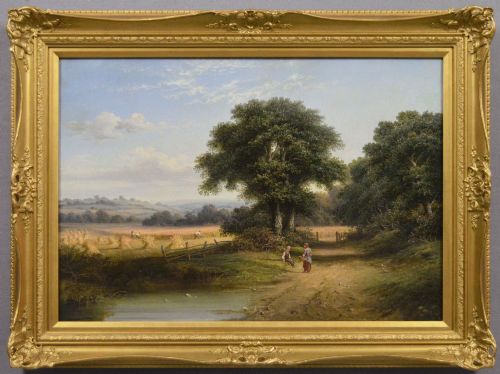


Rural Harvest Oil Painting
A rural harvest oil painting captures agricultural labour and golden fields across British landscapes from the nineteenth and twentieth centuries.
Rural Harvest Oil Painting
A rural harvest oil painting depicts agricultural life, farmworkers, and seasonal field labour across British landscapes. These works record traditional farming methods, haymaking, and cornfields during the nineteenth and twentieth centuries. The majority of pieces on this page emerge from Victorian, Edwardian, and mid-century periods, showcasing regional scenes from Sussex, Yorkshire, and Scotland.
Most examples focus on narrative genre scenes involving figures gathering wheat, handling horses, or resting near hayricks. Artists capture specific localities, from the Vale of Evesham to the river Kennet, grounding each pastoral view in accurate topography. Canvas dimensions vary, but standard formats suit domestic display in traditional or contemporary interiors.
Materials and technique
Painters relied upon oil paint applied to prepared canvas supports stretched over wooden frames. Pigments were worked with brushes to build texture, depth, and atmospheric light across fields and skies. Some compositions retain their original giltwood or gold leaf frames, which complement the warm palette of the harvest scenes.
Techniques range from Victorian realism and British impressionism to twentieth-century realism and naive school approaches. Artists balanced detailed draughtsmanship in the depiction of farmworkers with looser brushwork in the rendering of clouds, foliage, and distant hills.
Several canvases manage to sneak a lazy farm dog into the corn harvest.
Factors determining quality
Quality rests upon the artist's ability to render human anatomy, animal movement, and natural light with conviction. Works by established named painters demonstrate superior handling of perspective and atmospheric depth compared to anonymous or naive student pieces. The expressiveness of the brushwork and the structural integrity of the canvas and frame also influence overall merit.
Condition plays a central role in valuation, particularly the stability of the oil paint layer and the absence of heavy relining or disruptive overpaint. Paintings that retain their original tonal balance without darkening from discoloured varnish offer a more authentic visual experience.
Walter Heath Williams·Henry John Boddington·William Grant Murray·James William Booth·Henry H Parker·Herbert Royle·Arthur Walker Redgate·Joseph Paulman·Henry John Kinnaird·Frederick William Jackson·George Cole·William Greaves·Joseph Thors·Alfred Augustus Glendening Snr·William Kay Blacklock·John Clayton Adams
The Rural Harvest Oil Painting Glossary
- Canvas
- A heavy woven fabric, usually linen or cotton, stretched tightly over a wooden frame to serve as the support for oil paint. It provides a durable and responsive surface for layering pigments.
- Genre painting
- Artwork that depicts scenes from everyday life, typically involving ordinary people engaged in common activities. In this context, it refers to depictions of farmworkers and agricultural labourers.
- Giltwood
- Wood carved and covered with a thin layer of gold leaf or metallic gilt paste. Antique frames treated this way often accompany period oil paintings.
- Impressionism
- An art movement focused on capturing the visual impression of the moment, particularly shifting light and open-air conditions. British interpretations often apply these principles to rural landscapes and farming communities.
- Relining
- A conservation process where a deteriorated original canvas is adhered to a new backing canvas for structural support. This procedure stabilises fragile works against sagging or tearing.
Rural Harvest Oil Painting: Frequently Asked Questions
What periods do these paintings date from?
The works span from the mid-nineteenth century through the Edwardian era and into the mid-twentieth century. Styles evolve from Victorian realism toward British impressionism and twentieth-century realism.
Most items reflect rural subjects popular during periods of industrialisation when pastoral scenes offered a nostalgic view of agrarian traditions.
How should I hang an oil painting?
Select a wall away from direct sunlight and damp conditions to protect the canvas and paint layers. Ensure the hanging hardware is securely fixed into wall studs or masonry to support the weight of the framed artwork.
Keep paintings away from direct heat sources such as radiators to prevent the wood and canvas from warping.
Are these paintings signed by the artists?
Many examples feature artist signatures or monograms inscribed directly into the paint surface, often in the lower corners. Some works remain unattributed or fall under the classification of the naive school.
Examine the lower margins of the canvas to locate legible signatures or dates left by the painter.